

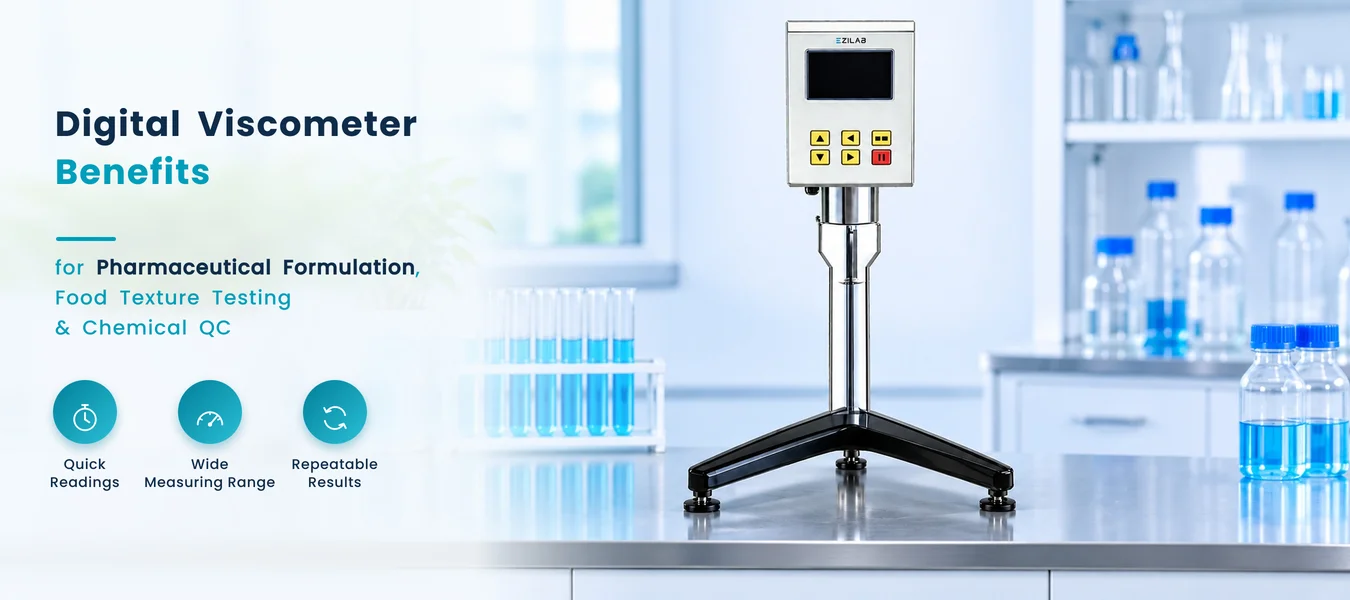
A professional overview of how a rotating element, a selectable speed and a microprocessor turn the resistance of a fluid into a viscosity reading.
Why Viscosity Is Worth Measuring Carefully
Viscosity describes how strongly a fluid resists flow, and it shapes how a product pours, spreads, fills and feels. Pharmaceutical teams watch it in gels, creams and lotions, food laboratories track it in slurries and pastes, and chemical plants check it in adhesives, paints and inks before a batch moves on. A small shift in viscosity is often the first sign that a formulation has drifted.
The Digital Viscometer EZL-DV412 from Ezilab is an electronic viscometer with a wide measuring range, selectable speeds and a large LCD. This article explains how that kind of instrument works, where it is applied and which selection mistakes are worth avoiding.
From Rotation to Reading: The Working Principle
The digital viscometer working principle is resistance to rotation. A rotating element is turned at a chosen speed while immersed in the sample. A thicker fluid resists the turning more strongly, so the instrument must work harder to hold the speed, and that effort is converted into a viscosity value.
A digital rotary viscometer adds electronics to this simple idea. A microprocessor controls the speed, reads the resistance and shows the result on a display, which removes the dial reading and interpolation that older instruments needed.
Speed matters because many products change their apparent thickness as they are stirred. Measuring at a stated speed, and reporting that speed with the result, keeps readings comparable from one test to the next.
Reading a Digital Viscometer Diagram, Part by Part
A simple digital viscometer diagram shows why the chain is short and easy to follow. The sample resists the rotating element, the electronics sense that resistance, and the display shows the value.
Diagram: measurement path, parts lettered A to F
- ASample — The fluid is placed in a suitable container at a stable temperature.
- BRotating element — The element turns in the sample and meets resistance from the fluid.
- CSpeed selection — Speeds from three tenths to sixty revolutions per minute suit thin and thick fluids.
- DMicroprocessor — Microprocessor control manages the speed and processes the signal.
- EKeypad — A direct-access keypad reaches settings without deep menus.
- FLCD — A large LCD with guided menus shows the setting and the reading.
Running a Test Step by Step
In daily use, digital viscometer testing follows a short routine that keeps results comparable.
Quick Readings, Wide Range and Repeatable Results
Quick Viscosity Readings
Guided menus, a direct-access keypad and a large LCD keep the path from setup to reading short.
Wide Measurement Range
Readings run from one to two million millipascal seconds, covering thin emulsions through thick pastes.
Selectable Speeds
Speeds from three tenths to sixty revolutions per minute let one instrument handle gels, pastes and liquids.
Consistent Accuracy
Accuracy of plus or minus two percent is listed for Newtonian liquids, which supports repeatable comparison.
Microprocessor Control
Electronic control of speed and signal processing replaces manual dial reading.
Compact Footprint
A small body, listed at under seven kilograms net, suits crowded quality control benches.
EZL-DV412 Technical Details
| Parameter | Value |
|---|---|
| Measuring range | One to two million millipascal seconds |
| Speed | Three tenths to sixty revolutions per minute |
| Accuracy | Plus or minus two percent on Newtonian liquids |
| Display | Large LCD with guided menus |
| Control | Microprocessor with direct-access keypad |
| Room temperature | Five to thirty-five degrees Celsius |
| Humidity | Eighty percent or less relative humidity |
| Outline size | Three hundred seventy by three hundred twenty-five by two hundred eighty millimeters |
| Net weight | Six point eight kilograms |
The full list is available on the Digital Viscometer EZL-DV412 product page.
Where It Fits: Formulations, Foods and Coatings
Pharmaceutical Gels, Creams and Lotions
Formulation checks on semi-solid products.
Cosmetics and Biochemicals
Viscosity control for personal care and biochemical preparations.
Starch and Food Products
Starch slurries and similar food materials.
Paints, Coatings and Printing Inks
Solvent-based coatings and inks.
Batch Consistency Checks
Confirming viscosity before filling.
Adhesives and Paper Pulp
Adhesive application viscosity and pulp tracking in paper mills.
These digital viscometer uses share one aim: confirm that a fluid is as thick or thin as the process expects. Common digital viscosity meter work also includes incoming material checks, and readers who want to see how other models differ can browse the digital viscometer category page.
Range and Accuracy Across the Category
| Class | Speed Range | Measuring Range | Accuracy |
|---|---|---|---|
| Entry range models | Six to sixty revolutions per minute | Up to one hundred thousand millipascal seconds | Two to five percent |
| This model | Three tenths to sixty revolutions per minute | Up to two million millipascal seconds | Two percent |
| Highest range model | One tenth to sixty revolutions per minute | Up to six million millipascal seconds | Three percent |
The right class depends on how thick the samples are and how closely readings must agree, so some laboratories keep more than one.
Common Selection Mistakes
Choosing by range alone. Speed range and accuracy matter as much as the top of the measuring range.
Ignoring the sample type. Accuracy is listed for Newtonian liquids, so pastes and gels may behave differently with speed.
Forgetting temperature. Viscosity changes with temperature, and the room is listed for five to thirty-five degrees Celsius.
Reading too close to the limits. Choose a speed that puts the reading comfortably inside the range.
Comparing readings at different speeds. Always report the speed with the value.
Overlooking bench space. Even a compact unit needs room for the sample container and handling.
Habits That Keep Readings Consistent
- Bring samples to the same temperature before testing.
- Use the same container size and immersion depth for comparable results.
- Let each reading settle before recording it.
- Clean the rotating element between samples.
- Record speed, element and temperature with each value.
Exploring the Wider Family of Digital Viscometers
This model belongs to a category of laboratory viscometers with a bright LCD, a simple interface and a space-efficient design. The range offers several speed options so a wide span of viscosities can be measured.
When reviewing an electronic viscosity meter or comparing suppliers, readers usually look at measuring range, speed options, accuracy, display and operating temperature. The full range is easy to browse on the Ezilab digital viscometer range, and wider laboratory categories sit on the Ezilab.
Continue to the Product Details
See the full specification list, features and applications for this model.
Explore Digital Viscometer EZL-DV412Amelia Brooks
Blog Content Writer at Ezilab Scientific
Amelia Brooks is a blog content writer at Ezilab Scientific, specializing in laboratory equipment, scientific instrumentation, and technical content development. She focuses on translating complex product specifications and scientific concepts into clear, informative, and engaging articles. Her writing highlights equipment features, practical applications, and industry developments to help readers understand laboratory technologies and make informed decisions based on their technical requirements.