

A practical look at how automatic titration systems support laboratories, hospitals, research centers, and advanced labs that need repeatable endpoint results.
By Amelia Brooks, Blog Content Writer at Ezilab Scientific
Moving Beyond the Manual Burette
Titration remains one of the most direct ways to determine the amount of an active component, an acid, a salt, or an oxidizing agent in a sample. In a manual setup, however, the result depends heavily on the person at the bench: how steadily the stopcock is turned, how closely a color change is judged, and how carefully the burette is read. An automatic titration machine removes much of that judgment by controlling the dosing and reading the electrical response of the sample directly.
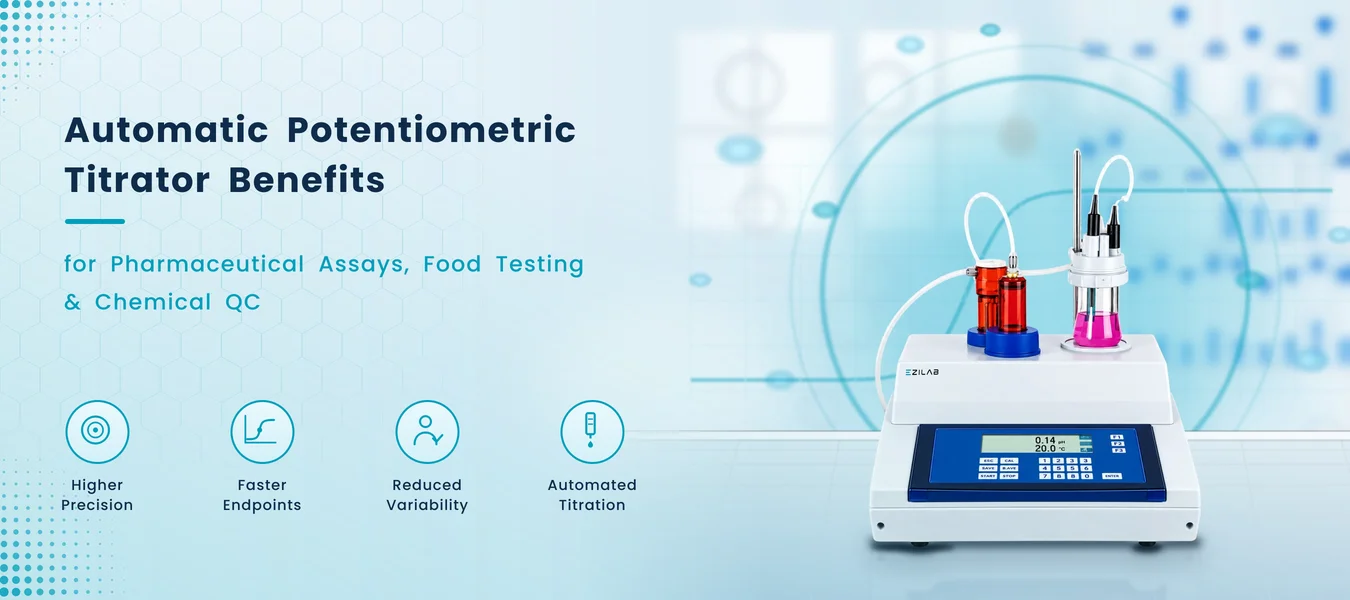
The Automatic Potentiometric Titrator EZL-APT51 from Ezilab follows that approach. Instead of waiting for a visual cue, it tracks the potential of the sample while titrant is added, which is why automatic potentiometric titration is chosen where color indicators are unclear, unavailable, or open to interpretation.
This article covers the working principle, the hardware details that matter, practical use cases, and the selection mistakes that can leave an instrument poorly matched to a laboratory's actual work.
Understanding the Working Principle
The automatic potentiometric titrator principle rests on a simple electrochemical relationship. An indicator electrode and a reference electrode are placed in the sample, and the instrument measures the potential difference between them. While the reaction is far from complete, each small addition of titrant shifts that potential only slightly. Near the equivalence point the potential changes sharply, and the point of steepest change marks the endpoint. The volume of titrant delivered up to that point is then used to calculate the amount of analyte.
In practical terms, the automatic potentiometric titrator working principle is a loop of dose, measure, evaluate, and repeat. A potentiometric titration instrument automates each of those stages, and a potentiometric autotitrator records the full titration curve so the endpoint can be reviewed rather than assumed. The diagram below shows the sequence an automatic potentiometric titration system follows during a single titration.
Sample and Electrodes
Electrodes sit in the prepared sample.
Titrant Dosing
The burette adds titrant in fine increments.
Potential Reading
The measuring unit follows the changing potential.
Endpoint Found
The sharpest potential change marks the endpoint.
Curve and Data
The titration curve is output for reporting.
The EZL-APT51 reads in pH from zero to fourteen and in millivolts across a wide window, so the same measuring unit can follow acid-base reactions by pH and redox or precipitation reactions by potential.
Hardware Details That Shape Daily Performance
The principle explains why potentiometric titration works, while the hardware decides how consistently it can be carried out. These are the elements of the EZL-APT51 that matter most in routine work.
Measuring Range
The measuring unit covers zero to fourteen pH and minus eighteen hundred to eighteen hundred millivolts, with a pH reading step of one hundredth, leaving room for both acid-base and redox work.
Burette Precision and Charging
A ten milliliter burette that divides each dose into one part in ten thousand dispenses titrant in fine increments, and a full burette charges in roughly fifty-five seconds, which keeps the wait between samples short.
Temperature Compensation
Compensation from minus five to one hundred five degrees Celsius keeps endpoint detection stable when sample temperatures differ from one run to the next.
Display and Titration Modes
An LCD display and multiple titration modes let operators select the method that suits the sample in front of them.
Guided Setup
A built-in guide system walks operators through setup, so method preparation does not rest on individual habits.
Connectivity
Computer control through a USB or serial port, along with easy data transfer, allows titration curves to be exported for reporting.
Practical Use Cases Across Industries
Because one measuring unit handles acid-base, redox, and precipitation titrations, a single instrument can serve several departments. In settings where instruments are shared between teams, such as hospital laboratories and research centers, that flexibility reduces the need for separate setups. The automatic potentiometric titrator uses listed for the EZL-APT51 include the following.
Pharmaceutical Laboratories
Assay work and content uniformity testing.
Food and Beverage QC
Acidity and salt content checks.
Environmental Monitoring
Water hardness testing in monitoring programs.
Chemical Laboratories
Redox titrations that make use of the wide millivolt range.
Petrochemical Testing
Named among the industries where automatic potentiometric titrators are widely applied.
Cosmetics Manufacturing
Raw material QC that replaces manual burette work.
Laboratories matching these uses against their own sample lists can look through the potentiometric titration options Ezilab lists alongside the specification details covered here.
Manual Versus Automatic Titration at the Bench
Operator variability rarely comes from one large error. It builds from small differences: where one person sees the color change and another does not, how fast titrant is added near the endpoint, and how each user prepares the method. Automatic titration systems narrow those gaps by moving each decision into the instrument.
| Aspect | Manual Burette Work | Automatic Potentiometric Titration |
|---|---|---|
| Endpoint recognition | Judged by eye from a color change | Read from electrode potential and the titration curve |
| Titrant delivery | Controlled by hand at the stopcock | Dosed in fine, instrument-controlled increments |
| Result record | Written down by the operator | Curve and data transferred to a computer |
| Method preparation | Differs from person to person | Guide system leads the operator through setup |
Choosing Electrodes for the Titration Type
The measuring unit is only as useful as the electrodes connected to it. The EZL-APT51 includes an ATC probe, a platinum electrode, a silver electrode, a pH electrode as the indicator, single bridge and double bridge reference electrodes, and pH buffer powder.
Each has a role. The pH electrode follows acid-base reactions, the platinum electrode suits redox work, and the silver electrode is the usual indicator choice for precipitation titrations. A double bridge reference electrode places a second barrier between the sample and the reference element, which helps with samples that may interact with the reference electrolyte. The ATC probe feeds temperature compensation, and the buffer powder supports pH calibration. A twenty milliliter burette and an anti-diffusion capillary are available as optional accessories.
Common Selection Mistakes
Most mismatches between an instrument and a laboratory trace back to a short list of oversights.
Choosing on burette volume alone
Capacity matters, but burette fineness and charging time also influence daily throughput.
Overlooking the potential window
A laboratory planning redox work should confirm the millivolt range, not only the pH range.
Treating electrodes as an afterthought
The included set should match the titration types in the sample list, including whether a double bridge reference is needed.
Ignoring data handling
If reports require titration curves, confirm computer control and transfer options before settling on a model.
Forgetting sample temperature
Check that the compensation range covers the temperatures samples actually arrive at.
Exploring the Wider Titrator Category
The Automatic Potentiometric Titrator EZL-APT51 belongs to a category of instruments that automate dosing and detect endpoints by electrode potential rather than by eye. Laboratories comparing options in this group typically weigh measuring range, reading step, accuracy, and signal fluctuation, along with burette size, titration modes, temperature compensation, connectivity, and the electrodes supplied.
The automatic potentiometric titrator category page lays these specifications out side by side. For the rest of the laboratory instruments in the lineup, the Ezilab is a practical starting point.
About the Author
See the full specification details on the product page.
Explore Automatic Potentiometric Titrator EZL-APT51