
A professional overview of how automated sample handling, controlled reactions and photometric reading shape daily biochemistry work.
Why Automation Reshapes the Biochemistry Workday
Routine biochemistry produces a steady stream of similar requests: glucose, lipids, liver markers and kidney markers, often arriving together and often needed quickly. Handling each one by hand ties up staff and introduces small differences between operators. A clinical chemistry analyzer takes over the repetitive steps, so the laboratory can focus on review and decisions.
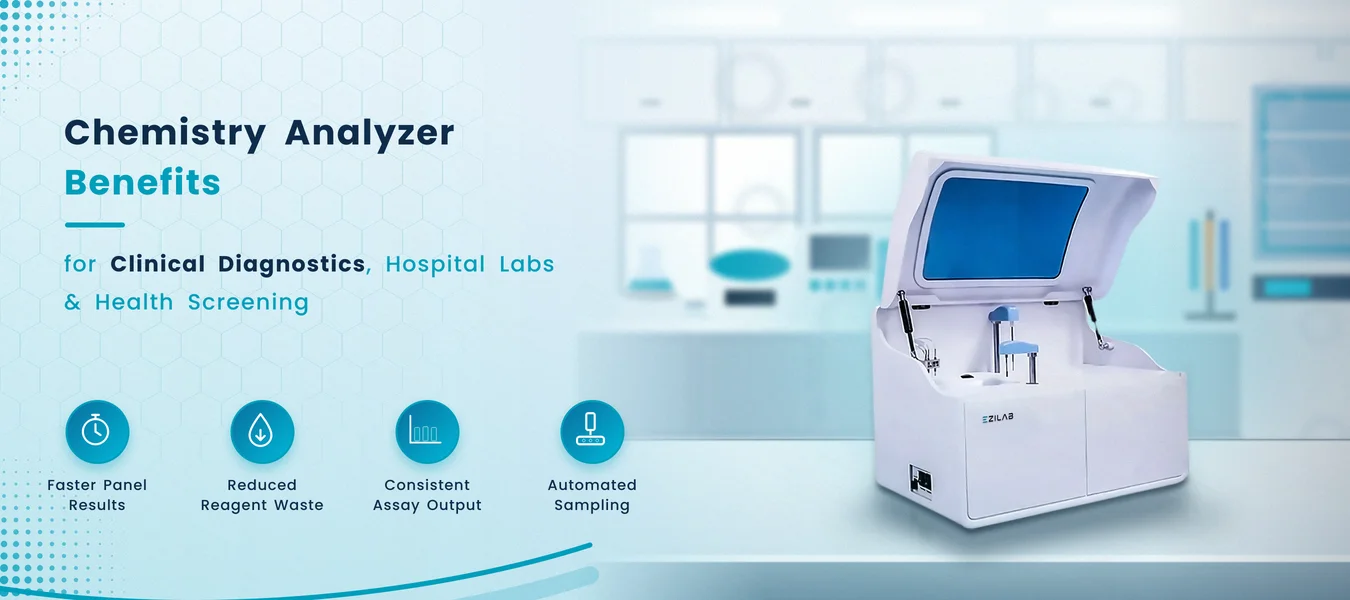
The Auto Chemistry Analyzer EZL-CA101 from Ezilab is a benchtop example of this approach. It combines a sample tray, a refrigerated reagent tray, reusable cuvettes and a touch screen in a compact body, which makes it a useful reference for readers learning how a biochemical analyzer fits into an auto chemistry analyzer laboratory.
The Automated Chemistry Analyzer Principle
An automated biochemistry analyzer measures how much light a reaction mixture absorbs. A probe places a small amount of sample and reagent into a cuvette, the mixture reacts at a controlled temperature, and a lamp shines light through it. The detector reads the absorbance, which relates to the amount of the substance being measured.
Software then converts absorbance into a concentration using the calibration method chosen for that test. Because each step is repeated in the same way for each sample, differences between results reflect the samples rather than the handling.
Reading an Automated Chemistry Analyzer Diagram, Part by Part
An automated chemistry analyzer diagram shows why the layout works. Samples and reagents come from separate trays, meet at the probe, react in the cuvettes and are read before the software reports the result.
Diagram: sample path, parts lettered A to F
- ASample tray — Holds up to thirty-seven samples for the probe to reach.
- BReagent tray — Keeps up to twenty-eight reagents cooled, with its own switch.
- CProbe and mixing — The probe dispenses sample and reagent, and an independent stirring probe mixes them.
- DReaction cuvettes — Forty-eight reusable cuvettes are washed automatically and held at a controlled temperature.
- ELamp and photometer — A halogen lamp and spectrophotometer read the absorbance of each reaction.
- FSoftware and connection — The touch screen runs the tests, and a bidirectional LIS link exchanges data.
From Loaded Tray to Reported Result
On the bench, an automated chemistry analyzer machine follows a short sequence that stays the same from the first sample to the last.
Panel Speed, Reagent Economy and Assay Consistency
Faster Biochemical Panel Results
A listed throughput of two hundred tests per hour and a stat function help panels move quickly, including urgent samples.
Reduced Reagent Waste
Sample volumes from two to seventy microliters and reagent volumes from twenty to three hundred fifty microliters keep each test small.
Controlled Reaction Temperature
The reaction is held at thirty-seven degrees Celsius with real-time monitoring, so conditions match from run to run.
Consistent Assay Output
Real-time quality control, multi-rule checks and a cumulative sum check help flag drift before results are released.
Refrigerated Reagent Tray
A cooled tray with an independent switch protects reagents between uses.
Connected Reporting
A bidirectional LIS link and a LAN port reduce manual transcription.
EZL-CA101 Technical Details
| Parameter | Value |
|---|---|
| Throughput | Two hundred tests per hour |
| Sample positions | Thirty-seven |
| Reagent positions | Twenty-eight, refrigerated |
| Sample volume | Two to seventy microliters |
| Reagent volume | Twenty to three hundred fifty microliters |
| Cuvettes | Forty-eight reusable, six millimeter optical length |
| Light source | Halogen lamp |
| Absorbance range | Zero to three |
| Reaction temperature | Thirty-seven degrees Celsius, monitored in real time |
| Washing | Automatic for cuvettes and probes |
| Connectivity | Bidirectional LIS link, LAN port |
| Display | Touch screen |
The full list is available on the Auto Chemistry Analyzer EZL-CA101 product page.
Where It Fits: Clinical, Hospital and Diagnostic Settings
Clinical Laboratories
Routine chemistry panels.
Hospital Biochemistry Units
Liver function, kidney function and lipid profile testing.
Diagnostic Centers
Walk-in and inpatient testing during peak hours.
Hospital Networks
Consolidating testing from satellite sites.
Pharmaceutical Quality Facilities
Stability and raw-material screening.
Academic Research Programs
Teaching automated biochemical methods.
These settings share a need for steady turnaround across mixed test requests. Readers who want to see how sibling models differ can browse the chemistry analyzers category page.
Manual Handling Versus Automated Analysis
| Factor | Manual Workflow | Automated Workflow |
|---|---|---|
| Sample and reagent handling | Pipetted by the operator | Dispensed by a probe |
| Mixing | Varies with technique | Performed by a stirring probe |
| Reaction temperature | Depends on the bath or block used | Held and monitored by the instrument |
| Quality checks | Applied after the run | Tracked in real time |
| Result transfer | Often typed or copied | Sent through the connected system |
Automation does not remove the need for trained review, but it narrows the sources of variation that reach the result.
Common Selection Mistakes
Choosing by throughput alone. Sample positions, reagent positions and test menu also decide how smoothly a daily workload runs.
Ignoring reagent volumes. Smaller reaction volumes reduce waste, but only when the method supports them.
Overlooking calibration options. Check that the calibration methods fit the assays your laboratory runs.
Underestimating connectivity. Confirm the laboratory information system link and data format before installation.
Forgetting the operating environment. Room temperature and humidity should stay within the listed range.
Skipping routine maintenance planning. Probe, cuvette and lamp care affect long-term consistency.
Routine Habits That Keep Output Consistent
- Check reagent levels and the cooling tray before each run.
- Run quality control material at the start of each shift.
- Keep sample tubes clear of bubbles and clots before loading.
- Review calibration status when a new reagent lot is opened.
- Record maintenance and quality checks so trends are easy to spot.
Exploring the Wider Family of Chemistry Analyzers
This model belongs to a category of automated analyzers for biochemical measurement. The range steps from compact benchtop units to higher throughput systems with larger sample capacity, and a benchtop chemistry analyzer is usually the starting point for laboratories with moderate daily volumes.
When reviewing automated chemistry analyzer manufacturers and their ranges, readers usually compare throughput, sample and reagent positions, reagent cooling, quality control tools and connectivity. Laboratories familiar with roche clinical chemistry or beckman coulter clinical chemistry platforms often apply the same criteria when assessing any benchtop option. The full range is easy to browse on the Ezilab chemistry analyzer range, and wider laboratory categories sit on the Ezilab.
Continue to the Product Details
See the full specification list, features and applications for this model.
Explore Auto Chemistry Analyzer EZL-CA101Amelia Brooks
Blog Content Writer at Ezilab Scientific
Amelia Brooks is a blog content writer at Ezilab Scientific, specializing in laboratory equipment, scientific instrumentation, and technical content development. She focuses on translating complex product specifications and scientific concepts into clear, informative, and engaging articles. Her writing highlights equipment features, practical applications, and industry developments to help readers understand laboratory technologies and make informed decisions based on their technical requirements.