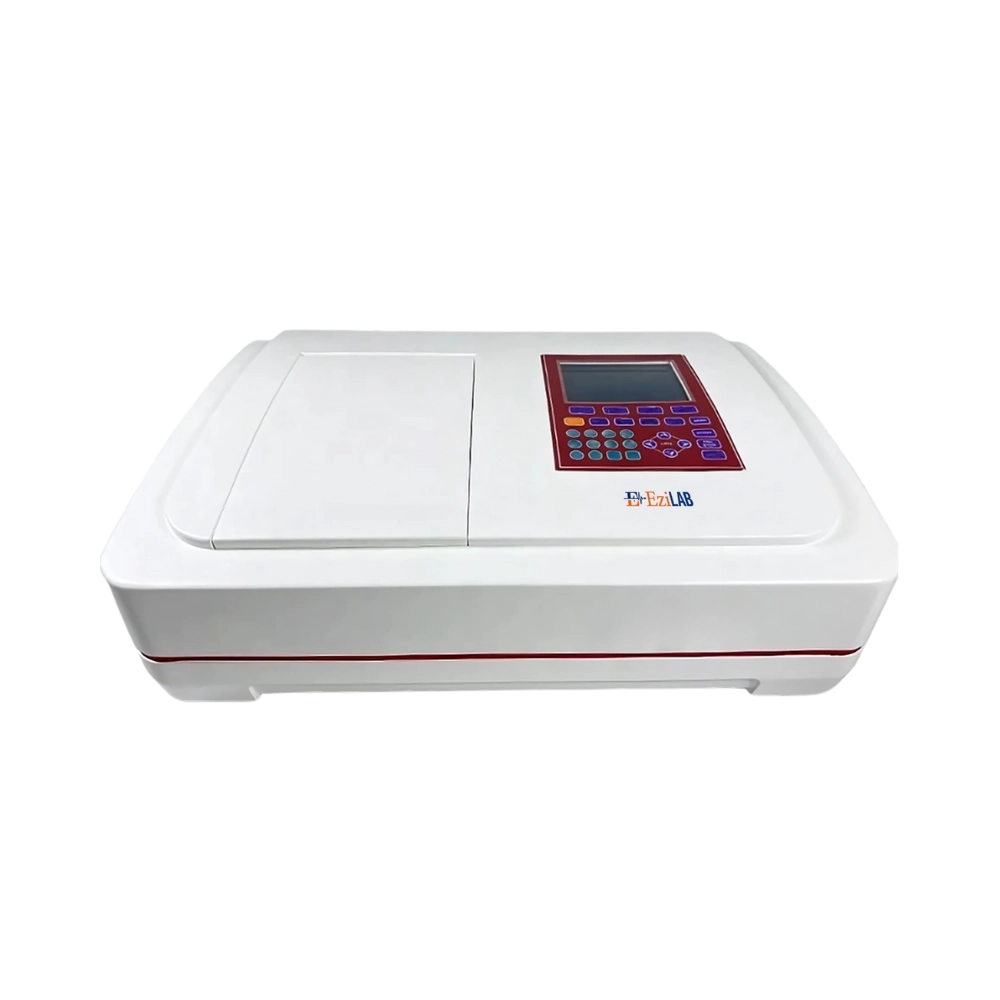
Ezilab's Single Beam UV-Vis Spectrophotometer EZL-SBS106 serves pharmaceutical laboratories that need a fixed 1.8nm bandwidth on a single beam design, positioned between the 2nm standard model and the finer 1nm unit in this catalog. Covering 190-1100nm at 1.8nm resolution, this lab UV instrument sits at a middle bandwidth point among the single beam options in this line, offering slightly tighter resolution than the entry-level 2nm model without reaching the finest 1nm spec reserved for close peak-separation work. That 1.8nm bandwidth suits pharmaceutical QC testing needing marginally better resolution than the standard 2nm configuration provides, without requiring the finest available bandwidth in this catalog — a middle option for labs whose testing protocols specify slightly tighter tolerances than the base single beam model meets. As with the other single beam units in this line, this configuration skips double beam drift correction, keeping the design simpler and lower-cost for shorter-duration scans where extended-session lamp drift isn't a significant factor. Pharmaceutical labs with bandwidth requirements that fall between the 2nm and 1nm options get a matched middle-ground instrument here. EziLab's Lab UV and Single Beam UV-Vis Spectrophotometer cover mid-resolution single beam absorbance needs across USA laboratory settings.
| Wavelength Range | 190 to 1100 nm |
|---|---|
| Spectral Bandwidth | 1.8 nm |
| Wavelength Accuracy | ± 0.5 nm |
| Wavelength Repeatability | Less than or equal to 0.2 nm |
| Photometric Accuracy | ± 0.3 % T (0 to 100 % T); ± 0.002 Abs (0 to 0.5 Abs); ± 0.004 Abs (0.5 to 1.0 Abs) |
| Photometric Repeatability | Less than or equal to 0.1 % T; Less than or equal to 0.001 Abs (0 to 0.5 Abs); Less than or equal to 0.002 Abs (0.5 to 1.0 Abs) |
| Photometric Range | - 0.3 to 3 (Absorbance), 0 to 200 % (Transmittance), 0 to 9999 (Concentration) |
| Stability | Less than or equal to 0.001 A / h at 250 nm & 500 nm |
| Stray Light | Less than or equal to 0.05 % T at 220 nm & 360 nm |
| Light Source | Tungsten & Deuterium Lamp |
| Optical System | Single Beam |
| Control Mode | Stand-alone or PC Software (Optional) |
| Display | 7-inch Touch Screen |
| Output | USB Port or Bluetooth (Optional) |
| Power Requirements | AC 110 / 220 V, 50 / 60 Hz |
Automatic cell holder
Wavelength scanning function
USB data transfer
High-quality grating
Bench-top design
Spectrophotometer | 1 unit |
1 cm Glass Cuvette | 4 pieces |
1 cm Quartz Cuvette | 2 pieces |
Power Cord | 1 piece |
User’s Manual | 1 piece |
Dust Cover | 1 piece |
1 | Cell Holders |
2 | Control Units |
3 | Lamps |
4 | Glass Cuvette with Lid |
5 | Quartz Cuvette with Lid |
6 | Micro Cuvette |
7 | PC Software |
Single Beam UV-Vis Spectrophotometer EZL-SBS106 features a stand-alone system that allows easy operation of multiple testing modes for absorbance measurements, making it ideal for pharmaceutical analysis and environmental monitoring.
The Single Beam UV-Vis Spectrophotometer EZL-SBS106 is designed to measure the absorbance and transmittance of liquid samples across the ultraviolet and visible light spectrum, 190 to 1100 nm. It is used in laboratories for qualitative and quantitative analysis of compounds, such as detecting concentration levels in chemical, pharmaceutical, environmental, and educational applications. The single-beam design ensures simple, cost-effective operation while delivering accurate and repeatable results, making it ideal for routine laboratory testing and research work.
Ezilab’s Single Beam UV-Vis Spectrophotometer EZL-SBS106 is a single-beam spectrophotometer, meaning it measures light intensity through a sample in one path at a time, using blank measurements for comparison. In contrast, double-beam models split the light into two paths, one through the sample and one through a reference, allowing real-time comparisons. While double-beam systems are more stable over long-term experiments, it offers excellent accuracy with a simpler, more affordable design perfect for everyday laboratory use.
Our Single Beam UV-Vis Spectrophotometer EZL-SBS106 uses a combination of a Tungsten (W) lamp and a Deuterium (D?) lamp to cover the full wavelength range of 190 to 1100 nm. The deuterium lamp emits in the ultraviolet region 190 to 400 nm, while the tungsten lamp covers the visible region 320 to 1100 nm. This dual-lamp system ensures broad spectral coverage, allowing users to analyze a wide range of samples that absorb light in both UV and visible regions with high accuracy and reliability.
Ezilab’s Single Beam UV-Vis Spectrophotometer EZL-SBS106 features a 7-inch touch screen display, offering an intuitive interface for smooth operation without needing extensive training. Users can view results, set parameters, and operate the system easily via the screen. For data output, the spectrophotometer provides USB connectivity and optional Bluetooth, allowing for flexible data transfer to computers or printers. It supports both standalone and PC-controlled modes, offering convenience and versatility for modern lab environments and documentation requirements.
Our Single Beam UV-Vis Spectrophotometer EZL-SBS106 is widely used in laboratories for various applications, including nucleic acid and protein quantification, concentration analysis, quality control, water testing, and chemical formulation studies. Its high accuracy, compact size, and broad wavelength range make it suitable for educational institutions, pharmaceutical labs, environmental monitoring, and food testing industries. With its user-friendly design and reliable performance, it is an ideal choice for both basic research and routine testing applications.
The Single Beam UV-Vis Spectrophotometer EZL-SBS106 is built for precision, featuring a wavelength accuracy of ±0.5 nm and a photometric accuracy of ±0.3% T. It maintains excellent repeatability with wavelength reproducibility of ±0.2 nm and photometric repeatability of ?0.2% T. The instrument’s low stray light (?0.05% T) and stable baseline ensure accurate results even for low-concentration or sensitive samples. These performance attributes, combined with automatic wavelength setting and a reliable monochromator system, make it ideal for laboratories requiring consistent, high-quality analytical data.