

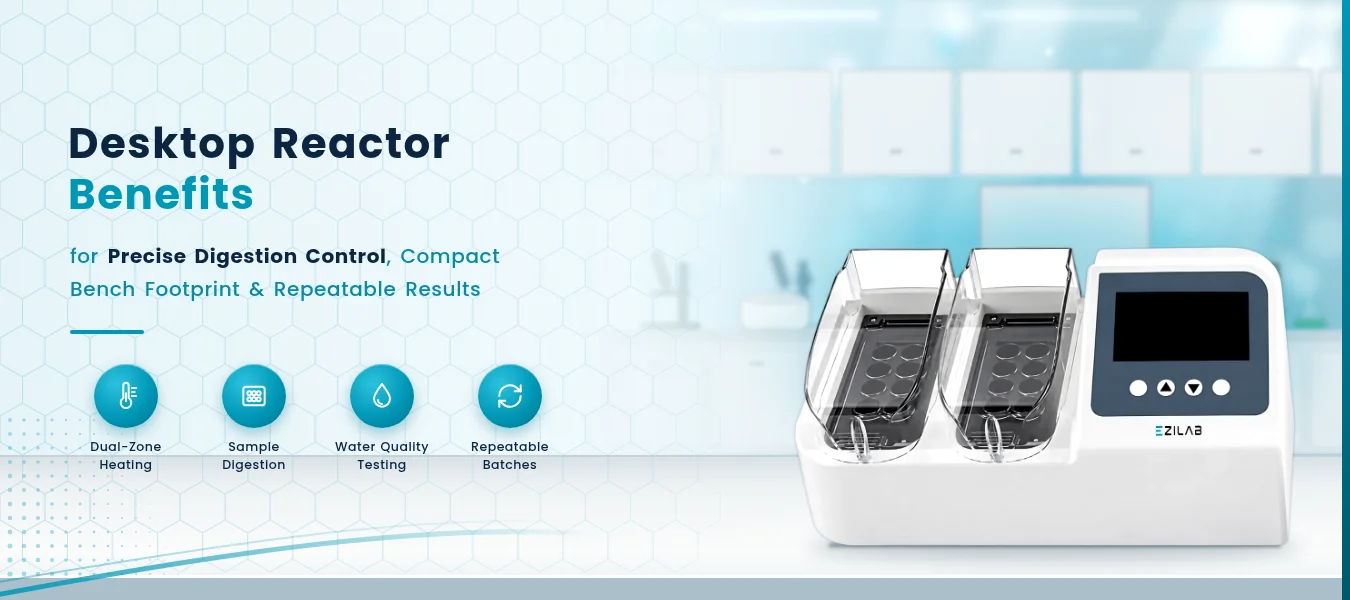
How a dual-zone digestion block prepares water samples for COD and nutrient testing, and how to get consistent results from each batch.
Why Sample Digestion Decides the Result
Chemical oxygen demand, total phosphorus and total nitrogen are read on a photometer, but the number on the screen is shaped well before that. Each sample must first be digested: heated with strong reagents in a sealed vial at a fixed temperature for a fixed time. If one vial runs a few degrees cooler or comes out early, oxidation is incomplete and the result reads low.
The Ezilab Desktop Reactor EZL-DR10 is a 16-position digestion block built for this step. It splits the block into two independently controlled zones, holds temperature to ±0.1 °C, reaches 165 °C from room temperature in about 20 minutes and runs stored programs from a touchscreen, all in a 4 kg unit that fits beside a photometer.
How a COD Digestion Block Works
A COD digestion block is a dry heater: a machined aluminum block with wells sized for sealed digestion vials. Electric heaters warm the block, and heat passes directly through the metal into each vial. With no water or oil bath, warm-up is faster, there is nothing to top up, and all wells see the same temperature.
During COD digestion, a strong oxidant in acid breaks down organic matter at high temperature. The amount of oxidant consumed is later measured by color change, which is why stable temperature and timing translate directly into accurate readings. Nutrient methods work the same way, converting bound phosphorus or nitrogen into forms that reagents can detect.
Desktop Reactor Layout: Two Zones, Sixteen Wells
Seen from above, the block is divided into two heating zones of eight wells each, with the controller beside them.
Diagram: top view, parts numbered 1–6
- 1Zone A — eight wells with their own setpoint, for example a COD program.
- 2Zone B — eight more wells that can run a different temperature, such as a nutrient method.
- 3Touchscreen controller — sets temperature, stores programs and runs timers.
- 4Over-temperature alarm — cuts power if either zone drifts upward.
- 5Clear lids — shield the operator while vials heat.
- 6Insulated housing — keeps heat in the block and the exterior safe to touch.
Control, Footprint and Repeatability
Precise Digestion Control
±0.1 °C accuracy and a built-in heating curve keep oxidation consistent from vial to vial.
Two Methods at Once
Independent zones let COD and nutrient digestions run side by side instead of in sequence.
Compact Bench Footprint
At 359 × 195 × 167 mm, it fits next to a photometer or inside a fume hood.
Repeatable Small Batches
Sixteen positions and stored programs suit routine daily runs with matching profiles.
Fast Warm-Up
From 25 °C to 165 °C in about 20 minutes, so the first batch starts soon after power-on.
Low Power Draw
300 W with energy-saving operation keeps long digestion shifts efficient.
EZL-DR10 Technical Specifications
| Parameter | Value |
|---|---|
| Capacity | 16 positions |
| Heating zones | 2, independently controlled |
| Digestion temperature | 40 °C to 180 °C |
| Temperature accuracy | ±0.1 °C |
| Heating time | 25 °C to 165 °C in 20 min |
| Operating environment | 5 – 45 °C, ≤85% RH |
| Power consumption | 300 W |
| Dimensions | 359 × 195 × 167 mm |
| Weight | 4 kg |
| Key features | Dual temperature control, built-in heating curve, over-temperature alarm, touchscreen |
Desktop Reactor Use in Water and Environmental Labs
Water Utilities
Routine COD checks on raw and treated water to track organic load.
Wastewater Plants
Influent and effluent monitoring to adjust aeration and treatment steps.
Environmental Agencies
Surface water and discharge sampling programs.
Chemical and Food Plants
Tracking organic load in process water before discharge.
University Departments
Teaching and research in water chemistry and environmental science.
Metals Prep
Releasing bound metals before ICP or photometric measurement.
Typical desktop reactor use covers COD, total phosphorus, total nitrogen and ammonia. You can see how this unit fits alongside related equipment on the Ezilab desktop reactor page.
Running a Desktop Reactor Test Step by Step
After digestion, vials are usually read on a UV-Vis instrument such as the Ezilab Double Beam UV-Vis Spectrophotometer EZL-DBS102.
Dry Block vs Hot Plate vs Water Bath Digestion
| Factor | Dry digestion block | Hot plate | Water bath |
|---|---|---|---|
| Maximum temperature | High enough for COD (about 150 °C) | High, but uneven | Below 100 °C |
| Temperature uniformity | Even across wells | Varies across the plate | Even, limited range |
| Sealed vial support | Wells sized for vials | No | Partial |
| Spill and splash risk | Low, lids fitted | Higher | Water contact |
| Typical role | COD and nutrient digestion | Open-vessel heating | Gentle incubations |
Common Selection Mistakes
Mismatched vial size. Check that well diameter fits the reagent vials your methods use.
Choosing a single zone. One zone forces COD and nutrient runs into separate cycles.
Ignoring warm-up time. Slow blocks delay the first batch of the day.
Skipping safety features. Over-temperature alarms and lids matter with hot, acidic vials.
Expecting synthesis features. A digestion block heats sealed vials; it does not stir or hold pressure like a reaction vessel.
Overlooking placement. Position the block near the photometer and a fume hood to cut handling.
User Tips for Consistent Digestion
- Load vials only after the zone reaches setpoint.
- Use one vial type per batch so heat transfer stays even.
- Cap vials firmly to stop volatile loss during heating.
- Wear gloves, eye protection and work under a fume hood; digestion reagents are strongly acidic.
- Check block temperature with a reference thermometer at regular intervals.
- Wipe spills from the wells right away to protect the aluminum block.
- For field campaigns, the desktop reactor portable size makes it easy to move between benches or into a mobile lab.
- Log program, zone, batch ID and results for traceable records.
Exploring the Desktop Reactor Category
This category covers compact dry-block digesters used to prepare water and wastewater samples before photometric analysis. When comparing a COD digestion block, buyers usually look at the number of positions, how many independent heating zones it has, top digestion temperature, temperature accuracy, warm-up time, stored programs and safety alarms.
You can review the current model and its details in the Ezilab desktop reactor collection, or browse photometers and other water-testing equipment from the Ezilab.
| Model | Positions | Zones | Digestion temperature |
|---|---|---|---|
| EZL-DR10 | 16 | 2 | 40 – 180 °C |
Prepare Each Batch the Same Way
Review the full specifications, zone control and safety features of the EZL-DR10 before setting up your digestion workflow.
Explore EZL-DR10Amelia Brooks
Blog Content Writer at Ezilab Scientific
Amelia Brooks is a blog content writer at Ezilab Scientific, specializing in laboratory equipment, scientific instrumentation, and technical content development. She focuses on translating complex product specifications and scientific concepts into clear, informative, and engaging articles. Her writing highlights equipment features, practical applications, and industry developments to help readers understand laboratory technologies and make informed decisions based on their technical requirements.