

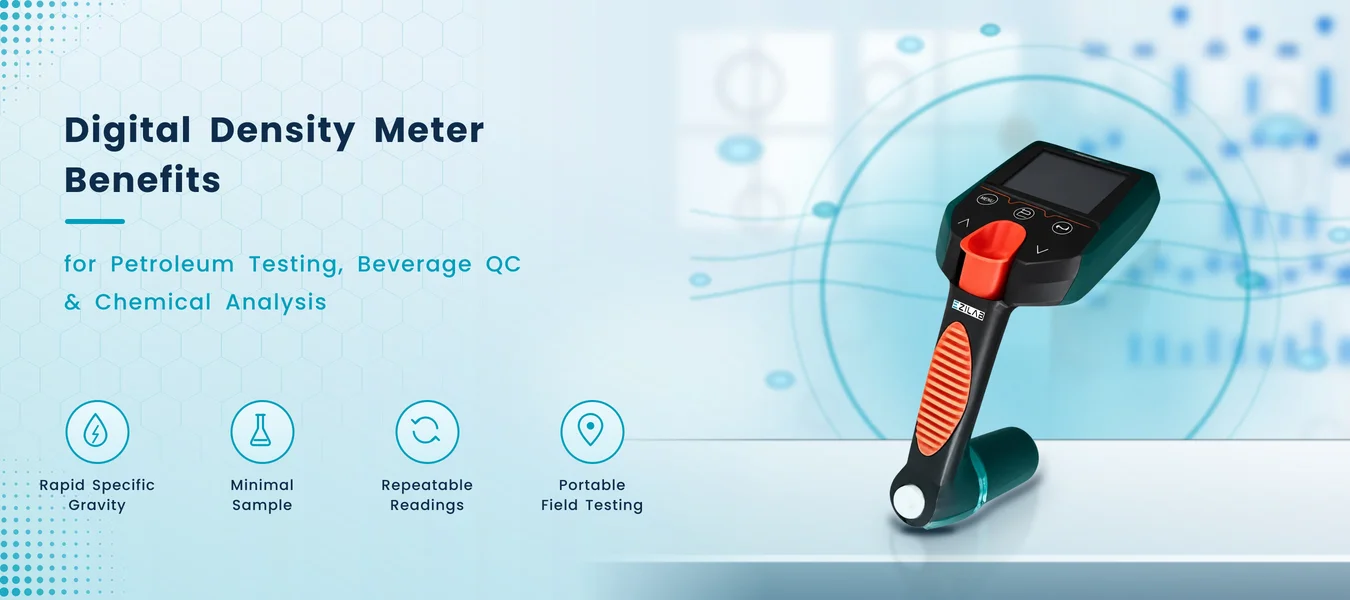
Density is among the quickest physical checks a laboratory can run on a liquid. A digital density meter turns that check into a short, repeatable routine for laboratories, hospital pharmacies, research centers and advanced labs.
Why Density Readings Deserve Attention
A liquid's density reflects what is inside it. A fuel batch with the wrong blend, a beverage base that drifts from its recipe, or a chemical lot diluted by mistake will each show up as a shift in density long before a longer test is finished. Specific gravity, which compares a liquid with a reference, tells the same story in a form many teams already record on their sheets.
Density meters give staff a fast first look. Instead of waiting on slower methods, a technician can screen a sample, log the number and decide whether the batch needs a closer review. For labs that handle many samples, that early signal saves time and keeps attention on the samples that matter.
Portable Density Meter Work in Practice
Understanding how a portable density meter work during a normal test makes it easier to judge what the instrument can and cannot tell you. The operator draws a small liquid sample, the instrument reads its density, and the sample temperature is measured at the same moment. Temperature matters because liquids expand and contract as they warm or cool, so a density figure means little without the temperature beside it. The finished reading appears on the screen and can be stored for later review.
The same flow applies whether the instrument sits on a bench or is carried to a tank. What changes is the environment around it, and that is where handheld design earns its place.
Where Density Measurement Fits Across Industries
Fuel handling teams check gasoline, diesel, jet fuel and solvent batches when product is received and again when it is dispatched. A density reading at each point helps confirm that the material leaving a site matches the material that arrived, and it gives the team a record to point back to if a question comes up later.
Beverage producers use density to follow alcohols and flavor extracts through blending, where a small deviation in a base liquid carries into the finished product. Chemical and pharmaceutical groups apply the same idea to light liquid formulations, using density as a quick screen that confirms a mixture behaves as expected before it moves to the next stage. Research centers add a further use, treating the density meter for liquids as a flexible bench tool for characterizing new samples and formulations.
Features That Shape Daily Use
The Portable Density Meter EZL-PDM101 is a useful example of how design choices translate into practical benefits. Its details are listed on the Portable Density Meter EZL-PDM101 product page, and the points below summarize why they matter to the person holding the instrument.
Small sample need
Only a couple of milliliters is needed per reading, and an optional hand pump and straw draw liquid straight from a container without waste.
Repeatable readings
Tight repeatability means repeat tests on one sample land close together, which makes real differences between samples easier to see.
Built for the site
An Ex ia explosion-proof rating and dust and splash resistant sealing suit depots, tank farms and pipeline locations where vapors and spray are present.
Data handling
A color screen, large internal memory and a Bluetooth link let teams query stored results and transfer them, which supports data tracing during audits.
A rechargeable battery that lasts more than ten hours covers a long shift in the field, and the instrument also works as a desktop unit once it returns to the lab.
Common Selection Mistakes to Avoid
Most disappointments with a handheld density meter trace back to choices made before the purchase, not to the instrument itself. Teams often match a model to a brochure instead of to their samples, and the gaps appear later.
Overlooking the measuring range. Light liquids sit in a narrow band, so confirm the range covers the materials you actually test.
Ignoring the test location. A meter used near fuel vapors needs a suitable explosion-proof rating, while a meter kept indoors may not.
Forgetting sample volume. Precious or limited samples call for an instrument that works from a small draw.
Treating temperature as optional. Without temperature recorded alongside density, readings from different days are hard to compare.
Skipping data needs. If results must be stored, traced or transferred, check memory and connectivity early. The full density meter range shows how models differ on these points.
Handheld and Benchtop Formats Side by Side
Both formats measure density, but they suit different working conditions. The table outlines where each tends to fit.
| Aspect | Handheld format | Benchtop format |
|---|---|---|
| Typical setting | Depots, tank sites and field locations | Controlled laboratory rooms |
| Sample flow | Spot checks taken at the container | Higher throughput for batches of samples |
| Portability | Carried by one operator | Stays at one workstation |
| Strongest fit | Petroleum testing and on-site screening | Beverage and pharmaceutical formulation checks |
Some instruments, such as the one discussed above, serve both roles, which can simplify equipment planning for smaller teams.
Exploring the Wider Density Meter Family
Density meters form a category of laboratory instruments built around density and specific gravity measurement. The range includes laboratory digital density meters and density analyzers that support specific gravity determination, concentration checks and formulation consistency across liquid and semi-fluid materials.
When laboratories evaluate options within this category, they usually compare measuring range, temperature handling and display options, along with whether the model is portable or fixed to a bench. To see how those features vary, browse the full density meter category, or start from the Ezilab to see the other laboratory equipment lines the company offers.
Habits That Keep Readings Meaningful
Good instruments still need good habits. Let a sample settle to a steady temperature before reading it, since a sample that is still warming will drift. Watch for trapped air bubbles, which make a liquid appear lighter than it is. Rinse between samples so one liquid does not carry into the next, and record each result along with its temperature and a sample label. Stored readings are far more useful when a later question arises about a particular batch.
Final Thoughts
A digital density meter will not replace other laboratory methods, but it gives teams a fast, low-volume check that fits naturally into receiving, blending and formulation work. Matching the instrument to the samples, the location and the data needs is what turns that quick check into a steady habit rather than an occasional measurement.