

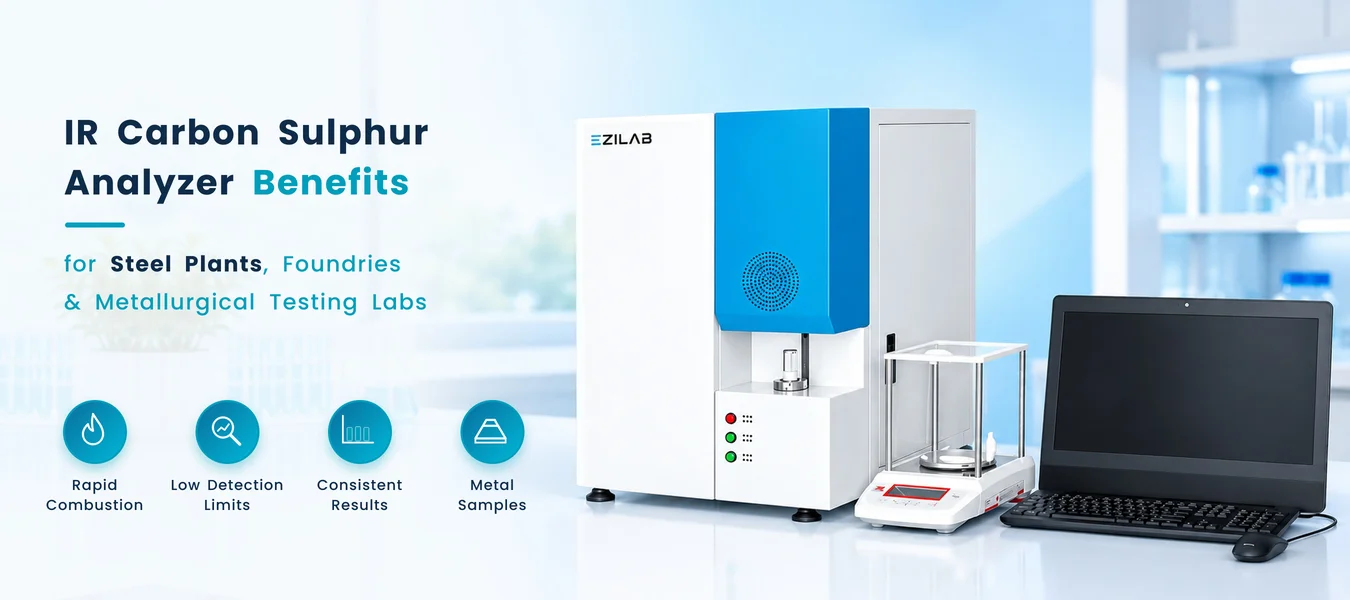
A professional overview of how combustion and infrared detection turn a small metal sample into carbon and sulfur readings.
Why Carbon and Sulfur Levels Decide Material Quality
Carbon governs the hardness and strength of steel and cast iron, while sulfur affects machinability and brittleness. Small shifts in either element change how a batch behaves, so foundries, steel plants and metallurgical laboratories check both before material is released for use. A carbon sulfur analyzer, sometimes called a carbon sulfur determinator, gives those checks a fast, repeatable form.
The IR Carbon Sulphur Analyzer EZL-IA101 from Ezilab is built around high-frequency combustion and infrared detection. It covers a wide carbon range, reaches very low sulfur levels and shows live curves during the run, which makes it a useful reference for readers learning how a cs analyzer fits into routine materials testing.
The Working Principle Behind Combustion and Infrared Detection
The ir carbon sulphur analyzer principle starts with a weighed sample and a flux placed in a crucible. A high-frequency induction furnace heats the sample until it burns, and carbon and sulfur leave the material as gases.
Those gases pass through dust filtration and into an infrared cell. Each gas absorbs infrared light at its own characteristic wavelengths, and the amount absorbed relates to the amount of carbon or sulfur in the sample. In the ir carbon sulphur analyzer working principle, software turns that signal into a percentage, so the result reflects the material rather than the operator.
Reading the Equipment Layout, Part by Part
A simple diagram of ir carbon sulphur analyzer equipment shows why the sequence is short. The sample moves from the balance to the furnace, the gas is cleaned, and the infrared cells report the result.
Diagram: analysis path, parts lettered A to F
- ABalance and sample — An electric balance weighs the sample, with a read precision of one tenth of a milligram.
- BCrucible and flux — Ceramic crucibles hold the sample, and tungsten or pure iron flux supports combustion.
- CInduction furnace — A high-frequency automatic furnace burns the sample.
- DDust filter and purification — Dust filtration, a desiccant and an absorbent clean the gas stream, with automatic leakage detection.
- EInfrared cells — One analysis pool each for carbon and sulfur measure the absorbed infrared light.
- FComputer and printer — Live carbon and sulfur curves appear on the computer, and results can be printed.
Running an IR Carbon Sulphur Analyzer Test Step by Step
In daily use, a test on an ir carbon sulphur analyzer machine follows a repeatable routine that suits both single samples and long batches.
Speed, Sensitivity and Repeatability
Rapid Combustion Analysis
Analysis time can be set from twenty-five to sixty seconds, and a typical run takes about thirty-five seconds.
Low Detection Limits
Both elements can be read down to five ten-thousandths of a percent, with a minimum reading sensitivity of one tenth of a part per million.
Consistent Results
Precision is listed at under one percent RSD for carbon and under one and a half percent RSD for sulfur.
Wide Carbon and Sulfur Range
Carbon reads up to six percent and sulfur up to half a percent, and both ranges can be extended.
Live Curve Monitoring
Real-time carbon and sulfur curves show how each run develops.
Built-In Maintenance Aids
Auto-cleaning, dust filtration and leakage detection help keep the gas path in working order.
EZL-IA101 Technical Details
| Parameter | Value |
|---|---|
| Carbon range | Five ten-thousandths of a percent up to six percent, extendable |
| Sulfur range | Five ten-thousandths of a percent up to half a percent, extendable |
| Minimum reading sensitivity | One tenth of a part per million |
| Carbon precision | Under one percent RSD |
| Sulfur precision | Under one and a half percent RSD |
| Analysis time | Twenty-five to sixty seconds, adjustable |
| Typical sample weight | Half a gram |
| Furnace | High-frequency automatic induction furnace |
| Detection | Infrared, with separate carbon and sulfur analysis pools |
| Operating temperature | Ten to thirty degrees Celsius |
| Humidity | Below seventy-five percent relative humidity |
| Included items | Balance, computer, printer, crucibles, flux media and filter consumables |
The full list is available on the IR Carbon Sulphur Analyzer EZL-IA101 product page.
Where It Fits: Foundries, Steel Mills and Materials Labs
Foundries and Steel Mills
Carbon and sulfur checks and composition verification.
Nonferrous Metal and Alloy Testing
Elemental checks on metals outside the iron family.
Cement Plants
Material composition checks before production batches.
Ore and Coal Laboratories
Sulfur and carbon screening of raw materials.
Alloy Research
Comparing results across trial batches.
Quality Control Laboratories
Routine release checks on incoming and outgoing material.
These ir carbon sulphur analyzer use cases all depend on quick, repeatable readings. Readers who want to see the model in context can browse the Ezilab IR carbon sulphur analyzer category page.
Wet Chemistry Versus Infrared Combustion at a Glance
| Factor | Wet Chemical Methods | Infrared Combustion Analysis |
|---|---|---|
| Sample handling | Several manual preparation steps | Weigh, add flux and load |
| Time per result | Longer, with waiting between steps | Under a minute for a typical run |
| Operator influence | Higher, with more manual steps | Lower, with automated combustion and detection |
| Result display | Calculated after the procedure | Live curves and a reported percentage |
Wet methods remain useful for specific checks, but infrared combustion suits routine, high-frequency testing where speed and repeatability matter.
Common Selection Mistakes
Choosing by range alone. Low-level work also depends on sensitivity and precision at the bottom of the range.
Ignoring analysis time settings. A shorter cycle speeds throughput, while a longer one can suit difficult samples.
Overlooking consumables. Crucibles, flux media and filter materials are used up and should be easy to restock.
Underestimating maintenance. Dust and leaks affect the gas path, so cleaning and leak checks matter.
Forgetting room conditions. Keep temperature and humidity within the listed operating range.
Skipping balance quality. Sample weight feeds directly into the percentage result.
Habits That Keep Results Steady
- Weigh samples with the same method and similar mass each time.
- Use clean crucibles and keep flux media sealed between runs.
- Replace dust tubes, desiccant and absorbent on a regular schedule.
- Run a leak check after changing any filter component.
- Brush out the furnace area and keep a log of maintenance steps.
Exploring the Wider Family of Carbon and Sulfur Instruments
This model belongs to a category of infrared analyzers for elemental analysis of metals, alloys and industrial materials. Users typically include metallurgy and foundry operations, quality control laboratories and research institutes.
When reviewing ir carbon sulphur analyzer manufacturers and their ranges, readers usually compare measurement range, precision, analysis time, furnace type, purification features and maintenance aids. A complete ir carbon sulphur analyzer system also includes a balance, consumables and reporting tools. The current range is easy to browse on the Ezilab carbon and sulfur analyzer range, and wider laboratory categories sit on the Ezilab.
Continue to the Product Details
See the full specification list, features and applications for this model.
Explore IR Carbon Sulphur Analyzer EZL-IA101Amelia Brooks
Blog Content Writer at Ezilab Scientific
Amelia Brooks is a blog content writer at Ezilab Scientific, specializing in laboratory equipment, scientific instrumentation, and technical content development. She focuses on translating complex product specifications and scientific concepts into clear, informative, and engaging articles. Her writing highlights equipment features, practical applications, and industry developments to help readers understand laboratory technologies and make informed decisions based on their technical requirements.