

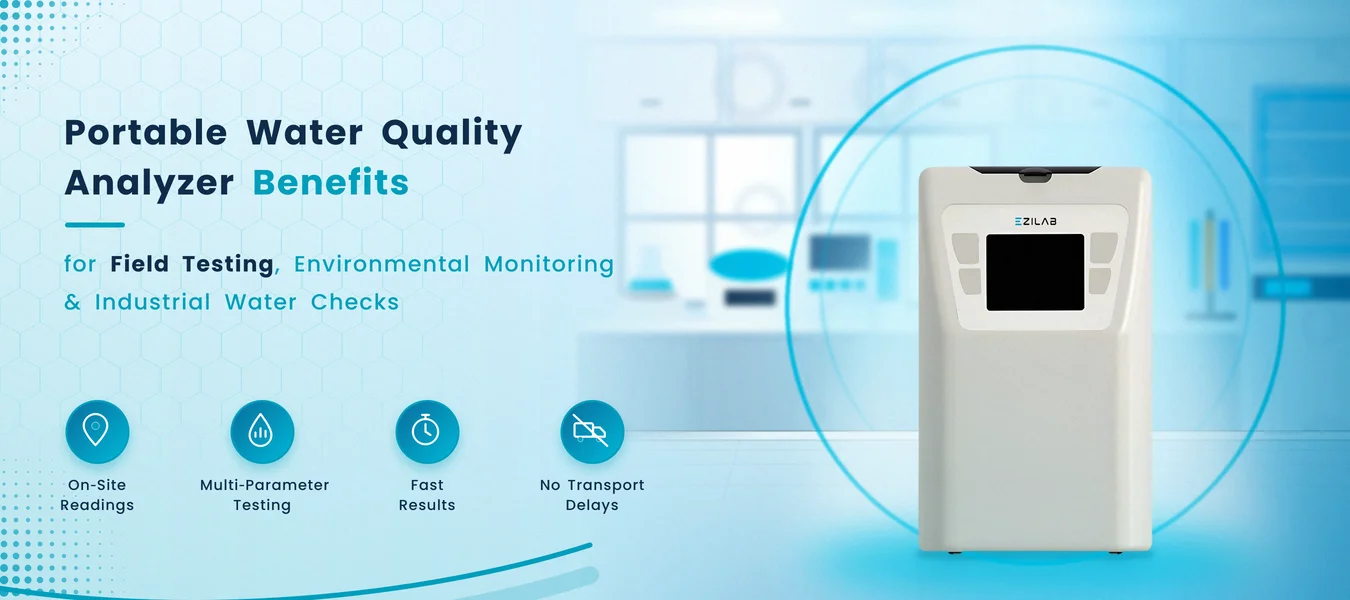
How a handheld analyzer brings several water readings to the sampling point, where it fits in aquaculture, treatment plants and environmental work, and how to choose and use one well.
Why Testing at the Sampling Point Matters
Water changes between the moment it is collected and the moment it reaches a bench. Bottles wait in vehicles, schedules slip, and a reading taken a day later may describe water that no longer exists. Decisions about a pond, a treatment stage or a discharge point are better made while the team is still standing beside the water.
The Ezilab Portable Water Quality Analyzer EZL-PWA10 is built for that moment. This compact portable water analyzer reports oxygen demand together with several nutrient parameters, so a single visit can answer more than one question. The sections below explain how it works, where it fits and how to get steady use from it in the field.
How the Measuring Principle Works
The analyzer uses an LED light source with three wavelengths: four hundred twenty, five hundred twenty and six hundred twenty nanometers. A treated sample sits in the light path, and the instrument converts the optical response into a concentration reading. Each parameter follows its own chemical method, and some need a short heating step first.
Because the optics, the methods and the stored results all live in one handheld body, portable water quality testing no longer depends on a laboratory visit to produce a usable number.
The Testing Routine in Five Steps
Measurement Path Diagram: Key Stages
A portable water quality analyzer system is easiest to understand as a path, from the water in your hand to the stored result.
Diagram: measurement path, stages lettered A to F
- AWater sample — collected at the sampling point, with no transport to a laboratory.
- BMethod and digestion — each parameter has its own chemical method, and three of the four involve heating.
- CLED light source — provides three wavelengths across the visible range.
- DOptical reading — turns the response of the treated sample into a concentration.
- EReal-time display — shows the reading through a user-friendly interface.
- FData log — keeps up to three hundred entries so results travel back with the team.
Why Field Teams Choose a Handheld Analyzer
Four outcomes explain the move from sample collection alone to testing on site.
Readings Where Water Is
Testing at the sampling point removes the wait for transport and the risk that the sample changes on the way.
Several Parameters
COD, ammonia nitrogen, total phosphorus and total nitrogen come from one instrument, so one visit answers more questions.
Quicker Decisions
Real-time monitoring lets the team act on a reading before leaving the site.
Easy to Hold
A hand-sized body of three hundred grams moves between sampling points without extra equipment.
Stored Results
The data log holds up to three hundred entries, so readings can be reviewed after the field trip.
Power-Saving Operation
A power-saving feature helps the instrument last through a working day away from the bench.
Parameters, Ranges and Methods
The parameters an instrument covers decide whether it answers your question. This model lists four, each with its own method and range.
| Parameter | Method | Range, milligrams per liter | Test limit | Digestion |
|---|---|---|---|---|
| COD | Potassium dichromate | Ten to fifteen thousand | Ten | One hundred sixty-five degrees Celsius for twenty minutes |
| Ammonia nitrogen | Salicylic acid | Zero point zero two to fifty | Zero point zero two | Not applicable |
| Total phosphorus | Ammonium molybdate | Zero point zero two to twenty | Zero point zero two | One hundred fifty degrees Celsius for fifteen minutes |
| Total nitrogen | Thymol crystals | Zero point five to five hundred | Zero point five | One hundred twenty-five degrees Celsius for thirty minutes |
EZL-PWA10 Technical Specifications
| Parameter | Value |
|---|---|
| Light source | LED |
| Wavelengths | Four hundred twenty, five hundred twenty and six hundred twenty nanometers |
| Accuracy | Within plus or minus five percent |
| Repeatability | Within plus or minus three percent |
| Zero drift | Within zero point three percent of full scale per thirty minutes |
| Dimensions | Ninety by seventy by one hundred twenty-five millimeters |
| Weight | Three hundred grams |
| Data storage | Up to three hundred entries |
| Key features | Power-saving operation, easy to hold, user-friendly interface, real-time monitoring |
Practical Uses Across Water Testing Sites
Aquaculture
Pond water quality checks alongside oxygen demand, taken at the pond edge.
Treatment Plants
Influent and effluent checks across the stages of wastewater treatment.
Municipal Authorities
Spot-checks at distribution points without sending samples away.
Industrial Wastewater
Monitoring of wastewater as it leaves the process.
Environmental Monitoring
Readings across wide sampling areas where a laboratory is far away.
Teams that search for a portable COD analyzer or a COD meter portable enough for field use will find that oxygen demand is the first parameter listed, with a wide range that spans light to heavily loaded water.
Comparing Neighboring Models
Placing related instruments side by side shows what each is meant for. You can also browse the portable analyzer range for further options.
| Model | Format | Stated specifications |
|---|---|---|
| EZL-PWA10 | Portable | COD, ammonia nitrogen, total phosphorus and total nitrogen, with an LED light source at three wavelengths |
| EZL-PWA20 | Portable | Absorbance detection from four hundred twenty to six hundred twenty nanometers, resolution of zero point zero zero one absorbance, repeatability within plus or minus zero point one absorbance |
| EZL-BW11 | Benchtop | COD from zero to fifteen thousand, ammonia nitrogen from zero to fifty and total phosphorus from zero to twenty milligrams per liter |
Common Selection Mistakes
Assuming the parameter list. A portable chlorine analyzer measures something different from this model, whose listed parameters are COD, ammonia nitrogen, total phosphorus and total nitrogen.
Ignoring range and test limit. Compare the concentration expected at your site with the range and limit of each parameter.
Overlooking the heating step. COD, total phosphorus and total nitrogen involve digestion, so plan time for it in the field routine.
Choosing portability when a bench is needed. Large sample volumes in a fixed laboratory may suit a benchtop instrument better.
Forgetting record needs. Decide how many readings must be kept before the team returns to the office.
Expecting oxygen readings. Dissolved oxygen is not among this model's listed parameters; separate instruments such as the Dissolved Oxygen Meter EZL-DOM121 cover it.
User Tips for Repeatable Field Readings
- Confirm the parameter list before leaving for the site.
- Match the expected concentration to the range and test limit of each method.
- Allow time for digestion when measuring COD, total phosphorus or total nitrogen.
- Watch the real-time reading and note the sampling point alongside each result.
- Review the data log after each trip, because it holds up to three hundred entries.
- Take readings across a wide sampling area to see how conditions change from place to place.
Exploring the Portable Water Analyzer Range
Portable water quality analyzers sit within the larger group of water testing instruments, which also includes benchtop analyzers, turbidity analyzers, dissolved oxygen meters and reactors. Within the portable range, laboratories usually compare the test method, the measuring range, the detection range and the resolution, which are the same attributes the range uses to filter its models.
To explore all models, open the portable water quality analyzers category page, or browse other laboratory equipment from the Ezilab.
Take Testing to the Water
Review the full specifications, methods and dimensions of the EZL-PWA10 before planning your next round of on-site testing.
Explore EZL-PWA10Amelia Brooks
Blog Content Writer at Ezilab Scientific
Amelia Brooks is a blog content writer at Ezilab Scientific, specializing in laboratory equipment, scientific instrumentation, and technical content development. She focuses on translating complex product specifications and scientific concepts into clear, informative, and engaging articles. Her writing highlights equipment features, practical applications, and industry developments to help readers understand laboratory technologies and make informed decisions based on their technical requirements.