

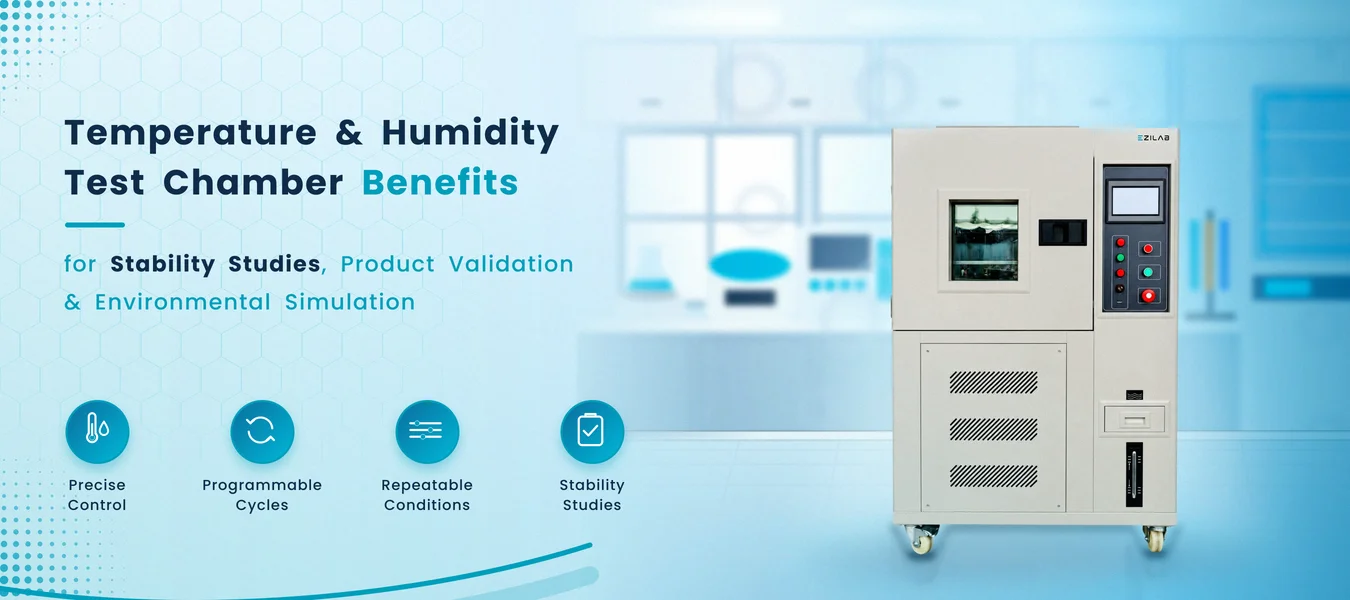
A practical read for laboratories, hospital facilities, research centers and advanced labs that need to hold heat and moisture steady, or move them on a schedule, and get the same result the next time.
What Dual-Parameter Climate Control Actually Does
Many materials and assemblies behave differently when heat and moisture act on them together than when either acts alone. A Temperature and Humidity Test Chamber EZL-TH162 from Ezilab holds both variables inside a closed workspace so a laboratory can watch that interaction under conditions that can be repeated on demand.
The workspace holds two hundred twenty-five liters, which suits component batches and small assemblies. The operating window runs from negative fifty to one hundred eighty degrees Celsius, with relative humidity adjustable from ten to ninety-eight percent. In practical terms, one temperature and humidity chamber can carry a cold-start exposure, a high-heat aging run and a near-saturation damp heat cycle without moving samples between units.
Laboratories often call this kind of equipment a temperature and humidity controlled chamber because both conditions are measured, compared against a target and corrected continuously. That feedback behavior is what separates it from a simple oven or a cold room, and it is the reason results can be compared from one run to the next.
Humidity Chamber Working Principle in Plain Terms
The working principle rests on a feedback loop. An operator enters target conditions on the temperature and humidity control instrument. Platinum resistance sensors report what the workspace is actually experiencing, and the controller closes the gap. When the chamber runs cool, a heating element adds energy. When it runs warm, a refrigeration circuit made up of a compressor, a condenser with a cooling fan, an evaporator and an expansion valve removes it. Moisture is raised or lowered through the same loop until the reading meets the target.
Temperature and humidity test chamber diagram: the control loop
Readings return to the control instrument, and the cycle repeats until conditions match the target.
Rates matter when a program is written. Heating proceeds at about three to five degrees Celsius per minute, while cooling proceeds at about seven tenths to one and two tenths degrees per minute. A method that asks for steep downward ramps should be planned around the slower cooling figure rather than the faster heating one.
Where the Benefits Show Up During Stability and Validation Work
The practical temperature and humidity test chamber benefits appear when a study has to run for a long time or be repeated across batches. Used at fixed set points, the unit behaves like a constant temperature and humidity chamber for long soak exposure. Used with changing set points, it works as a programmable temperature & humidity chamber, so a method can be written once and repeated.
Wide thermal window
Cold exposure and high heat share one workspace, so samples stay in place between test stages instead of traveling between separate units.
Tight humidity control
Humidity fluctuation stays within one percent relative humidity, which keeps comparisons between moisture-sensitive samples meaningful.
Repeatable cycles
Detailed parameter programming and long-duration cycle capability let one method run again on the next batch without being rebuilt.
Protected long runs
Over-temperature protection, an audible alarm, anti-frost and anti-condensation protection, and a pressure relief balance port support extended runs.
Practical Use Cases Across Laboratories
Typical temperature and humidity test chamber use starts with a question about how a product behaves once the environment changes. The Ezilab product page describes several settings where the EZL-TH162 is applied:
Aerospace supply
Avionics and materials are exposed to extreme cold and heat.
Automotive teams
Sensors and connectors are checked under cold-start and hot-soak conditions.
Industrial electronics
Boards are screened for how they respond to temperature and moisture.
Product testing
Component batches and small assemblies are tested as part of quality assurance.
Research and development
Conditions from arctic storage to tropical humidity are simulated for new designs.
Environmental simulation in a humidity chamber laboratory usually means stepping a sample through cold, heat and damp stages in sequence. Keeping those stages inside one workspace removes handling between them and keeps the exposure history of each sample clean.
Matching Chamber Format to Test Intent
Two questions decide most selections: how far the test range must stretch, and how much sample volume must fit. The table sets the wide-range EZL-TH162 beside the moderate-range models listed on the same Ezilab pages.
| Consideration | EZL-TH162 | Moderate-range models |
|---|---|---|
| Workspace volume | Two hundred twenty-five liters | Two hundred seventy-five liters to four hundred seventy-five liters across the related models |
| Temperature range | Negative fifty to one hundred eighty degrees Celsius | Zero to sixty-five degrees Celsius |
| Suited to | Extreme cold, high heat and near-saturation damp heat profiles | Tests that stay within a narrower temperature band |
| Room conditions | Five to twenty-eight degrees Celsius, humidity at or below eighty-five percent | Five to forty degrees Celsius operating temperature |
Laboratories whose tests stay between zero and sixty-five degrees Celsius can look at the Temperature and Humidity Test Chamber EZL-TH161 or the larger Temperature and Humidity Test Chamber EZL-TH164. A wide range is valuable only when the test program actually uses it.
Common Selection Mistakes to Avoid
Sizing the range for the extreme case
A cold floor and a near-saturation humidity ceiling suit extreme profiles. If routine tests are milder, the temperature and humidity test chambers available from Ezilab include models better matched to a narrower range.
Ignoring ramp rates
Cooling is slower than heating. A program with tight dwell times between a hot stage and a cold stage needs to leave room for the downward ramp.
Overlooking site conditions
The chamber expects three-phase power and a room held between five and twenty-eight degrees Celsius with humidity at or below eighty-five percent. The external footprint is roughly one hundred fifteen by ninety-seven centimeters and the height is one hundred ninety centimeters, so floor space should be confirmed before delivery.
Treating protective features as optional
Over-temperature protection and the audible alarm are what make long runs practical. They deserve the same attention as the temperature range when comparing models.
Exploring the Wider Climate Chamber Family
The EZL-TH162 belongs to Ezilab's range of dual-parameter environmental equipment, designed for laboratories evaluating moisture sensitivity, component stability and long-term material performance. The full lineup is gathered on the Ezilab temperature and humidity test chambers category page, where models can be explored side by side.
A temperature and humidity test chamber system in this category typically combines reinforced insulation, balanced humidity-generation pathways and precise temperature synchronization. When laboratories evaluate temperature and humidity test chamber manufacturers, the points they usually compare are volume, temperature range, operating temperature and temperature uniformity, which are also the filters used to sort the category. The range supports studies across electronics, pharmaceuticals, polymers, packaging materials and research specimens.
The wider catalog of laboratory instruments, from climate chambers to analyzers, can be browsed from the Ezilab home page.
Ready to review the complete specification list, included accessories and downloads for this model? The product page has them in one place.
Explore Temperature and Humidity Test Chamber EZL-TH162