

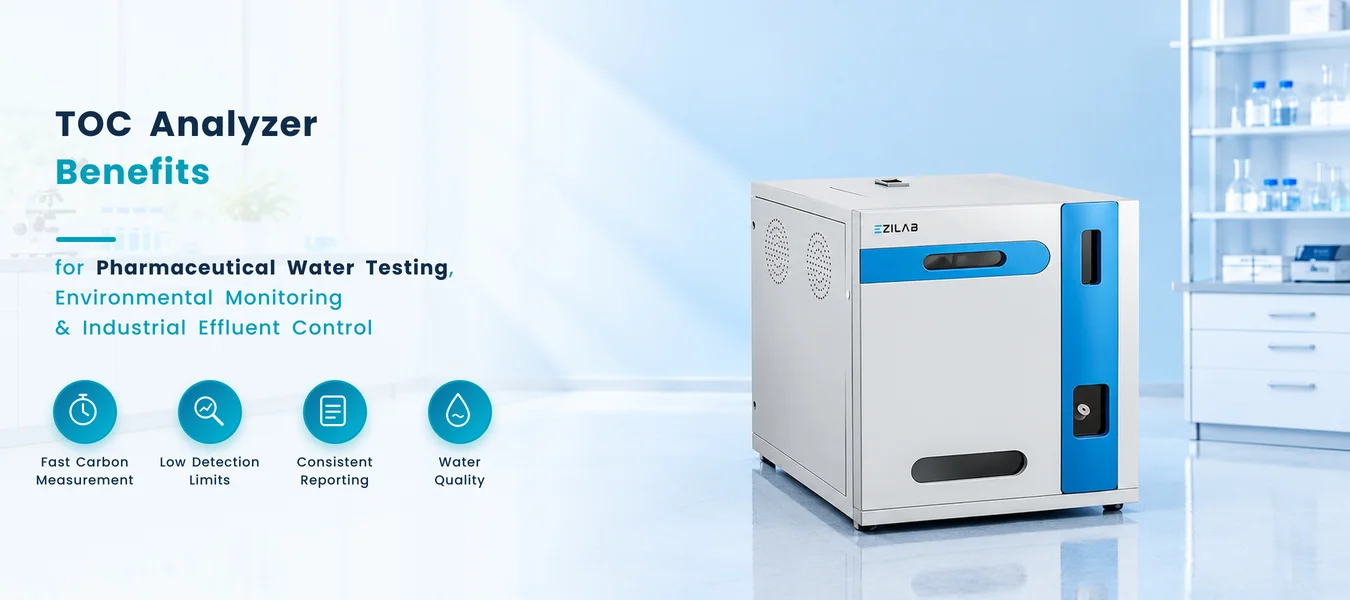
A professional overview of how oxidation and infrared detection turn the organic carbon in a water sample into a measured value.
Why Organic Carbon Measurement Matters in Water Quality
Organic carbon is a common indicator of how much organic material a water sample carries. Wastewater teams use it to follow treatment, environmental laboratories use it to track surface water and groundwater, and pharmaceutical laboratories use it to verify purified water. A total organic carbon analyzer measures that carbon in a controlled, repeatable way, so the number reflects the water rather than the operator.
The TOC Analyzer EZL-TOC102 from Ezilab is a toc analyzer machine built around UV wet chemical oxidation and an NDIR detector. It reads from zero to ten thousand milligrams per liter, reaches a detection limit of five micrograms per liter and handles samples with high salinity, which makes it a useful reference for readers learning how toc analyzer equipment fits into water testing.
From Carbon in Water to a Reading: The Working Principle
The toc analyzer working principle has three stages. First, the sample is oxidized, here by UV light together with a wet chemical process, so organic carbon is converted into carbon dioxide. Next, nitrogen carrier gas moves that carbon dioxide to the detector. Finally, an NDIR detector measures how much infrared light the gas absorbs, and software converts the signal into a concentration.
The same toc analyzer principle covers more than one result. Total organic carbon, total inorganic carbon and non-purgeable organic carbon are all reported, and which one a laboratory chooses depends on how inorganic carbon is treated before measurement.
Reading a TOC Analyzer Diagram, Part by Part
A simple toc analyzer diagram shows why the sequence is easy to follow. The sample moves through oxidation, the gas stream carries the result to the detector, and the software reports the value.
Diagram: sample path, parts lettered A to F
- ASample and autosampler — Liquid samples enter manually or through an optional autosampler.
- BOxidation module — UV light with a wet chemical process converts organic carbon into carbon dioxide.
- CCarrier gas — Nitrogen of high purity moves the gas, with gas flow control managing the stream.
- DNDIR detector — Measures the carbon dioxide by its absorption of infrared light.
- ELeak detection — Automatic leak detection watches the gas path.
- FPC software — The software controls the analysis, converts signals into concentrations and holds the results.
Running a Measurement Step by Step
In daily use, a measurement on a total organic carbon analyzer follows a short, repeatable routine.
Fast Measurement, Low Limits and Consistent Reporting
Fast Organic Carbon Measurement
The page describes fast analysis capability, and an optional autosampler helps move through sample sets.
Low Detection Limits
A detection limit of five micrograms per liter supports work with cleaner water.
Wide Measurement Range
Readings span zero to ten thousand milligrams per liter, covering both light and heavily loaded samples.
High-Salinity Samples
Salinity up to eighty-five grams per liter is listed, which suits brine-laden effluents.
Consistent Result Reporting
PC software controls the analysis, and an optional module adds electronic signatures and audit trails.
Built-In Safeguards
Gas flow control and automatic leak detection help keep the gas path in order.
EZL-TOC102 Technical Details
| Parameter | Value |
|---|---|
| Oxidation method | UV wet chemical oxidation |
| Detector | NDIR |
| Reported parameters | Total organic carbon, total inorganic carbon and non-purgeable organic carbon |
| Measurement range | Zero to ten thousand milligrams per liter |
| Detection limit | Five micrograms per liter |
| Precision | Three percent |
| Carrier gas | Nitrogen, ninety-nine point nine nine five percent purity or higher |
| Sample type | Liquid, with salinity up to eighty-five grams per liter |
| Autosampler | Optional |
| Control | PC software |
| Power | One hundred ten or two hundred twenty volts, fifty or sixty hertz, one hundred watts |
The full list is available on the TOC Analyzer EZL-TOC102 product page.
Where It Fits: Water, Effluent and Process Testing
Wastewater Monitoring
Municipal and industrial wastewater checks.
Surface Water and Groundwater
Environmental testing of natural water sources.
High-Salinity Effluents
Brine-laden discharges.
Pharmaceutical and Biotech Water
Purified water and water for injection verification.
Food and Beverage Process Water
Process water checks in food and drink plants.
Petrochemical Process Water
Process water checks in petrochemical settings.
Each toc analyzer application above relies on a controlled, repeatable measurement, and a typical toc analyzer use covers routine monitoring as well as occasional checks. Readers who want to see how other models differ can browse the TOC analyzer category page.
Oxidation Approaches Across the Category
| Approach | Detection | Range Focus |
|---|---|---|
| UV lamp oxidation | Conductivity detector | Low-range models for clean water |
| UV wet chemical oxidation (this model) | NDIR detector | Higher concentrations, up to ten thousand milligrams per liter |
| High-temperature catalytic combustion | NDIR detector | Highest range model, with manual dilution for its full range |
The right approach depends on how clean or heavily loaded the samples are, so the same laboratory may need more than one type.
Common Selection Mistakes
Choosing by range alone. Detection limit and the type of sample matter just as much as the top of the range.
Ignoring salinity. Check the salinity limit when samples include brines or heavy effluents.
Overlooking carrier gas. Nitrogen purity and supply need to be planned before installation.
Assuming compact means portable. A toc analyzer portable between sites still needs power, gas and sample planning, and this model is described as a compact system design, so confirm size and weight before moving it.
Skipping the autosampler decision. Large sample sets are easier to run with an autosampler than by hand.
Mixing up parameters. Match total organic, total inorganic or non-purgeable organic carbon to the method the laboratory follows.
Habits That Keep Readings Consistent
- Use clean glassware and rinse sample lines between different samples.
- Check the nitrogen supply and fittings before each session.
- Run calibration on a regular schedule and record it.
- Watch for leak detection messages and act on them promptly.
- Save results together with the sample details and run date.
Exploring the Wider Family of Total Organic Carbon Analyzers
This model belongs to a category of total organic carbon analyzers for water analysis, used in environmental testing, pharmaceutical water systems and industrial quality programs. The range includes low-range models for clean water and higher-range models for heavily loaded samples.
When reviewing toc analyzer manufacturers and their ranges, readers usually compare measurement range, detection limit, oxidation approach, detector type, autosampler support and software features. The full range is easy to browse on the Ezilab TOC analyzer range, and wider laboratory categories sit on the Ezilab.
Continue to the Product Details
See the full specification list, features and applications for this model.
Explore TOC Analyzer EZL-TOC102Amelia Brooks
Blog Content Writer at Ezilab Scientific
Amelia Brooks is a blog content writer at Ezilab Scientific, specializing in laboratory equipment, scientific instrumentation, and technical content development. She focuses on translating complex product specifications and scientific concepts into clear, informative, and engaging articles. Her writing highlights equipment features, practical applications, and industry developments to help readers understand laboratory technologies and make informed decisions based on their technical requirements.