Description
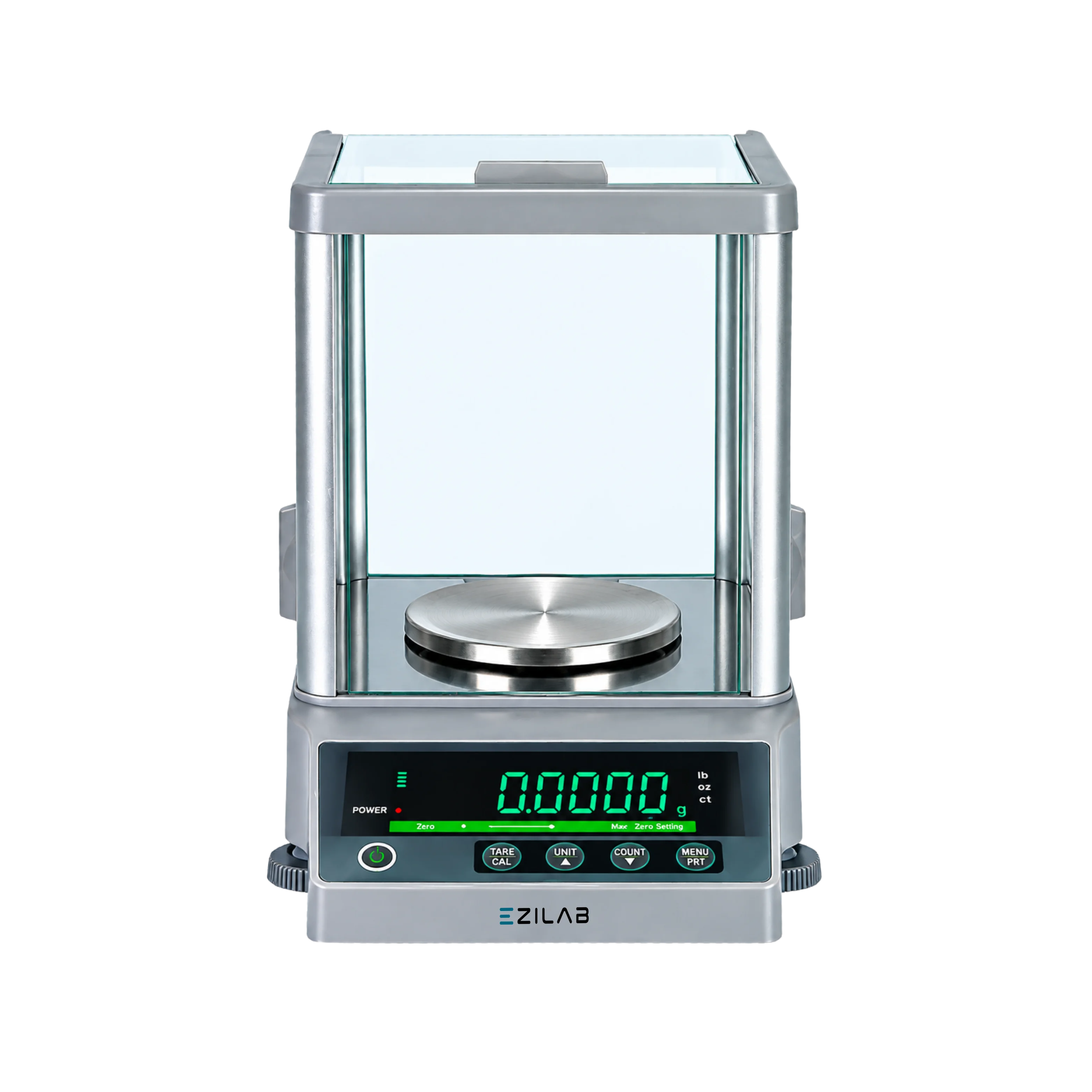
EziLab offers the Analytical Balance EZL-AB105, one of the entry level milligram balances that reads 1 mg across 0–110 g on a Φ110 mm pan. The weighing cell settles in 2 seconds or less, holds ±3 mg linearity and ±2 mg repeatability, and works between 15 and 35 °C. External calibration with a reference mass keeps the purchase cost low and lets labs tie results to in-house certified weights, flexible modes cover grams, carats, counting and percentage, and intelligent error alerts flag overload, instability or a missed calibration. An RS232 port sends each reading to a printer or PC, and the compact 3.3 kg body moves between benches without fuss. Chemistry teaching laboratories, pharmaceutical dispensaries, small formulation units, quality control stations, environmental testing labs and research groups on tight budgets use this analytical balance for routine milligram work. Typical tasks include weighing out reagents for standards, quantitative analysis by mass, formulating small batches, checking tablet weights and preparing calibration standards. Choose it over internally calibrated models when a certified weight is already on hand and budget rules. Repeatability of ±2 mg puts the practical floor for a 0.1% weighing near 4 g (twice the repeatability divided by 0.001, my rough arithmetic); check your smallest sample against that floor before choosing. Settle it first, then look across Laboratory Balance and Analytical Balance pages.
Specifications
| Capacity | 0 to 110 g |
|---|---|
| Readability | 1mg |
| Linearity | ±3mg |
| Repeatability | ±2 mg |
| Stability Time | ≤2s |
| Working Temperature | 15 to 35 °C |
| Pan Size | Φ110mm |
| Output Interface | RS232 |
| Calibration Mode | External calibration |
| Dimensions(L×W×H) | 28×18×28mm |
| Weight | 3300 g |
Features
| Feature Area | Description |
| Layout | A compact, portable layout suits benches with limited space. |
| Weighing Modes | Flexible modes switch between grams, carats, counting and percentage. |
| Serial Output | A serial interface sends readings to a computer. |
| Alerts | Alerts flag overload, unsettled readings and missed calibration. |
| Calibration | External calibration works with a reference mass on hand. |
Applications