

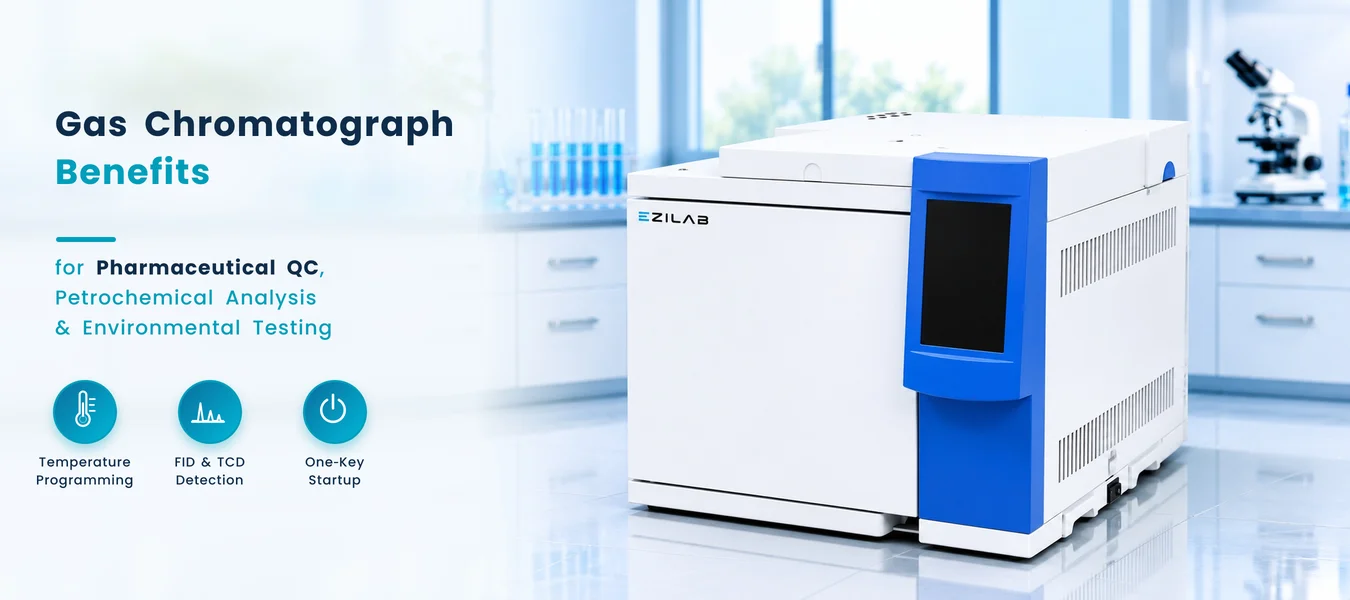
A professional overview of how a heated oven, a carrier gas stream and a detector separate and measure the volatile compounds in a sample.
Why Volatile Compound Analysis Depends on Controlled Separation
Many laboratories must answer the same question about a sample: which volatile compounds are present, and how much of each. Pharmaceutical teams check residual solvents, petrochemical laboratories profile hydrocarbons, and environmental teams screen air and soil for volatile contaminants. Gas chromatography answers that question by separating a mixture before it is measured, so each compound produces its own signal.
The Gas Chromatograph EZL-GC62 from Ezilab is a gas chromatography instrument with a programmable oven that reaches four hundred degrees Celsius, a choice of flame ionization or thermal conductivity detection, and one-key startup. This article explains how the equipment works, where it is applied and which selection mistakes are worth avoiding.
From Injection to Chromatogram: The Working Principle
The gas chromatography principle is differential travel. A small sample is injected into a heated inlet, vaporized and swept by a carrier gas into a column. Compounds that interact weakly with the column material move quickly, while those that interact strongly move slowly, so the mixture spreads into separate bands.
The same gas chromatograph principle then relies on a detector at the column outlet. Each band produces a signal as it passes, and software draws the signals over time as a chromatogram, where peak position identifies a compound and peak size reflects its amount.
A gas chromatography machine of this kind is the core of most gc chromatography work, and gas chromatography mass spectrometry follows the same separation but adds a mass detector for identification. The EZL-GC62 itself offers flame ionization and thermal conductivity detectors, which suit quantitative work on known compounds.
Reading a Gas Chromatography Diagram, Part by Part
A simple gas chromatography diagram shows why the sequence is easy to follow. The injector introduces the sample, the oven and column separate it, the detector senses each compound, and the software turns the signal into a record.
Diagram: sample path, parts lettered A to F
- AInjector — Up to three injectors, in packed column or split mode, introduce the sample.
- BColumn and oven — A packed column sits in an oven that reaches four hundred degrees Celsius.
- CDetector — A flame ionization or thermal conductivity detector, up to two installed, measures the compounds.
- DCarrier gas control — Constant carrier gas flow control and pre-column pressure from zero to four hundred kilopascals steady the stream.
- ETouchscreen — A seven-inch color touchscreen runs one-key startup and stores twenty test methods.
- FSoftware — Chromatography workstation software records the signal as a chromatogram.
Running an Analysis Step by Step
In daily use, a gas chromatograph analyzer follows a short, repeatable routine.
Oven Programming, Detector Sensitivity and Simple Startup
Precise Oven Temperature Programming
Nine programming steps, an accuracy of one tenth of a degree and heating rates from one tenth to sixty degrees per minute shape the separation.
High-Sensitivity FID Detection
The flame ionization detector lists a detection limit of three picograms per second and a dynamic range of seven orders of magnitude.
TCD Detection
The thermal conductivity detector adds a second option, with up to two detectors installed together.
Streamlined One-Key Startup
One-key startup and automatic detector ignition shorten the path from power-on to a ready instrument.
Stored Methods
Twenty test methods can be stored, which supports repeatable work between operators.
Connectivity
Serial and LAN connections link the instrument to a computer and the workstation software.
EZL-GC62 Technical Details
| Parameter | Value |
|---|---|
| Oven capacity | Twenty-two liters |
| Oven temperature range | Room temperature up to four hundred degrees Celsius |
| Oven accuracy | Plus or minus one tenth of a degree |
| Programming | Nine steps |
| Heating rate | One tenth to sixty degrees per minute |
| Injectors | Up to three, packed column or split |
| Detectors | Flame ionization or thermal conductivity, up to two installed |
| Detector and injector temperature | Room temperature up to four hundred twenty degrees Celsius |
| Pre-column pressure | Zero to four hundred kilopascals |
| Display | Seven-inch color touchscreen |
| Method memory | Twenty methods |
| Connectivity | Serial and LAN |
| Power | Two hundred twenty volts, three thousand watts |
| Size | One thousand twenty by six hundred sixty by seven hundred forty millimeters |
| Net weight | Seventy kilograms |
The full list is available on the Gas Chromatograph EZL-GC62 product page.
Where It Fits: Pharmaceutical, Chemical and Environmental Labs
Pharmaceutical Quality Control
Residual solvent testing.
Environmental Laboratories
Screening of volatile compounds in air and soil.
Chemical Laboratories
Solvent purity profiling.
Research and Development
Method development using multi-step oven programming.
Contract Testing Labs
Varied sample types, handled with dual detectors.
Laboratory Research
Separating volatile and semi-volatile compounds.
These gas chromatograph uses depend on controlled separation followed by clear detection, and a typical gas chromatography application mixes routine screening with occasional method work. Readers who want to see how other models differ can browse the gas chromatograph category page.
Choosing Between FID and TCD Detection
| Consideration | Flame Ionization | Thermal Conductivity |
|---|---|---|
| Typical targets | Organic compounds such as hydrocarbons and solvents | A wider range of compounds, including permanent gases |
| Sensitivity | Higher, with a very low detection limit | Lower, suited to larger amounts |
| Sample effect | Burns the sample in a flame | Leaves the sample intact |
| Operating need | Fuel gas and automatic ignition | Carrier gas flow only |
This table is general background on detector types; the laboratory sample list usually decides which detector, or which pair, is installed.
Common Selection Mistakes
Choosing a detector by habit. Match the detector to the compounds being measured, since flame and thermal detectors respond differently.
Overlooking injector count. Plan how many injectors and detectors the workload needs before choosing a configuration.
Ignoring column type. This model uses packed columns, so confirm that method requirements fit before buying into a workflow.
Underestimating gas supply. Carrier gas and, for a flame detector, fuel gas supplies need planning, along with flow ranges.
Forgetting the room. The unit draws three thousand watts and weighs seventy kilograms net, so check power and bench space.
Expecting mass identification. Flame and thermal detectors quantify known compounds, while unknown identification calls for a mass detector.
Habits That Keep Chromatograms Consistent
- Use clean, dry carrier gas and check fittings for leaks.
- Let the oven and detector settle before the first injection.
- Run a blank to confirm a stable baseline.
- Store proven methods and recall them rather than retyping settings.
- Record column, method and sample details with each run.
Exploring the Wider Family of Gas Chromatographs
This model belongs to a category of gas chromatography equipment for separating volatile compounds in research, quality control, petrochemical testing and environmental studies. The range targets hydrocarbons, solvents, gases and other organic compounds, with oven control, carrier-gas regulation and programmable sequences common across it.
When reviewing a gas chromatography device or comparing suppliers, readers usually look at oven range, injector count, detector options, repeatability and software features. The full range is easy to browse on the Ezilab gas chromatograph range, and wider laboratory categories sit on the Ezilab.
Continue to the Product Details
See the full specification list, features and applications for this model.
Explore Gas Chromatograph EZL-GC62Amelia Brooks
Blog Content Writer at Ezilab Scientific
Amelia Brooks is a blog content writer at Ezilab Scientific, specializing in laboratory equipment, scientific instrumentation, and technical content development. She focuses on translating complex product specifications and scientific concepts into clear, informative, and engaging articles. Her writing highlights equipment features, practical applications, and industry developments to help readers understand laboratory technologies and make informed decisions based on their technical requirements.