

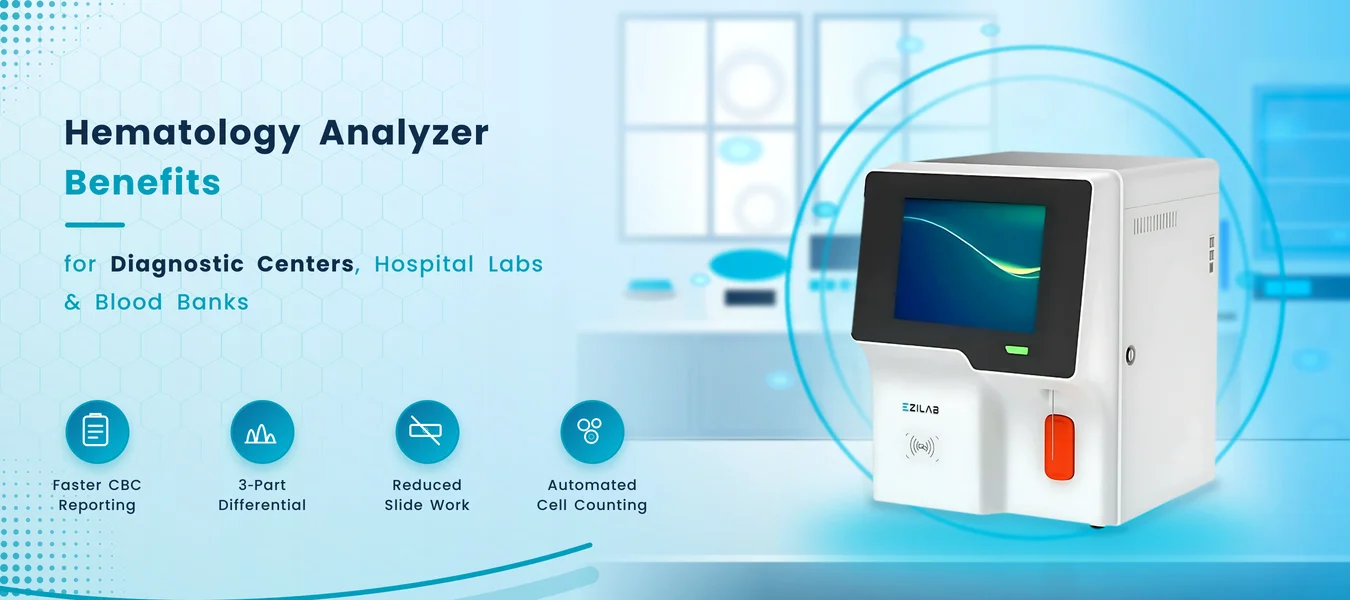
A complete blood count sits at the start of many clinical decisions, so the instrument behind it shapes how quickly a laboratory can respond. This guide explains how a hematology analyzer machine works, what it reports, and how to match one to the workload of your laboratory.
Why Automated Blood Counting Matters
Hematology analyzer uses reach well beyond routine screening. Hospital laboratories run blood count panels for admissions and follow-up, diagnostic centers handle referrals from nearby clinics, and research centers need consistent cell counts across long studies. A hematology analyzer system brings counting, differential review and data storage onto one bench instrument, so results arrive the same day and samples do not travel to outside laboratories.
The Hematology Analyzer EZL-HA104 from Ezilab, a hematology analyzer manufacturer focused on laboratory instruments, is a laser scatter model with a five-part differential. It works in a complete blood count mode or a complete blood count plus five-part differential mode, which makes it a practical hematology analyzer for laboratory teams that need both quick counts and deeper cell grouping.
How the Working Principle Fits Together
The hematology analyzer working principle in this model rests on laser scatter technology. As the prepared sample passes the detection point, cells scatter laser light at different angles, and the pattern separates white cell groups by size and internal detail. The hematology analyzers principle is therefore optical rather than manual: the instrument sorts cells into populations and plots them as histograms and scattergrams for the operator to review.
SampleBlood is loaded for testing
PreparationLyse and diluent prepare the sample
Laser scatterCells scatter light at the detector
PlotsHistograms and scattergrams form
ReportParameters are reported
Hematology analyzer diagram: a simplified path from sample to report
Reading the Report: Parameters and Test Modes
A hematology analyzer test is only as useful as the report it produces. This model covers thirty-one parameters across three histograms and two scattergrams, and the operator can choose between a complete blood count alone and a complete blood count with the five-part differential. That choice keeps routine counts quick while leaving deeper cell grouping available when a case calls for it.
Red cell and white cell counts
WBC, RBC, HGB and HCT sit alongside the red cell indices MCV, MCH and MCHC, plus RDW-SD and RDW-CV for size variation.
Five-part differential
Neutrophils, lymphocytes, monocytes, eosinophils and basophils are reported as both counts and percentages.
Platelet and research items
PLT, PDW, MPV, PCT and P-LCR describe platelets, while ALY and IG are offered as research parameters.
Practical Use Cases Across Laboratory Types
Different sites lean on the same instrument for different reasons. The applications below are the ones described for this model.
- Hospital laboratories use it for routine complete blood count testing.
- Clinics apply it for hemoglobin measurement.
- Diagnostic laboratories use it for five-part differential screening.
- Patient follow-up benefits from historical trend review of stored results.
- Veterinary clinics use species-specific configuration for blood analysis.
- Animal research centers and academic veterinary programs apply it to multi-species cell counting.
Daily Operation and Quality Control
Throughput reaches sixty tests per hour, and the memory holds two hundred thousand results together with their histograms and scattergrams. Quality control is supported through multiple rules, including L-J and X-B, and both automatic and manual calibration are available. The interface is described as user-friendly, the sample volume as minimal, and the maintenance design as easy, with quick result processing completing the picture.
Placement
The analyzer operates between fifteen and thirty degrees Celsius with humidity between thirty and eighty-five percent, and its net weight is twenty-eight kilograms, so plan a stable bench in a controlled room.
Supplied consumables
One bottle of lyse, one bottle of diluent and one bottle of probe cleanser ship with the unit, so the laboratory can begin testing with the initial supplies in hand.
Common Selection Mistakes to Avoid
- Ignoring daily case volume. Match the expected number of samples to the sixty tests per hour rate before deciding.
- Choosing differential depth by habit. Decide whether complete blood count alone or the five-part differential suits most of your cases.
- Overlooking storage. Follow-up work depends on how many past results, with plots, the instrument can keep.
- Skipping the room check. Temperature and humidity limits apply to the space where the analyzer will sit.
- Forgetting species needs. Veterinary and research programs should confirm species-specific configuration early.
Model Comparison Within the Range
Seeing neighboring models side by side makes the differences concrete. Laboratories can also review the wider hematology analyzers range for further variants. In short, the Hematology Analyzer EZL-HA104 suits those who value thirty-one parameters and a larger result archive over the twenty-eight-parameter sibling.
| Model | Assay items | Storage | Notable point |
|---|---|---|---|
| EZL-HA104 | Five parts, thirty-one parameters, three histograms, two scattergrams | Two hundred thousand results | Laser scatter, with complete blood count and five-part differential modes |
| EZL-HA105 | Five parts, twenty-eight parameters, two histograms, two scattergrams | One hundred thousand results | Sixty tests per hour |
| EZL-HA101 | Three histograms | One hundred thousand results | Accepts pre-diluted blood volumes |
| EZL-HA102 | Twenty-one parameters, three histograms | Not stated | Electric impedance and colorimetry methods |
About the Wider Product Category
Hematology analyzers belong to the broader analyzers group, which also includes chemistry, biochemistry and total organic carbon instruments. Within the hematology range, laboratories typically compare measuring principle, assay items, sample volume, throughput and storage, which are the same points the range uses to filter its models.
To explore the full range, open the hematology analyzers category page, and visit the Ezilab to see how other laboratory instruments are organized across the wider catalog.