

How refrigerated and frozen storage work side by side, where each zone fits in a lab workflow, and what to check before choosing a cold storage cabinet.
Why Cold Storage Planning Matters
Reagents, specimens, vaccines and reference materials lose value quickly once they leave their storage range. A few degrees of drift can change enzyme activity, shorten a kit's usable life or put a patient sample at risk. Many labs still split this load between a household fridge and a separate chest freezer, which uses more floor space and makes temperature records harder to keep in one place.
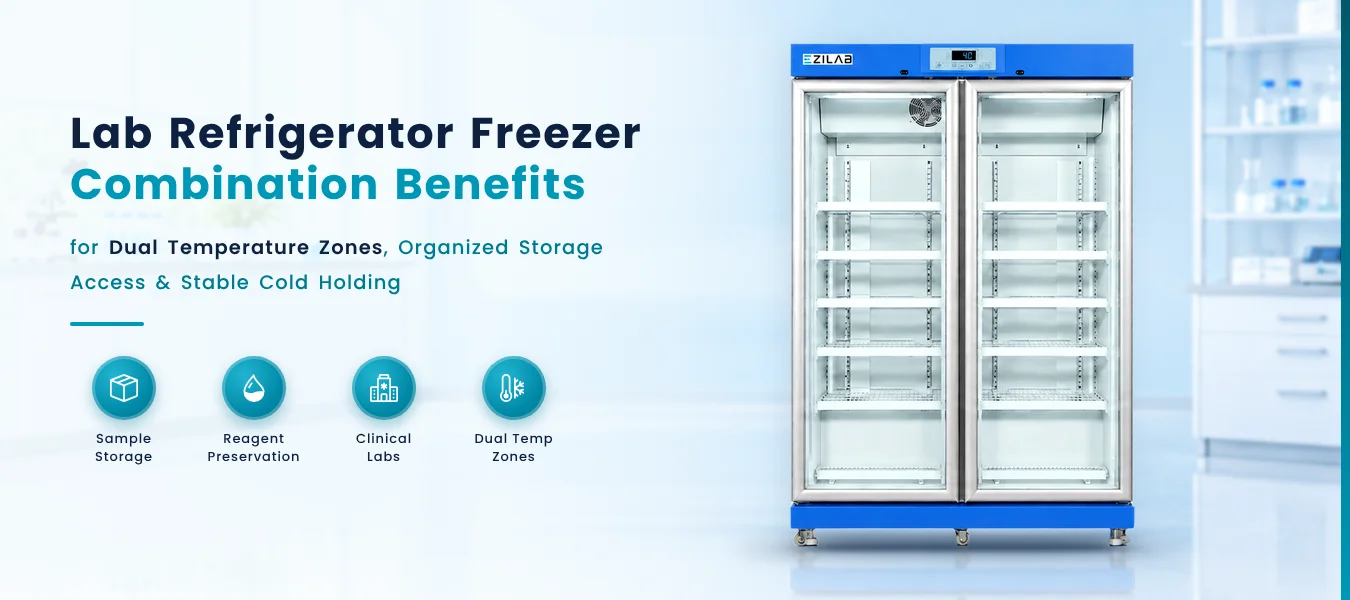
A lab refrigerator freezer combination brings refrigerated and frozen storage into one cabinet line, so teams can plan cold storage by zone instead of by appliance. Within that line, the Ezilab Lab Refrigerator Freezer Combination EZL-LRFC100 is the large refrigerated cabinet: 624 L held at 2 °C to 8 °C behind two glass doors, with eight adjustable shelves and a full alarm set.
How the Cooling System Holds Temperature
A lab refrigerator works on the vapor compression cycle. A compressor raises the pressure of the refrigerant, the condenser releases heat to the room, an expansion device drops the pressure, and the evaporator absorbs heat from inside the cabinet. A fan moves cold air across the shelves so the top and bottom of the chamber stay close in temperature. The thermostat reads a sensor in the chamber and switches the compressor on and off to hold the setpoint.
Lab refrigerator freezer combination diagram: cooling loop and zone layout
2 °C to 8 °C
−10 °C to −40 °C
In a dual-zone cabinet, the refrigerator and freezer compartments run under separate control, so opening one door does not disturb the other. In a single-zone refrigerated cabinet such as the EZL-LRFC100, the whole 624 L volume sits in the 2 °C to 8 °C band, which suits labs whose main load is refrigerated rather than frozen.
What Organized Cold Holding Delivers
Stable Cold Holding
An optimized cooling system and electric thermostat keep material within 2 °C to 8 °C.
Organized Access
Eight adjustable shelves across two doors let teams assign space by project or sample type.
Visible Inventory
Coated glass doors with anti-condensation heating and LED lighting cut search time with doors closed.
Full Alarm Set
High and low temperature, sensor fault, power off and door opening alarms flag problems early.
Corrosion-Resistant Interior
A pre-coated aluminum interior handles frequent cleaning and spills.
Easy Repositioning
Four universal casters let staff move the cabinet for cleaning or a room layout change.
EZL-LRFC100 Technical Specifications
| Parameter | Value |
|---|---|
| Capacity | 624 L |
| Temperature range | 2 °C to 8 °C |
| Doors | 2 off-line coated, tempered glass doors with anti-condensation heating |
| Shelves | 8 adjustable |
| Interior | Pre-coated aluminum plate, corrosion resistant |
| Lighting | LED interior lighting |
| Thermostat | Electric control |
| Alarms | High/low temperature, sensor fault, power off, door opening |
| Circuit breakers | 2 |
| Casters | 4 universal wheels |
| Dimensions (W × D × H) | 710 × 900 × 1989 mm |
| Gross weight | 142 kg |
Lab Refrigerator Freezer Combination Use by Setting
Hospitals
As a medical refrigerator for specimens, blood products awaiting testing and ward reagents.
Pharmaceutical Research
As a pharmaceutical refrigerator for temperature-sensitive compounds and reference materials.
Biotechnology Labs
Enzymes, buffers, antibodies and kits held at refrigerated temperature between runs.
Shared Research Centers
One large cabinet with labeled shelves for several teams instead of many small units.
A lab refrigerator freezer combination for lab use works well where refrigerated items dominate and frozen stock is small. Labs that also hold plasma, frozen aliquots or vaccines that need sub-zero storage can compare dual-zone models in the Ezilab lab refrigerator freezer combination lineup.
Setting Up the Cabinet for First Use
Mobility Versus Portability
Buyers sometimes search for a lab refrigerator freezer combination portable enough to carry between sites. Full-size cabinets are not portable in that sense: at 142 kg and nearly two meters tall, the EZL-LRFC100 is built to stay in one room. Its four universal casters make it mobile within a facility, which helps with cleaning, floor maintenance and lab layout changes. For field sampling or transport, a dedicated portable cooler or transport freezer is the right tool.
Common Selection Mistakes
Assuming all cabinets include a freezer. Check the temperature range on each model; some units in a combination line are refrigerator-only.
Using a household fridge. Domestic units cycle widely and have no alarms, which puts samples at risk.
Sizing for today only. Plan for sample growth; an overpacked cabinet blocks airflow.
Ignoring the alarm set. Power off and door opening alarms matter most for overnight storage.
Overlooking door type. Glass doors show stock at a glance; solid doors hold cold better in high-traffic areas.
Forgetting room fit. Measure doorways and ceiling height before choosing a lab refrigerator freezer combination machine of this size.
Good Practices for Daily Cold Storage
- Record the displayed temperature at the start and end of each shift.
- Keep a gap between containers and the back wall so cold air can circulate.
- Store liquids on lower shelves and in trays to contain spills.
- Label shelves and containers with owner, contents and date.
- Limit door openings; take out what you need in one trip.
- Clean the interior and check door seals on a set schedule.
- Never keep food or drinks in a laboratory fridge.
Exploring the Refrigerator Freezer Combination Range
This category covers cabinets that hold refrigerated stock at 2 °C to 8 °C, with dual-zone models adding a separate freezer compartment at −10 °C to −40 °C. When comparing options, buyers usually look at zone layout, total and per-zone capacity, temperature range, door type, shelf count, alarm set and footprint.
You can compare current models in the Ezilab refrigerator freezer combination collection, or browse other laboratory equipment from the Ezilab homepage.
| Model | Layout | Capacity | Temperature |
|---|---|---|---|
| EZL-LRFC100 | Single refrigerated zone, 2 glass doors | 624 L | 2 °C to 8 °C |
| EZL-LRFC101 | Dual zone: refrigerator + freezer | 506 L (247 L + 259 L) | 2 °C to 8 °C / −10 °C to −40 °C |
Plan Your Cold Storage Layout
Review the full specifications, shelf layout and alarm features of the EZL-LRFC100 before assigning storage space to your teams.
Explore EZL-LRFC100Amelia Brooks
Blog Content Writer at Ezilab Scientific
Amelia Brooks is a blog content writer at Ezilab Scientific, specializing in laboratory equipment, scientific instrumentation, and technical content development. She focuses on translating complex product specifications and scientific concepts into clear, informative, and engaging articles. Her writing highlights equipment features, practical applications, and industry developments to help readers understand laboratory technologies and make informed decisions based on their technical requirements.