

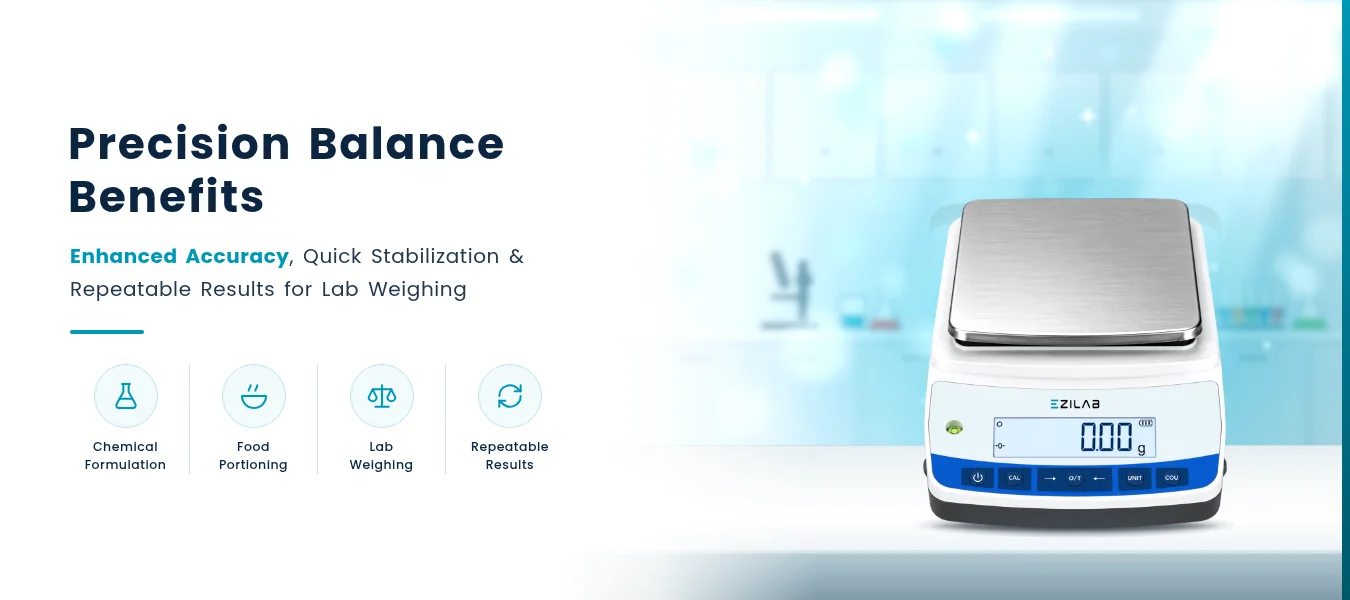
How fine readability, fast settling and repeatable readings shape batch quality, portion control and day-to-day lab results.
Why Fine Weighing Matters in Daily Lab Work
Small weighing errors rarely stay small. A pigment addition that is off by a fraction of a gram can shift a color batch out of tolerance. A portion that runs slightly heavy across a full shift turns into measurable product loss. A reagent weighed on a slow, drifting scale introduces variation that no later step can remove. The fix starts at the bench, with an instrument that reads finely, settles quickly and gives the same answer twice.
The Ezilab Precision Balance EZL-PB103 is built for this kind of work. It weighs up to 2000 g with 0.01 g readability, settles in under 1.5 seconds and holds repeatability and linearity to ±0.02 g. This article explains how it works, where it fits and how to keep its readings consistent.
How a Precision Balance Measures Mass
A digital precision weighing scale converts a tiny mechanical deflection into an electrical signal. When a sample is placed on the pan, the load is transferred to a sensing element beneath it. That element produces a signal proportional to the applied force, which the electronics filter, amplify and convert into a mass value on the display.
What separates a lab instrument from a kitchen or shipping scale is how carefully that signal is handled. Fine analog-to-digital conversion, temperature-compensated electronics and digital filtering let the balance show hundredths of a gram while rejecting the small vibrations and air movements found in a working lab.
From Pan to Display in Five Steps
Precision Balance Diagram: Main Components
A precision balance diagram is easiest to read from the side: the pan on top, the weighing cell below it and the electronics, display and keypad in the housing at the front.
Diagram: side view, parts numbered 1–8
- 1Weighing pan — a 168 × 165 mm stainless-steel surface that accepts beakers, trays and containers.
- 2Weighing cell — converts the load into an electrical signal.
- 3Overload protection — shields the cell from accidental heavy loads.
- 4Display — shows the weight with stability and zero indicators.
- 5Keypad — handles power, calibration, tare, units and counting.
- 6Bubble level — confirms the balance sits flat before weighing.
- 7Leveling feet and underhook — adjust the footprint and allow below-balance weighing.
- 8Lithium battery and data ports — hybrid power for bench or field use, with RS232 or USB output.
Accuracy, Stabilization and Repeatability Explained
These three qualities decide whether a high precision weighing scale produces data you can act on.
Enhanced Accuracy
0.01 g readability and ±0.02 g linearity keep small additions, such as catalysts or colorants, from being rounded away.
Quick Stabilization
A reading settles in under 1.5 seconds, which shortens batching and portion checks over a full shift.
Repeatable Results
±0.02 g repeatability means the same sample gives the same value when reweighed, so real process shifts stand out.
Useful Capacity
A 2000 g range covers both small reagent portions and full batch containers on one instrument.
Hybrid Power
A built-in lithium battery with mains backup supports production floors, cold rooms and field sampling.
Digital Records
As a precision balance digital setup with RS232 or USB output, it removes hand-copied results from the workflow.
EZL-PB103 Technical Specifications
| Parameter | Value |
|---|---|
| Capacity | 0 – 2000 g |
| Readability | 0.01 g |
| Repeatability | ±0.02 g |
| Linearity | ±0.02 g |
| Stabilization time | < 1.5 s |
| Pan size | 168 × 165 mm, stainless steel |
| Output interface | RS232 or USB |
| Leveling | Bubble level and underhook |
| Power | Lithium battery with hybrid mains supply |
| Working temperature | 15 – 35 °C |
| Instrument weight | 2200 g |
| Protection | Overload protection |
Applications in Formulation, Food and Lab Weighing
Chemical Formulation
Dosing resins, solvents, pigments and additives where ratio errors change viscosity, cure or color.
Food Portioning
Checking recipe ingredients, portion weights and pack fills in test kitchens and food QC labs.
Laboratory Weighing
Reagent preparation, sample weighing, QC sampling and inventory counts in research and pharma labs.
The same high precision lab scale also serves jewelry shops weighing gold and gemstones, teaching labs and field sampling teams who need a portable unit. If your loads are lighter or need a finer step, the Ezilab precision balance lineup includes models from 100 g to 5000 g.
Precision Balance vs Analytical Balance vs Bench Scale
Choosing between a precision balance and machine-style platform scales, or stepping up to an analytical balance, comes down to load size and the smallest step you need to see.
| Factor | Precision balance | Analytical balance | Bench / platform scale |
|---|---|---|---|
| Typical readability | 0.01 g or 0.001 g | 0.0001 g or finer | 1 g or coarser |
| Typical capacity | Hundreds of grams to several kg | Up to a few hundred grams | Several kg and above |
| Draft shield | Usually not needed at 0.01 g | Required | Not used |
| Settling speed | Fast | Slower | Fast |
| Typical work | Batching, portioning, reagent prep | Micro-dosing, assays | Shipping, bulk weighing |
Among precision balancing equipment, the EZL-PB103 covers most routine batching and portioning. Where a 0.001 g step is needed for lighter samples, a model such as the EZL-PB107 precision balance trades capacity for a finer reading.
Common Selection Mistakes
Choosing capacity only. A wide range helps little if the smallest step is too coarse for your lightest ingredient.
Confusing readability with accuracy. Check repeatability and linearity, not just the number of decimal places.
Overlooking settling time. A slow balance quietly cuts throughput in batching and portioning.
Ignoring data output. Without RS232 or USB, results are copied by hand and errors creep in.
Picking a small pan. Containers that overhang the pan cause off-center loading errors.
Forgetting the room. Drafts, vibration and temperatures outside 15–35 °C all affect fine readings.
User Tips for Accurate Weighing
- Check the bubble level and adjust the feet whenever the balance is moved.
- Power on and let the balance settle before critical weighing.
- Calibrate with traceable test weights at set intervals and after relocation.
- Place samples in the center of the pan to reduce corner-load error.
- Tare containers first and confirm the display returns to zero after removal.
- Let warm or cold samples reach room temperature to avoid air currents.
- Keep the precision balance scale away from vents, doors and vibrating equipment.
- Wipe spills from the pan promptly to protect the weighing cell.
Exploring the Precision Balance Range
This category covers two groups: 0.01 g models from 500 g to 5000 g for batching and portioning, and 0.001 g models from 100 g to 500 g for lighter, finer work. When comparing options, buyers usually weigh capacity against readability, repeatability, settling speed, pan size, power options and data connectivity.
You can compare the full set in the Ezilab precision balance collection, or browse other laboratory instruments from the Ezilab.
Set Up Faster, Cleaner Weighing
Review the full specifications, connectivity and power options of the EZL-PB103 precision weighing scale before planning your bench layout.
Explore EZL-PB103Amelia Brooks
Blog Content Writer at Ezilab Scientific
Amelia Brooks is a blog content writer at Ezilab Scientific, specializing in laboratory equipment, scientific instrumentation, and technical content development. She focuses on translating complex product specifications and scientific concepts into clear, informative, and engaging articles. Her writing highlights equipment features, practical applications, and industry developments to help readers understand laboratory technologies and make informed decisions based on their technical requirements.