

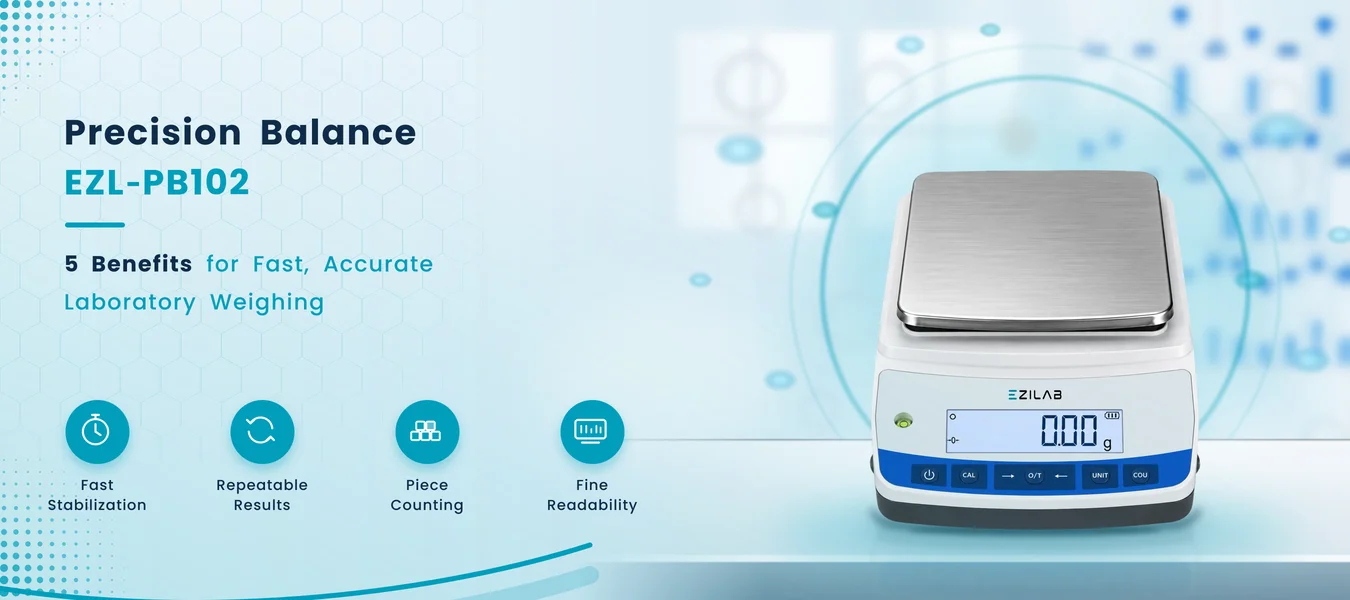
Routine weighing sits behind formulation, quality work and sample preparation, so small gains in speed and clarity add up across a shift. This guide looks at how Precision Balance EZL-PB102 from Ezilab supports that work, from the way it settles to the way it passes readings along.
What a Top Loading Balance Does at the Bench
A precision balance digital readout turns the placement of a beaker or container into a number a technician can record. Ezilab describes Precision Balance EZL-PB102 as a top loading balance for formulation and quality control work where milligram readout is not required. That framing shapes what follows, because the instrument is aimed at steady, quick, general purpose weighing rather than the finest readout possible. Teams that want a high precision lab scale for routine batches will find the five points below a useful way to judge the fit.
Quick Settling Keeps Routine Work Moving
Waiting for a number to stop moving is a small delay, yet it repeats many times during batching and reagent preparation. Precision Balance EZL-PB102 stabilizes in under one and a half seconds, so a technician can place a container, read the value and move to the next sample without a pause. That pace suits a high precision weighing scale role on busy benches, where throughput matters as much as the reading itself. Full specifications are listed on the Precision Balance EZL-PB102 product page.
Capacity and Readout That Match Formulation Work
The balance covers a range from zero up to one thousand grams with a readout of one hundredth of a gram. Repeatability and linearity are both listed at plus or minus two hundredths of a gram. Taken together, these figures describe a precision weighing scale for materials in the hundreds of grams, such as bulk reagents, raw materials and finished batch checks, where a milligram readout would add little.
A Wide Stainless Steel Pan for Real Containers
Beakers, containers and bulk materials rarely sit neatly on a small platform. The square stainless steel pan measures one hundred sixty-eight by one hundred sixty-five millimeters, which leaves room for common labware. A bubble level helps the operator set the balance up correctly, and an underhook allows below-balance weighing for density determination and suspended samples.
Data Output and Counting for Records and Inventory
A reading shown on the readout still has to be written down somewhere. The balance offers RS232 or USB output, which transfers readings to PCs or printers. A built-in piece counting function speeds up inventory and packaging checks, so one instrument can serve the laboratory bench and the stock room. In settings where a precision balance and machine work side by side, for example a counting task near a packaging area, this pairing keeps the record close to the weighing step.
Portable Power for Moving Between Benches
A built-in lithium battery and a flexible power supply allow the balance to run away from mains outlets. The body weighs about two point two kilograms, so it moves easily between workstations, and the listed working temperature runs from fifteen to thirty-five degrees Celsius. Teams that share one set of precision balancing equipment among a laboratory, a production area and a warehouse gain the most from that flexibility.
How the Weighing Principle Works
A precision balance diagram usually reads from left to right. The sample rests on the pan, a load cell beneath the pan registers the load, the reading settles, and the value passes to a PC or printer through the output port. The sketch below follows that path for this model.
Sample on pan
A container rests on the square stainless steel pan.
Load cell
The load cell beneath the pan registers the load.
Settled readout
The value stabilizes in under one and a half seconds.
RS232 or USB
Readings move on to a PC or printer.
Simplified path from pan to output
Where the Balance Fits in Practice
The same set of features serves several kinds of work, which is why laboratories, research centers and advanced labs often keep a unit like this close at hand.
- Pharmaceutical manufacturers use it for formulation weighing and quality control of raw materials and finished batches.
- Material testing labs weigh specimens and compounds.
- Research facilities prepare reagents and samples.
- Warehouses and production areas rely on it for inventory management and parts counting.
Common Selection Mistakes to Avoid
A few missteps appear again and again when a weighing instrument is chosen. The first is picking capacity without checking the lightest routine sample. Trading milligram readout for one thousand gram capacity works once that lightest sample weighs around one gram, since one hundredth of a gram is then one percent of the reading. Where lighter samples are routine, finer readout models such as the Precision Balance EZL-PB107 deserve a look, and where larger loads are common, the Precision Balance EZL-PB103 extends capacity to two thousand grams.
The second is overlooking the pan, since the container has to sit comfortably on it. The third is skipping the leveling step, which the bubble level exists to support. The fourth is ignoring output and power needs, such as whether readings must reach a PC or printer and whether the unit will move between work areas. The filters on the precision balance category page let readers narrow models by capacity, readability, repeatability and linearity before settling on one.
Exploring the Wider Precision Balance Range
Precision balances in the Ezilab range provide mid to high capacity weighing for routine sample preparation, batching, reagent formulation and industrial measurement. Models differ in capacity, in readability, with some reading to one hundredth of a gram and others to one thousandth, and in repeatability. Readers comparing options usually weigh those figures first, then check practical points such as pan size, output and power. Features across the range, including multiple weighing units, counting functions, tolerance checks and adjustable filtering, widen what each model can do.
The full lineup is available on the Ezilab Precision Balance range. For other laboratory equipment from the same maker, the Ezilab is a good place to start.