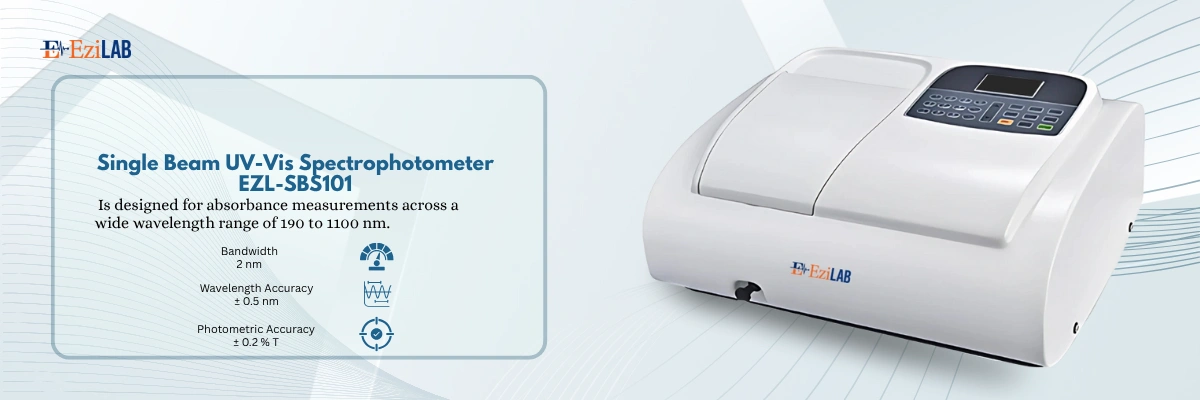
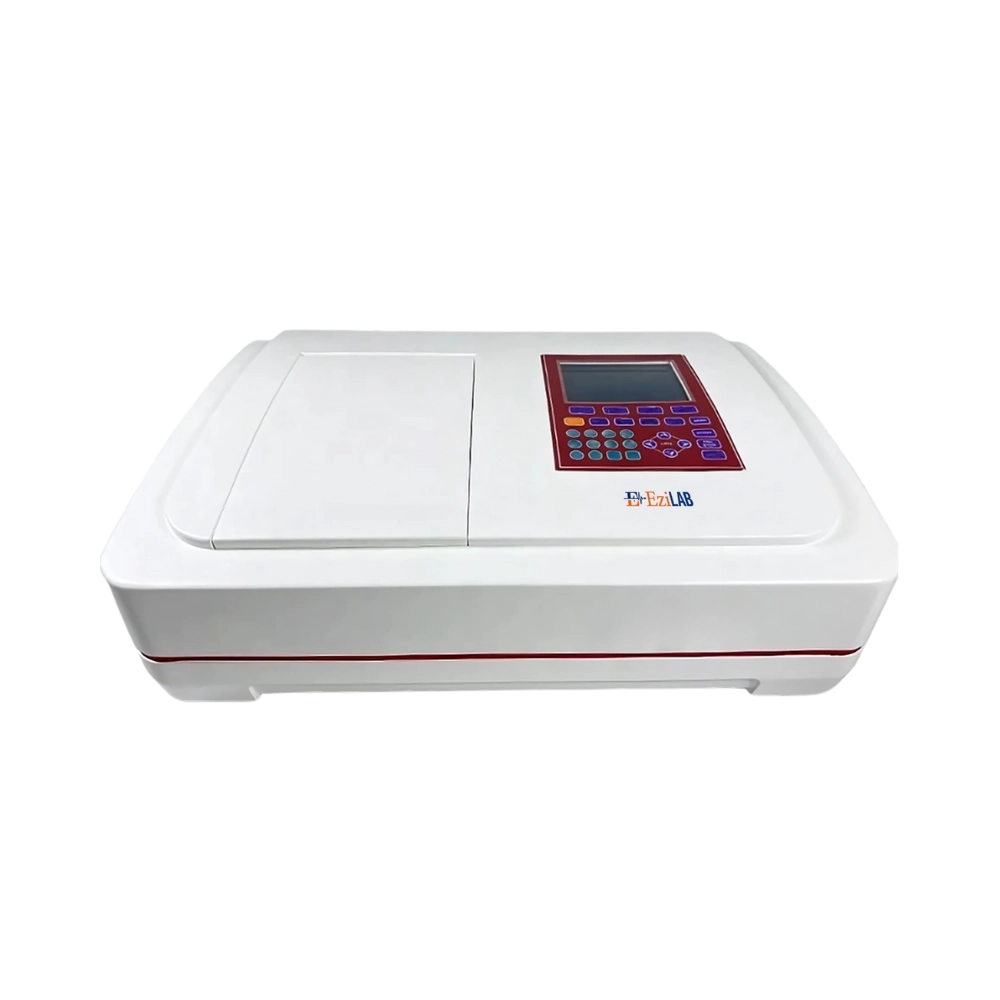
EziLab Single Beam UV-Vis Spectrophotometer EZL-SBS101 performs absorbance, transmittance, and concentration measurements across pharmaceutical analysis, environmental monitoring, food quality testing, and chemical laboratory applications. Wavelength range spans 190 to 1100 nm with 2 nm spectral bandwidth, 0.5 nm accuracy, and automatic wavelength setting for able lab spectrophotometer performance. Silicon photodiode detector and dual tungsten and deuterium lamp illumination ensures stable signal quality, while stability stays within 0.001 A per 30 minutes and stray light remains below 0.05% T. Photometric accuracy of 0.2% T and repeatability within 0.1% T deliver consistent results across extended analytical sessions. Getting equipped with EziLab's Lab Equipment and spectrophotometers connects your laboratory to the complete single beam lab spectrophotometer and UV-Vis analysis range.
| Wavelength Range | 190 to 1100nm |
|---|---|
| Spectral Bandwidth | 2 nm |
| Wavelength Accuracy | ± 0.5 nm |
| Wavelength Repeatability | Less than or equal to 0.2 nm |
| Wavelength Setting | Automatic |
| Photometric Accuracy | ± 0.2 % T |
| Photometric Repeatability | Less than or equal to 0.1 % T |
| Photometric Range | - 0.3 to 3 (Absorbance), 0 to 200% (Transmittance), 0 to 9999 (Concentration) |
| Stability | Less than or equal to 0.001 A / 30 min at 500 nm |
| Stray Light | Less than or equal to 0.05 % T at 220 nm & 360 nm |
| Output | USB port & Parallel Port |
| Display | 128 × 64 Dots LCD |
| Light Source | Tungsten and Deuterium Lamp |
| Detector | Silicon Photodiode |
| Power Requirements | AC 110 / 220 V, 50 / 60 Hz |
Spectrophotometer | 1 unit |
1 cm Glass Cuvette | 4 pieces |
1 cm Quartz Cuvette | 2 pieces |
Power Cord | 1 piece |
User’s Manual | 1 piece |
Black Block | 1 piece |
1 | Cell Holders |
2 | Control Units |
3 | Lamps |
4 | Glass Cuvette with Lid |
5 | Quartz Cuvette with Lid |
6 | Micro Cuvette |
7 | PC Software |
Single Beam UV-Vis Spectrophotometer EZL-SBS101 features a high-sensitivity photodiode detector, ensuring rapid and accurate detection of absorbance. It is widely used in pharmaceutical and environmental laboratories for compound analysis and pollutant detection.
The Single Beam UV-Vis Spectrophotometer EZL-SBS101 operates over a wide wavelength range of 190 to 1100 nm, covering both ultraviolet and visible light regions. This allows for versatile analysis of a broad spectrum of compounds, including nucleic acids, proteins, drugs, and chemicals. Its full-range capability ensures suitability for diverse applications across industries such as pharmaceuticals, environmental monitoring, life sciences, and research laboratories. With this broad range, users can perform accurate and reliable analysis on both organic and inorganic substances, supporting both routine tasks and advanced scientific research.
Ezilab’s Single Beam UV-Vis Spectrophotometer EZL-SBS101 is equipped with both tungsten and deuterium lamps, providing continuous and stable light sources across the UV and visible regions. The deuterium lamp covers the UV range (190 to 400 nm), while the tungsten lamp covers the visible range (400 to 1100 nm). This dual-lamp system ensures consistent spectral intensity across the full wavelength range, enabling precise measurements of samples requiring different light spectrums. Automatic switching between lamps enhances convenience and measurement efficiency, and minimizes user intervention while ensuring optimal illumination during each measurement cycle.
Our Single Beam UV-Vis Spectrophotometer EZL-SBS101 supports multiple measurement modes, including quantitative analysis, spectrum scanning, kinetics, and DNA/protein analysis. These modes allow users to perform a wide variety of tests, such as concentration determination, absorbance trend monitoring, and spectral profile analysis. The versatility of modes makes the device suitable for both basic routine testing and complex research applications, helping labs conduct a range of experiments with a single, efficient instrument. These functions improve data reliability, reduce manual calculations, and allow for in-depth study of sample behavior over time.
Ezilab’s Single Beam UV-Vis Spectrophotometer EZL-SBS101 ensures high measurement precision with ± 0.5 nm wavelength accuracy and ± 0.2 % T photometric accuracy. It also features a 2 nm bandwidth and automatic wavelength setting, which eliminates manual errors and delivers consistent results. The instrument’s stable optical system and high-quality light sources maintain uniform performance over time. This level of accuracy and repeatability is essential for reliable results in scientific, industrial, and educational settings, especially when working with critical or trace-level samples. Regular calibration protocols and built-in diagnostics further enhance the confidence in repeated analyses.
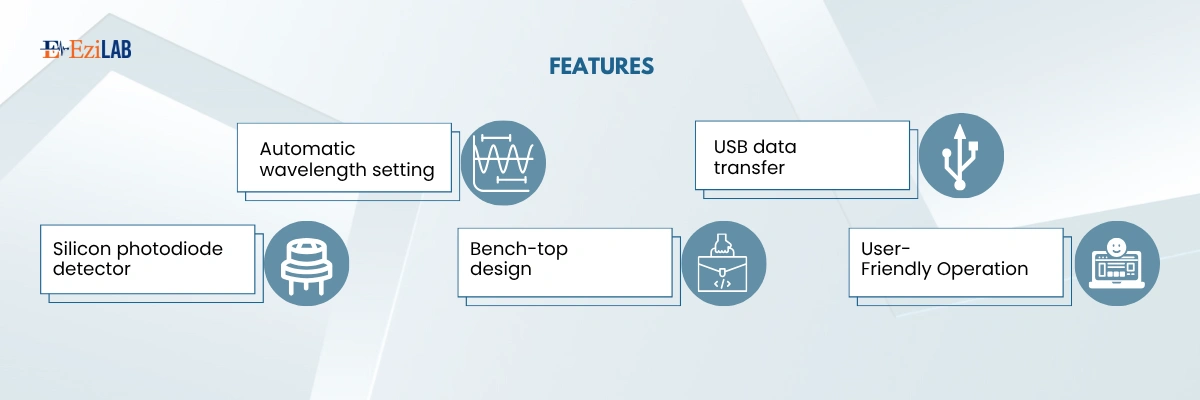
The Single Beam UV-Vis Spectrophotometer EZL-SBS101 is designed to be highly user-friendly, featuring an intuitive large LCD, automatic wavelength control, and simple navigation keys. It requires minimal training to operate and allows for quick setup and analysis. The compact bench-top design saves space, and the USB port makes data export convenient. These features, combined with robust performance, make the device ideal for both experienced analysts and newcomers performing routine spectrophotometric measurements in laboratory environments. In addition, the simplified interface reduces operator fatigue and promotes efficient workflow for high-throughput sample testing.
Our Single Beam UV-Vis Spectrophotometer EZL-SBS101 is equipped with a high-sensitivity silicon photodiode detector, which is known for its fast response time and stability. This detector efficiently converts light into electrical signals, ensuring precise absorbance and transmittance readings across the UV and visible spectrum. Its consistent performance is crucial for detecting even low-concentration samples accurately. Combined with the stable light source and optical design, the detector contributes significantly to the instrument’s reliability in quantitative and qualitative analysis across diverse laboratory applications. The detector’s low noise level also supports improved signal clarity for sensitive assays.