

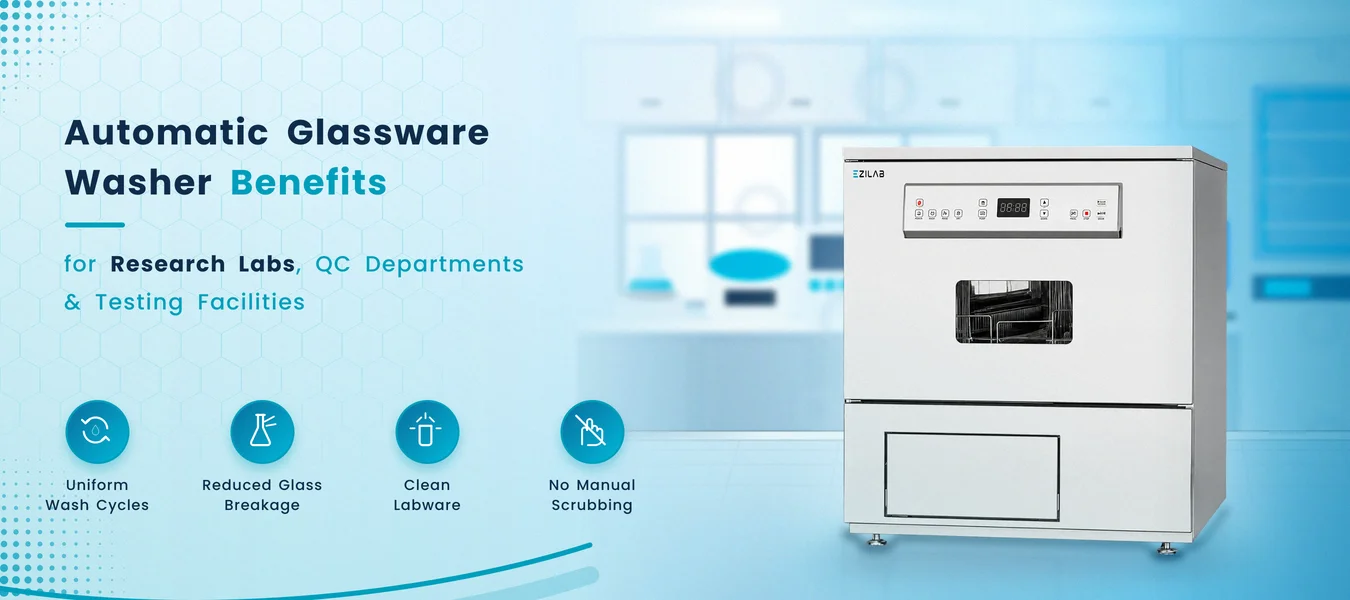
A practical guide for laboratories, hospitals and research centers on how a laboratory glassware washer brings repeatable cleaning to the daily glass workload.
Why Manual Scrubbing Struggles in Busy Labs
Clean glass is the quiet starting point of nearly all analytical work. A flask that still carries a detergent film, or a pipette holding a trace of the previous sample, can shift a result long before an instrument takes a reading. In many laboratories that cleaning is still done by hand, so the outcome depends on who is at the sink, how much time they have and how firmly they handle each piece.
An Automatic Glassware Washer EZL-GW211 from Ezilab is built around a closed, programmed cycle that cleans, rinses and dries lab glass in one run. Often described as a lab glassware dishwasher, this class of equipment sends each load down the same path regardless of who starts it, which is what makes wash results comparable from one day to the next.
Hand scrubbing also exposes narrow-necked and thin-walled pieces to knocks against the sink, the brush and neighboring items. Holding glassware in racks while water circulates around it takes the brush and the sink out of the process, and that is where many accidental chips and breaks begin.
Inside a Closed Wash Cycle
Once the racks are loaded and the door is shut, a circulation pump moves water through spray arms and injector racks at a flow of three hundred twenty liters per minute. The water runs at temperatures between fifty and ninety-three degrees Celsius, depending on the program chosen. Two peristaltic pumps add detergent and neutralizer in measured amounts rather than by hand, which removes another source of variation between loads.
LoadRacks and injector fittings
Wash and doseCirculating water, measured chemistry
RinseResidue carried away
Purity checkConductivity module
DryHot air with condensing unit
Simplified stages of one closed cycle inside the chamber.
Drying takes place in the same chamber. A condensing unit removes moisture during the hot-air stage, so glassware leaves the automatic glass washer machine ready to handle instead of dripping on a bench rack. An ICA conductivity module checks rinse purity before the cycle ends, which gives the operator a measured signal in place of a visual guess.
Where Automated Washing Earns Its Place
How a lab glassware washer is used depends on what passes through the chamber. The product page lists volumetric flasks, pipettes, injection vials, petri dishes, beakers, test tubes and HPLC vials as typical loads, all items where residue-free surfaces matter. Automatic glassware washer use therefore spreads across research, quality control, hospital and testing work.
Research and university labs
Chemistry departments and research groups wash varied glass in repeating cycles. Stored custom programs let a group reuse a cycle it has already settled on.
Pharmaceutical and QC work
Plants and contract research organizations need cleaning that can be documented for audits. The serial printing port prints or logs each run, so a wash record exists for each load.
Hospital laboratories
Hospital laboratories turn glass around between uses, and a closed cycle spares staff from slow scrubbing at the sink so their time goes to testing.
Food, beverage and cosmetics testing
Residues in these fields vary widely. Dosed detergent and a rinse purity check help limit carryover from one batch of glass to the next.
Reading the Feature List Closely
Several details on the specification sheet shape daily handling more than the headline numbers do. Each of the points below is covered in full on the Automatic Glassware Washer EZL-GW211 product page.
Program library
Thirty-five preset programs come ready to use, and up to one hundred user-defined cycles can be stored for specialized loads.
Chemical-resistant chamber
A stainless steel inner chamber and stainless shell stand up to both alkaline and acidic cleaners.
Printable records
The serial printing interface sends run data to a printer or a log, which supports good record keeping.
Low water, energy-saving
Low water consumption and energy-saving operation keep the running footprint modest.
Quiet running
Noise-free performance means the unit can sit near working areas without adding to the background din.
Compact and easy to operate
A space-saving body and a user-friendly interface suit laboratories where floor area and training time are limited.
Taken together, these details describe an automatic glassware washer system meant to fit into an existing workflow rather than reshape it.
Manual Scrubbing Versus Automated Washing
The table below sets the two approaches against the same handling points.
| Factor | Manual scrubbing | Automated washing |
|---|---|---|
| Cycle repeatability | Varies with operator and time pressure | Same programmed cycle for each load |
| Glass handling | Brush and sink contact | Racks and injector fittings hold glass in place |
| Detergent use | Measured by eye | Dosed by two peristaltic pumps |
| Rinse check | Visual inspection | Conductivity module checks rinse purity |
| Drying | Usually a separate step | Hot air with a condensing unit in the same chamber |
| Records | Handwritten notes, if kept | Printed or logged through the serial printing port |
| Operator time | Tied to the sink | Load, select a program and move on |
Selection Mistakes Worth Avoiding
Sizing for the average load
Match chamber volume to the largest regular load, not the typical one. Ezilab lists options of one hundred twenty-six liters and one hundred seventy liters, so lining up chamber volume and pump flow across the Ezilab automatic glassware washer range before shortlisting saves rework later.
Ignoring glass shape
Narrow pipettes and flasks rely on injector racks as well as spray arms. Confirm how the intended loads will sit in the racks before the choice is made.
Illustration placeholder: glassware seated on racks, with narrow-neck items placed on injector fittings.
Leaving utilities until late
A lab washer that looks right on paper can still stall at installation. Ask for the connection list, drain size and hose lengths before the install visit is booked.
Overlooking records and rinse checks
Laboratories that face audits need evidence of cleaning. Look at the data port and rinse monitoring together, not as afterthoughts.
Choosing on one headline feature
A large chamber means little if the program library, drying stage or chemical resistance does not suit the cleaners the laboratory actually uses.
The Wider Family of Glassware Washers
The EZL-GW211 belongs to the automatic glassware washer category at Ezilab, which covers machines that wash, rinse and dry laboratory glass through programmable cycles. Models in the category share a stainless chamber and the same program capacity, and they differ mainly in chamber volume and pump flow. The EZL-GW212 matches the one hundred twenty-six liter chamber, while the EZL-GW213 steps up to one hundred seventy liters with a pump flow of five hundred liters per minute.
When laboratories evaluate automatic glassware washer manufacturers, they usually line up the same four points: chamber volume, pump flow rate, chamber material and program count. Those are also the filters on the category page, and the full range can be explored through the automatic glassware washer category page. Equipment beyond washers, from balances to sterilizers, is reachable from the Ezilab .
See the Full Technical Table
The product page sets out chamber, pump, heating and power details for the model discussed here, along with its feature list and downloads.
Explore Automatic Glassware Washer EZL-GW211