

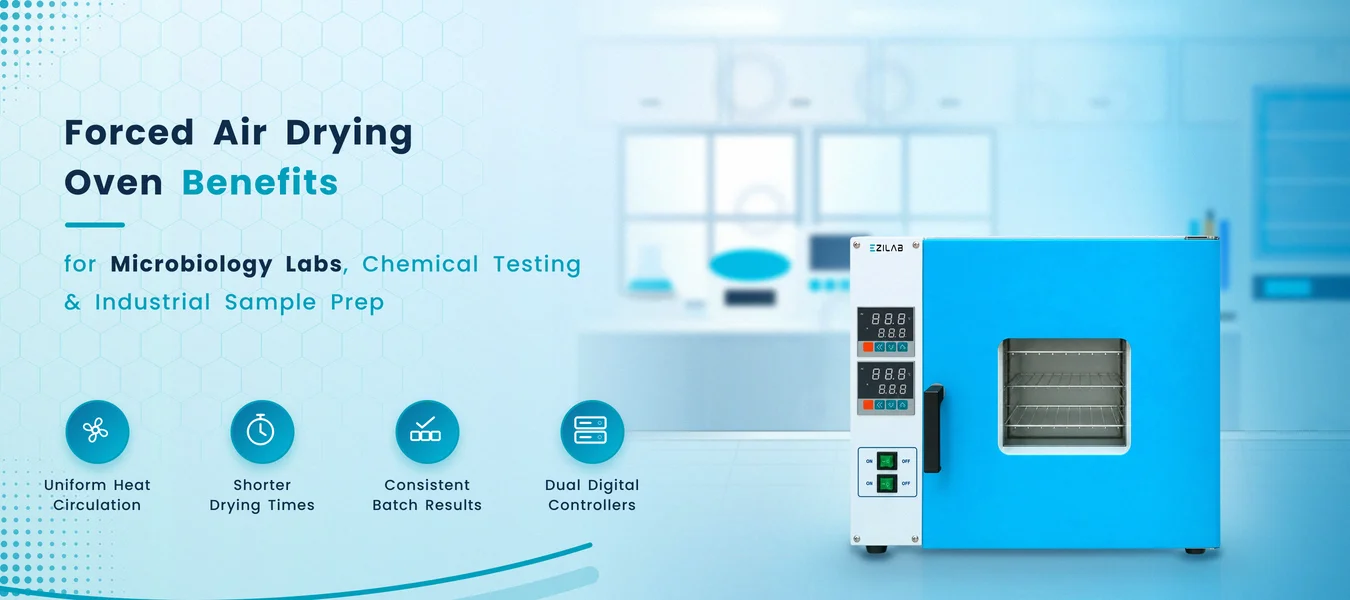
What circulating hot air changes in daily lab work, from dry-heat glassware prep to constant-weight testing, and how to choose and run a compact unit well.
Where Drying Errors Start
Many lab results depend on a step that gets little attention: getting something properly dry. Residual water in a crucible changes a gravimetric result. Damp glassware dilutes the next reagent. A filter that has not reached constant weight throws off a solids test. When a drying oven heats unevenly, these errors vary by shelf and by batch, which makes them hard to spot.
The Ezilab Forced Air Drying Oven EZL-FDO100 is a compact, 50-litre forced air lab oven built to reduce that variation. It runs from 80 °C to 250 °C with ±1 °C fluctuation, displays temperature in 0.1 °C steps and uses a low-noise circulation system to keep heat even across the chamber.
Inside Forced Air Convection Ovens
Forced air convection ovens move heat with a fan instead of relying on hot air to rise on its own. Air passes over the heating elements, travels through a duct and is pushed across the working space before returning to the heaters. This closed loop has two effects: it flattens temperature differences between shelves, and it sweeps moist air away from sample surfaces so water evaporates faster.
Forced air drying ovens diagram: the circulation loop
The controller watches chamber temperature through a sensor and adjusts heater output to hold the setpoint, while over-temperature protection cuts power if the chamber runs past its limit. A double glass window lets staff watch samples while the door stays shut and heat stays in.
What Circulating Heat Changes in Practice
Uniform Heat Circulation
Fan-driven air reduces the hot top and cool bottom typical of gravity units, so shelf position matters less.
Shorter Drying Times
Constant airflow removes humid air around samples, so constant weight is reached sooner.
Batch-to-Batch Consistency
±1 °C fluctuation and a timer from 0 to 9999 minutes keep repeat runs comparable.
Quiet Operation
A low-noise airflow system suits shared labs and benches near work areas.
Visual Checks
The double glass window shows samples without breaking chamber temperature.
Flexible Power
Available for 110 V 60 Hz or 220 V 50 Hz supplies, drawing 850 W.
EZL-FDO100 Technical Specifications
| Parameter | Value |
|---|---|
| Capacity | 50 L |
| Temperature range | 80 °C to 250 °C |
| Display step | 0.1 °C |
| Temperature fluctuation | ±1 °C |
| Working size | 415 × 375 × 345 mm |
| Timer | 0 – 9999 min |
| Voltage | 110 V 60 Hz / 220 V 50 Hz |
| Power consumption | 850 W |
| External dimensions | 690 × 610 × 530 mm |
| Net / gross weight | 45 kg / 58 kg |
| Key features | Double glass window, digital display, low-noise airflow, over-temperature protection |
Forced Air Drying Oven Uses by Lab Type
Microbiology Labs
Drying washed glassware and running dry-heat sterilization of heat-tolerant items such as glass pipettes and metal tools.
Chemical Testing
Drying crucibles, filters and reagents to constant weight for gravimetric and moisture analysis.
Industrial Sample Prep
Pre-drying raw material, powder and soil samples before grinding, sieving or analysis.
Electronics and Materials
Baking out circuit components, curing coatings and heat-treating small specimens.
A drying oven in laboratory work is often shared between these tasks, so chamber size and range matter. For larger loads or work below 80 °C, the Ezilab range of forced air drying ovens also includes a 72-litre model.
Compact Lab Unit vs Larger Lab Unit vs Industrial Drying Oven
| Factor | Compact (EZL-FDO100) | Larger lab unit (EZL-FDO101) | Industrial drying oven |
|---|---|---|---|
| Chamber volume | 50 L | 72 L | Hundreds of liters and up |
| Temperature range | 80 – 250 °C | RT +5 – 300 °C | Varies by process |
| Footprint | Benchtop | Benchtop or floor | Dedicated floor space |
| Control focus | Tight setpoint for small batches | Programmable multi-segment runs | Throughput over precision |
| Typical user | QC, microbiology, teaching and testing labs | Labs needing low-temperature drying or curing profiles | Production lines |
If your methods include drying below 80 °C or curing above 250 °C, the EZL-FDO101 forced air drying oven covers that wider span.
Common Selection Mistakes
Overlooking the lower limit. A unit starting at 80 °C will not suit gentle drying of heat-sensitive samples.
Treating drying and sterilizing as the same job. Dry-heat sterilization needs validated time and temperature, not just a hot chamber.
Placing volatile solvents inside. A general-purpose air drying oven is not built for flammable vapors.
Choosing by external size only. Check the working size against your largest tray or rack.
Forgetting the power supply. Order the 110 V or 220 V version that matches your outlets.
Ignoring noise and placement. Shared benches benefit from a quieter fan and clearance for ventilation.
Operating Tips for Even, Repeatable Drying
- Let the oven stabilize at setpoint before loading to shorten recovery time.
- Spread samples in a single layer and keep them clear of the chamber walls.
- Dry to constant weight: reweigh after cooling and repeat until readings agree.
- Cool dried samples in a desiccator so they do not pick up moisture before weighing.
- Use the timer for long runs so samples are not overheated.
- Check chamber temperature with a reference thermometer at regular intervals.
- Keep the door closed during cycles and use the window to monitor progress.
Exploring the Forced Air Drying Ovens System Range
This category covers benchtop forced-convection ovens sized for routine lab work. When evaluating a forced air drying oven laboratory setup, buyers usually compare chamber volume, lowest and highest working temperature, fluctuation, timer length, programming options, power supply and safety protection.
You can compare both models side by side in the Ezilab forced air drying oven catalog, or browse more lab instruments from the Ezilab homepage.
| Model | Capacity | Temperature range | Power |
|---|---|---|---|
| EZL-FDO100 | 50 L | 80 – 250 °C | 850 W |
| EZL-FDO101 | 72 L | RT +5 – 300 °C | 1400 W |
Bring Consistency to Daily Drying
Review the full specifications, power options and dimensions of the EZL-FDO100 before planning your bench layout.
Explore EZL-FDO100Amelia Brooks
Blog Content Writer at Ezilab Scientific
Amelia Brooks is a blog content writer at Ezilab Scientific, specializing in laboratory equipment, scientific instrumentation, and technical content development. She focuses on translating complex product specifications and scientific concepts into clear, informative, and engaging articles. Her writing highlights equipment features, practical applications, and industry developments to help readers understand laboratory technologies and make informed decisions based on their technical requirements.