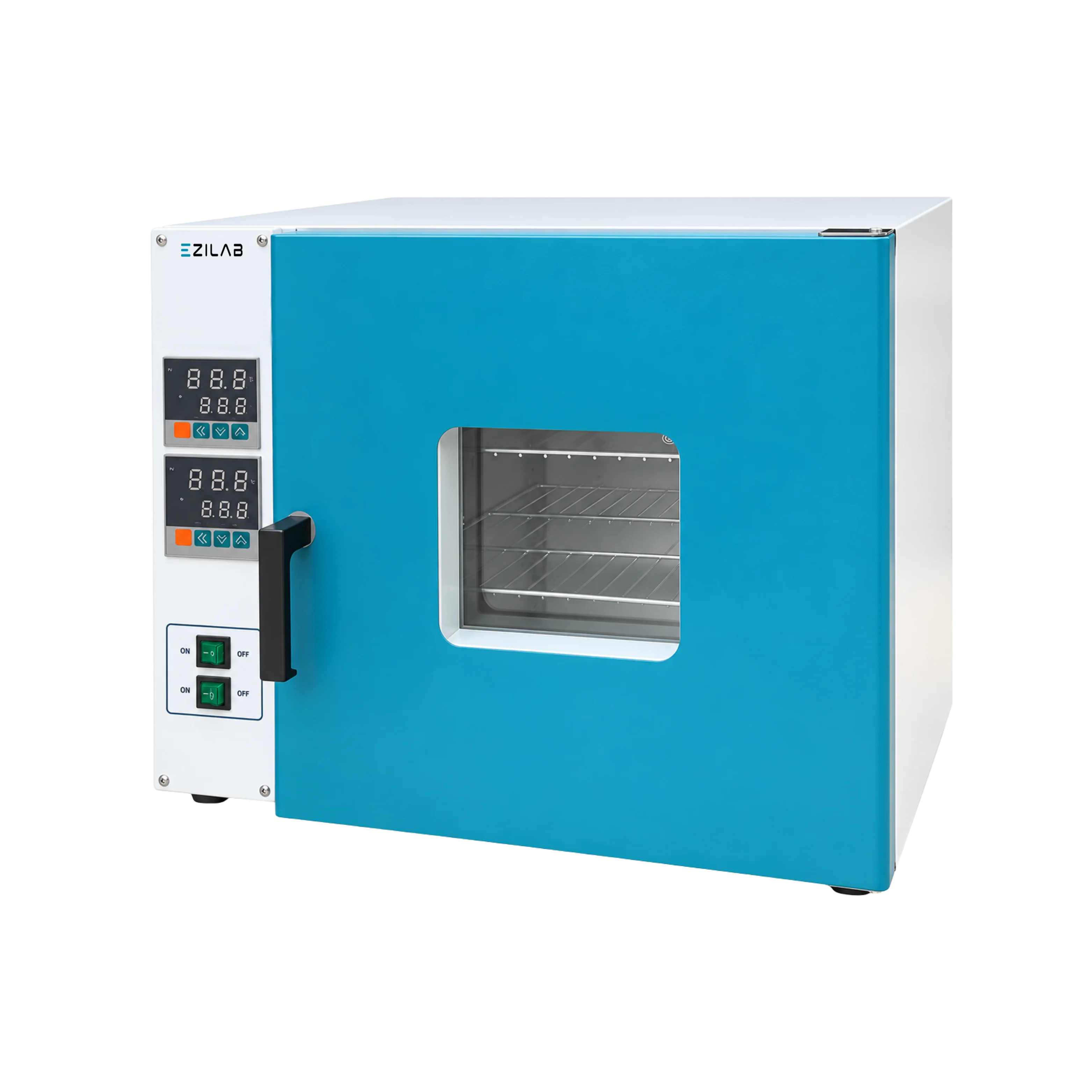
EziLab offers the Forced Air Drying Oven EZL-FDO100, a 50 L lab convection oven that circulates heated air to remove cold spots during drying, curing, and heat treatment. Choose forced air over gravity convection ovens when loads are dense or stacked, since moving air reaches all shelf positions and dries samples faster and more evenly. Temperature sets from 80 to 250°C with 0.1°C display steps and ±1°C fluctuation, covering glassware drying, moisture removal, and polymer curing in one unit. The 415 × 375 × 345 mm chamber suits smaller batches, and a 0 to 9999 minute timer runs unattended cycles that end on schedule. A low-noise airflow system keeps the lab quiet, while a double glass window lets staff check samples without opening the door and losing heat. Over-temperature protection cuts heating if temperature overshoots, protecting samples and the chamber. The 690 × 610 × 530 mm benchtop body draws 850 W. Pharmaceutical labs dry glassware, excipients, and samples for moisture tests, electronics plants cure coatings and bake circuit components, materials research labs heat-treat specimens, and general laboratories dry reagents, filters, and labware. Recipes that call for more than 250°C need a higher-rated oven, so check your hottest cure or bake step, then compare ranges on the Lab Equipment and Laboratory Oven pages.
| Capacity | 50L |
|---|---|
| Temperature Range | 80 to 250˚C |
| Temperature Resolution | 0.1˚C |
| Temperature Fluctuation | ± 1˚C |
| Working Size | 415 × 375 × 345mm |
| Timer | 0 to 9999 minutes |
| Voltage | 110 V 60 Hz / 220V 50 Hz |
| Power Consumption | 850W |
| Dimension | 690 × 610 × 530mm |
| Packaging Dimension | 790 × 660 × 620mm |
| Net Weight | 45 Kg |
| Gross Weight | 58 Kg |
| Feature Area | Description |
| Window | Double glass window. |
| Display | Clear digital display. |
| Airflow | Low-noise airflow system. |
| Protection | Over-temperature protection. |
| Circulation | Forced air circulation through the chamber. |