

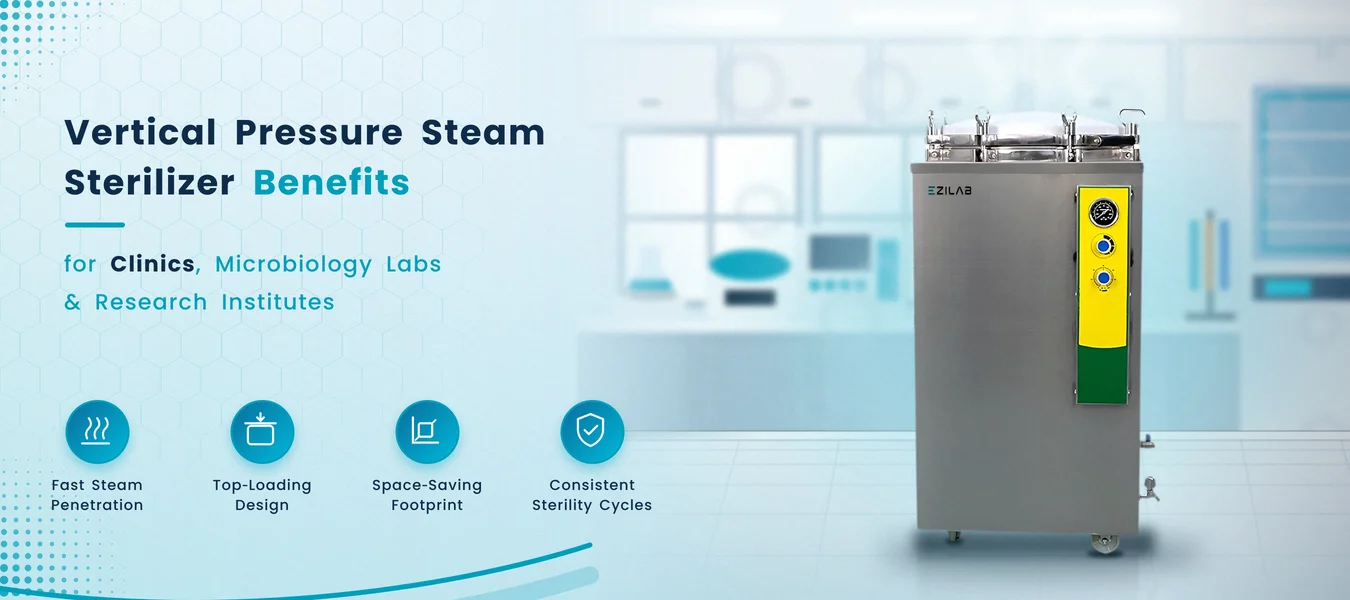
An educational look at how top-loading steam chambers fit into clinical, microbiological and research workflows.
Why Laboratories Keep Choosing Top-Loading Chambers
Reusable glassware, culture media, rubber items and surgical instruments all need a controlled heat treatment before they return to the bench or the procedure room. A vertical autoclave answers that need with a chamber that opens from the top, so loads are lowered in by basket and lifted out again without a door swinging into the work area.
The Vertical Pressure Steam Sterilizer EZL-VS98 from Ezilab follows this layout. It pairs a one hundred liter stainless steel chamber with a heater, a timer and a double-scale gauge, which makes it a useful reference point for readers who want to understand what a vertical sterilizer actually does during a working day.
How Steam Does the Work Inside the Chamber
Steam sterilization works because moist heat reaches surfaces quickly and carries energy into wrapped packs, porous fabric and hollow instruments. Water at the base of the chamber is heated until it turns to steam, and the closed chamber lets pressure rise to the working level.
Once the set temperature is reached, a timer holds it for the chosen period, and steam is then discharged so the load can be removed. People who search for a sterilizer vertical in layout are usually looking for exactly this simple, repeatable sequence in a compact body.
Reading a Vertical Pressure Steam Sterilizer Diagram, Step by Step
A clear diagram makes it easier to see where each control and safeguard belongs. In vertical pressure steam sterilizer equipment, the parts below sit in the same order from the lid down to the heater.
Diagram: side view, parts lettered A to F
- ATop lid — Opens upward for basket loading.
- BGauge and timer — Double-scale gauge with a timer.
- CBaskets — Two stainless steel baskets.
- DSteam outlet — Automatic steam discharge.
- EWater sensor — Water level shutoff.
- FHeater base — Water is heated to make steam.
Penetration, Footprint and Repeatability
Even Heat in the Chamber
Temperature variation inside the chamber stays within about one degree Celsius, so heat reaches the load evenly.
Fast Steam Penetration
Steam fills the chamber around porous fabric, wrapped packs and complex items, shortening the path heat has to travel.
Space-Saving Top-Loading Design
Loading from above keeps the footprint close to the body size, roughly three fifths of a meter on each side.
Consistent Sterility Cycles
A timer that can be set for up to an hour and a readable gauge help each run follow the same profile.
Two Stainless Steel Baskets
Instruments, flasks and media bottles can be grouped by type before they go into the chamber.
Self-Inflating Seal
The chamber closes tightly without manual locking, which keeps the loading routine simple.
EZL-VS98 Technical Details
| Parameter | Value |
|---|---|
| Capacity | One hundred liters |
| Working pressure | Point two two megapascal |
| Maximum working pressure | Point two three megapascal |
| Working temperature | One hundred five to one hundred thirty-four degrees Celsius |
| Timer | Up to one hour |
| Heat uniformity | Within about one degree Celsius |
| Chamber material | Stainless steel |
| Included baskets | Two stainless steel baskets |
| Key features | Automatic steam discharge, double-scale pressure gauge, over-temperature protection, water level shutoff |
The full list is available on the Vertical Pressure Steam Sterilizer EZL-VS98 product page.
Where It Fits: Clinics, Microbiology Labs and Research Institutes
Hospitals
Surgical instruments processed between procedures.
Central Sterile Supply
Repeated mixed-load cycles across long working periods.
Microbiology Labs
Glassware and culture media prepared for new work.
Research Institutes
Liquid loads that need controlled steam treatment.
Clinics
Rubber items and fabric alongside small instrument sets.
Veterinary Facilities
Instruments used in animal care.
The same layout also appears in vertical pressure steam sterilizer industrial laboratory settings, where teams prepare media and reusable tools in volume. Comparing sibling models on the vertical pressure steam sterilizer category page shows how chamber volume changes the fit.
Running a Sterilization Cycle Step by Step
Built-In Safeguards Worth Understanding
- Over-temperature protection stops the cycle when the chamber exceeds its set limit.
- Water level shutoff halts heating and sounds an alarm when water runs low.
- Automatic steam discharge releases steam at the end of the cycle, and a safety valve relieves excess pressure.
- A buzzer signals completion so the chamber is not left unattended.
- Overcurrent protection is part of the electrical setup.
Comparing Sterilizer Formats Side by Side
| Format | How Loads Enter | Typical Fit |
|---|---|---|
| Vertical | Lowered in by basket from the top | Mixed loads where floor space is limited |
| Horizontal | Through a front door, often on racks or trolleys | Larger chamber volumes and heavier throughput |
| Table top | Front opening on a bench-sized chamber | Small instrument sets near the point of use |
| Portable | Compact unit moved to where it is needed | Light, low-volume sterilization tasks |
Common Selection Mistakes
Choosing by chamber volume alone. Volume only helps if the load can be arranged so steam reaches each item.
Overlooking timer range and gauge readability. Repeatable cycles depend on controls that are easy to set and read.
Ignoring water habits. Distilled water reduces scale, which protects internal components over time.
Treating maintenance as optional. Seal, safety valve and sensor checks keep safeguards working as intended.
Overpacking the baskets. Crowded loads slow steam movement between items.
Overlooking placement. Leave room around the lid so loading and unloading stay safe.
Care Habits That Keep Cycles Consistent
- Check and refill the water reservoir before each session to prevent low-level stops.
- Clean the chamber and baskets after use so residue does not build up.
- Inspect the self-inflating seal periodically to keep the chamber airtight.
- Verify the safety valve and sensors, and ask a trained technician to review electrical parts.
- Use distilled water where possible to limit scale formation.
Exploring the Wider Family of Vertical Autoclaves
This model belongs to a category of top-loading steam sterilizers that share a working pressure of point two two megapascal and a top temperature of one hundred thirty-four degrees Celsius. Within the category, chamber volumes step from thirty-five liters through fifty and seventy-five up to one hundred liters.
Readers comparing options here usually look at chamber volume, working temperature range, timer span, gauge style and the safety features listed on each page. The full range is easy to browse on the Ezilab vertical pressure steam sterilizer range, and wider laboratory categories, from analyzers to sterilizers, sit on the Ezilab.
Continue to the Product Details
See the full specification list, features and applications for this model.
Explore Vertical Pressure Steam Sterilizer EZL-VS98Amelia Brooks
Blog Content Writer at Ezilab Scientific
Amelia Brooks is a blog content writer at Ezilab Scientific, specializing in laboratory equipment, scientific instrumentation, and technical content development. She focuses on translating complex product specifications and scientific concepts into clear, informative, and engaging articles. Her writing highlights equipment features, practical applications, and industry developments to help readers understand laboratory technologies and make informed decisions based on their technical requirements.