

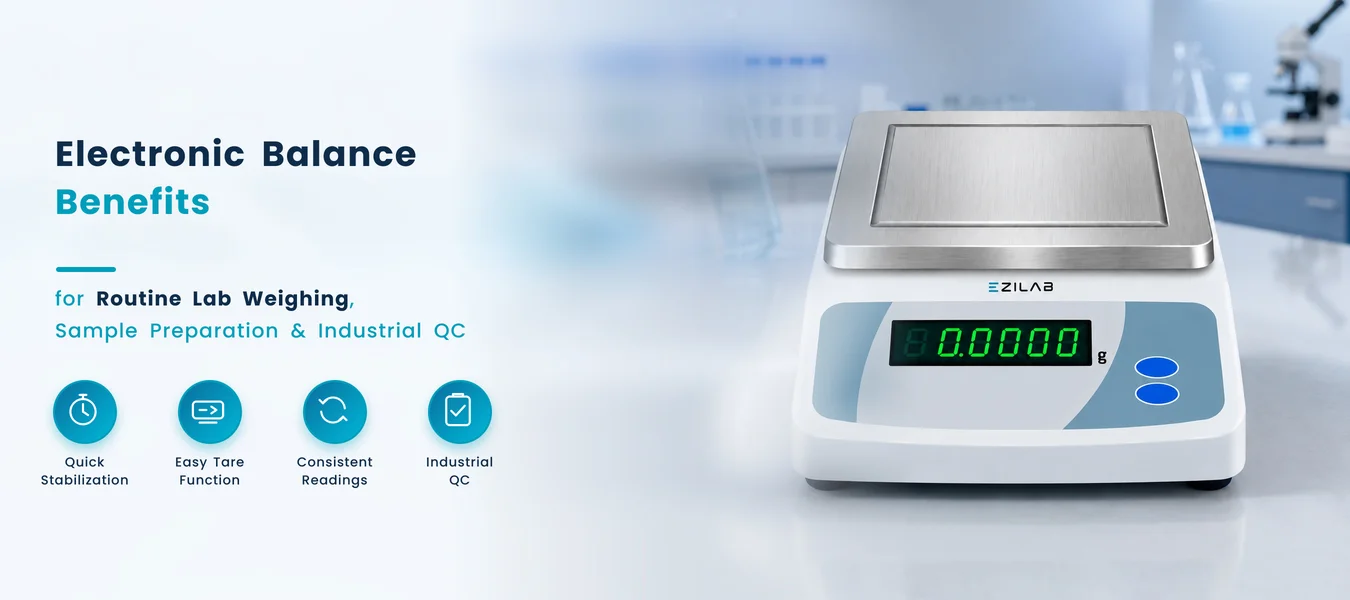
A professional overview of how load sensing, tare and piece counting support routine weighing in laboratories and production areas.
Why Routine Weighing Deserves Careful Equipment
Weighing is the quiet first step behind most laboratory and production work. A reagent mixed slightly off, a batch component added a little heavy or a count of small parts that drifts by a few pieces can carry through to the final result. A digital balance lowers that risk by turning the load on the pan into a clear number, quickly and in the same way each time.
The Electronic Balance EZL-EB87 from Ezilab is a compact model with a capacity of five thousand one hundred grams and a readability of one tenth of a gram. Readings settle within two seconds, a fast-response tare removes container weight, and a piece counting mode handles screws, tablets and packaged parts, which makes it a practical example for readers learning how a lab balance or lab scale fits into routine work.
The Electronic Balance Principle: From Load to Number
An electronic balance measures weight by converting force into an electrical signal. When a sample is placed on the pan, its weight presses on a load cell, a sensing element that produces a small electrical change in proportion to the load. Electronics amplify that signal, convert it into a digital value and send it to the display.
Because the signal is processed electronically, the balance can wait until the reading stops moving before it shows a final value. In routine electronic balance working, that short wait is the stabilization time, and it is the reason repeated weighings of the same item agree closely with each other.
Reading an Electronic Balance Diagram, Part by Part
A simple electronic balance diagram shows why the layout stays short. Weight enters at the pan, becomes a signal and leaves as a number on the display. The same flow appears in an electronic analytical balance diagram, only with finer readability.
Diagram: weighing path, parts lettered A to F
- AWeighing pan — A stainless steel pan receives the sample or its container.
- BLoad cell — Converts the force of the load into a small electrical signal.
- CSignal processing — Amplifies the signal, converts it into a digital value and waits for it to settle.
- DDisplay — Shows the settled weight in grams.
- ETare control — Subtracts the weight of a beaker or weigh boat so only the sample is read.
- FCounting and output — A piece counting mode and an optional printer connection carry results into records.
Electronic Balance Working, Step by Step
At the bench, an electronic balance machine follows a short routine that stays the same from the first weighing to the last.
Quick Stabilization, Easy Tare and Daily Repeatability
Quick Stabilization
Readings settle within about two seconds, which keeps repeated weighing moving.
Easy Tare Function
A fast-response tare subtracts beakers and weigh boats so only the sample is read.
Consistent Daily Measurements
Repeatability is listed at two tenths of a gram and linearity at three tenths of a gram across the range.
Piece Counting Mode
Counts screws, tablets and packaged parts, so the balance also works as a counting scale.
Printer Connectivity
A printer option carries results into batch records.
Stainless Steel Pan
A roomy stainless steel pan handles beakers, boats and small containers.
EZL-EB87 Technical Details
| Parameter | Value |
|---|---|
| Capacity | Zero to five thousand one hundred grams |
| Readability | One tenth of a gram |
| Repeatability | Plus or minus two tenths of a gram |
| Linearity | Plus or minus three tenths of a gram |
| Stabilization time | Two seconds or less |
| Pan | Stainless steel |
| Functions | Fast-response tare and piece counting |
| Optional features | Under-weighing function and printer connectivity |
| Net weight | Three kilograms |
| Included accessories | Adapter, weighing pan and carton |
The full list is available on the Electronic Balance EZL-EB87 product page.
What an Electronic Balance Is Used For Across Labs and Production
An electronic balance used for routine work tends to appear in the same few places. Each electronic balance application below comes from the uses listed for this model.
Pharmaceutical Formulation
Weighing excipients and bulk ingredients.
Food, Cosmetics and Chemical Production
Checking batch components before mixing.
Chemical Laboratories
Preparing reagents with tare-assisted weighing.
Industrial QC Laboratories
Incoming inspection and part counts.
Manufacturing Floors
Counting screws, tablets and packaged parts.
Quality Control Weighing
Printed results carried into batch records.
These examples of electronic balance use share a need for quick, repeatable readings, which is why electronic balance laboratory apparatus uses range from reagent preparation to incoming inspection. Readers who want to see how other models differ can browse the electronic balance category page.
Readability Classes Across the Range
| Readability | Capacity Range in the Category | Typical Weighing Task |
|---|---|---|
| One tenth of a milligram | About sixty to two hundred twenty grams | Fine samples and careful preparation |
| One milligram | One hundred to one thousand grams | Small formulation and sample work |
| Ten milligrams | Two to three kilograms | Medium batch components |
| One hundred milligrams | Two to thirty kilograms | Larger batches and bulk weighing |
| One tenth of a gram | Five thousand one hundred grams for this model | Routine weighing, counting and batch checks |
A finer readability class suits lighter samples, while a coarser class suits heavier loads, so the right choice follows the lightest and heaviest items weighed.
Common Selection Mistakes
Choosing capacity too close to the load. Leave headroom so routine loads sit well within the listed capacity.
Confusing readability with repeatability. Readability is the smallest displayed step, while repeatability describes how closely repeated readings agree.
Ignoring stabilization time. Slow settling adds up over long weighing sessions.
Overlooking counting needs. If parts are counted, confirm a counting mode is included.
Forgetting output needs. Check whether a printer connection is available for batch records.
Placing the balance poorly. Drafts, vibration and uneven benches disturb readings.
Habits That Keep Daily Readings Consistent
- Keep the pan clean and wipe away spills as soon as they happen.
- Tare with the empty container before adding each new sample.
- Place items gently at the center of the pan.
- Stay within the listed capacity to protect the balance.
- Log results, or print them, so batches can be traced later.
Exploring the Wider Family of Electronic Balances
This model belongs to a category of laboratory balances used for chemical preparation, pharmaceutical formulation, academic research and industrial quality control. The range steps from fine readability levels for small samples to coarser levels for heavier loads, and this electronic balance sits at the one tenth of a gram level.
When reviewing options for an electronic balance laboratory, readers usually compare capacity, readability, repeatability, pan size, stabilization time and available outputs. The full range is easy to browse on the Ezilab electronic balance range, and wider laboratory categories sit on the Ezilab.
Continue to the Product Details
See the full specification list, features and applications for this model.
Explore Electronic Balance EZL-EB87Amelia Brooks
Blog Content Writer at Ezilab Scientific
Amelia Brooks is a blog content writer at Ezilab Scientific, specializing in laboratory equipment, scientific instrumentation, and technical content development. She focuses on translating complex product specifications and scientific concepts into clear, informative, and engaging articles. Her writing highlights equipment features, practical applications, and industry developments to help readers understand laboratory technologies and make informed decisions based on their technical requirements.