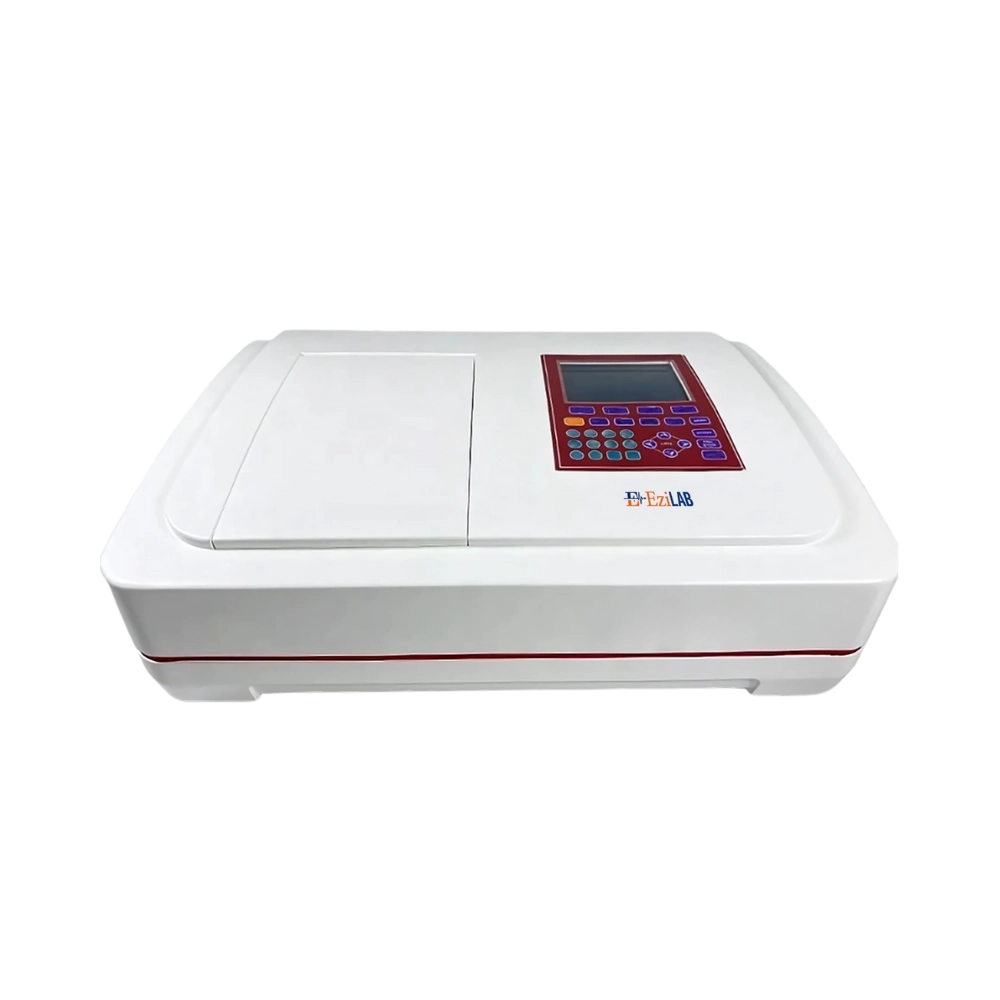
EziLab Micro Volume Spectrophotometer EZL-MS153 performs nucleic acid quantification using UVLED illumination across molecular biology, genomics, pharmaceutical, and life science laboratory applications. Wavelengths of 260 nm and 280 nm cover key nucleic acid and protein absorption points, while minimum sample size of 1 to 2 uL reduces consumption for UV vis spectrophotometer workflows. Absorbance range covers 0.02 to 80A with 0.005 Abs precision, and dsDNA detection spans 10 to 4000 ng/uL with sensitivity reaching 0.5 pg/uL. Repeatability stays below 1.5% with linear dynamic range R² above 0.995 for quantification. EziLab's Lab Equipment and spectrophotometers detail the complete UV vis spectrophotometer and UVLED micro volume analysis range.
| Wavelength Range | 260 nm, 280 nm |
|---|---|
| Minimum Sample Size | 1 - 2µl |
| Path Length | 0.5 mm |
| Absorbance Precision | 0.005Abs |
| Absorbance Accuracy | 1% (7.332Abs at 260nm) |
| Absorbance Range | 0.02 – 80A |
| Light Source | UVLED |
| Nucleic Detection Range | 10 – 4000ng/µl (dsDNA) |
| Sensitivity | dsDNA: 0.5pg/µl |
| Linear dynamic range | R²>0.995 |
| Repeatability | <1.5% |
| Detector Type | UV silicon photocell |
| Measurement Time | <8S |
| Data Output | USB |
| Operating Voltage | 24V DC |
| Operating Power | 25 W |
| Standby Power | 5 W |
| Packing Dimension (W×D×H) | 500×495×310 mm |
| Gross Weight | 9.2 Kg |
Micro-volume measuring
Large 7-inch touch screen display
Fast, easy and accurate micro-volume measurements
Long life xenon flash lamp
Turn on and instantly measure without lamp warm up time
Full scan capability within 6 seconds
Test chamber minimizes all stray light
Detects nucleic acids up to 4000ng/µl
Robust and sustainable
Micro-volume sample port
Low energy usage
0.5mm fixed path length
Easy to clean design – no sample cross-over
Data can be printed with a built in-printer and output via SD-RAM card
Automatic switch off function if system is idle for more than 5 mints
It is widely used for PCR analysis, DNA or RNA micro array, colorimetric protein methods in laboratories, pathology institutes and food industries etc.