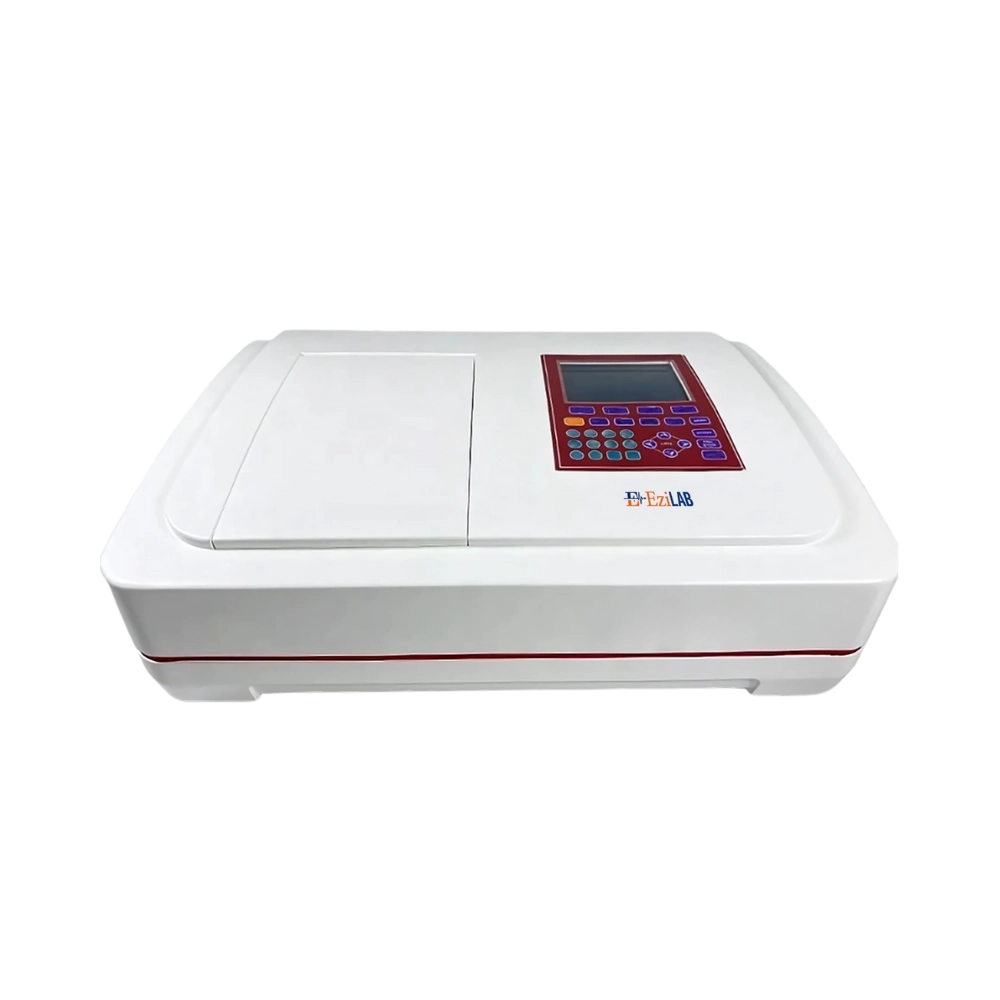
EziLab Flame Photometer EZL-FP100 measures potassium and sodium concentrations using dual-channel detection for clinical, agricultural, pharmaceutical, and environmental laboratory applications. Testing range covers K at 0.15 to 100 ppm and Na at 0.18 to 100 ppm with detection limits of 0.156 ppm for K and 0.184 ppm for Na. Response time of 8 seconds and sample uptake of 3 mL per minute support efficient clinical flame photometer workflows, while reproducibility remains within 2% for consistent analytical performance. Optional built-in thermal printer and USB connectivity simplify data output, and LPG fuel operation suits standard laboratory setups. EziLab's Lab Equipment and spectrophotometers cover the complete clinical flame photometer and dual-channel elemental analysis range.
| Testing Elements | K, Na |
|---|---|
| Channels | 2 |
| Test Range |
K:0.15 to 100 ppm Na: 0.18 to 100 ppm |
| LOD |
K: Less than or equal to 0.156 ppm Na: Less than or equal to 0.184ppm |
| Linearity Error |
K: less than or equal to 0.195 ppm Na: less than or equal to 0.69 ppm |
| Response Time | 8 s |
| Sample Uptake | 3ml/min |
| Stability | less than or equal to 3% drift within 15 s, less than equal to 15 % drift within 16 minutes |
| Reproducibility | less than or equal to 2% |
| Printer | Optional built in thermal printer |
| COM | USB |
| Fuel | LPG |
| Power | AC 220V/50Hz or AC 110V/60Hz |
| Package | 570 × 530 × 400 mm |
| Net Weight | 18Kg |
Automatic correlation calculation
Adjustable flame size
Gas leakage alarm
Standard curve storage
Safety protection system
LPG Reducing Valve | 1 piece |
Stainless steel bellows for LPG | 1 piece |
Silica gel tubing for waste liquid | 1 piece |
PU tubing for air | 1 piece |
Air Compressor | 1 piece |
1. | Built in thermal Printer |
2. | Software |
Flame Photometer EZL-FP 100 is suitable for laboratories focusing on elemental analysis. It is also used in environmental monitoring, clinical laboratories, pathology and routine analysis in research and development
The Flame Photometer EZL-FP100 is designed with a straightforward interface that simplifies routine testing. With direct concentration display and stable flame generation, users can quickly interpret results without complex calculations. The instrument’s compact design makes it convenient to install in laboratories with limited space. Our system requires minimal training, enabling both experienced staff and students to handle it efficiently. This ease of use is especially beneficial for teaching laboratories and high-throughput environments.
Ezilab’s Flame Photometer EZL-FP100 ensures high reproducibility, delivering reliable results across repeated measurements. Its precision is particularly important for clinical diagnostics, where accurate readings can guide treatment decisions. The instrument also supports calibration with standard solutions, enhancing reliability in different sample conditions. By maintaining stable flame performance, it minimizes errors caused by fluctuations. Laboratories can trust for dependable outcomes in both routine and advanced applications.
Our Flame Photometer EZL-FP100 requires only simple maintenance to remain reliable over time. Regular cleaning of the nebulizer and burner assembly prevents clogs and ensures steady performance. Routine checks on gas connections and flame stability help maintain safe operation. Our recommendation is to keep the instrument in a dust-free, ventilated area to prolong its lifespan. With these easy practices, laboratories can achieve consistent results and reduce downtime.
The Flame Photometer EZL-FP100 supports smooth data recording and transfer, making it practical for modern laboratory workflows. With options for connectivity and report printing, it helps maintain accurate documentation of results. This feature is useful in clinical and industrial settings where regulatory compliance is essential. By simplifying data management, laboratories can save time while ensuring traceability. It thus enhances efficiency along with analytical accuracy.
Our Flame Photometer EZL-FP100 is designed to handle a wide variety of liquid samples, making it suitable for multiple laboratory environments. In clinical laboratories, it is widely used for analysing biological fluids such as serum and urine to monitor essential electrolytes like sodium and potassium, which are critical for patient health. In the agricultural sector, the instrument plays a key role in assessing soil extracts and plant digests, helping to evaluate nutrient availability and guide better crop management practices.