

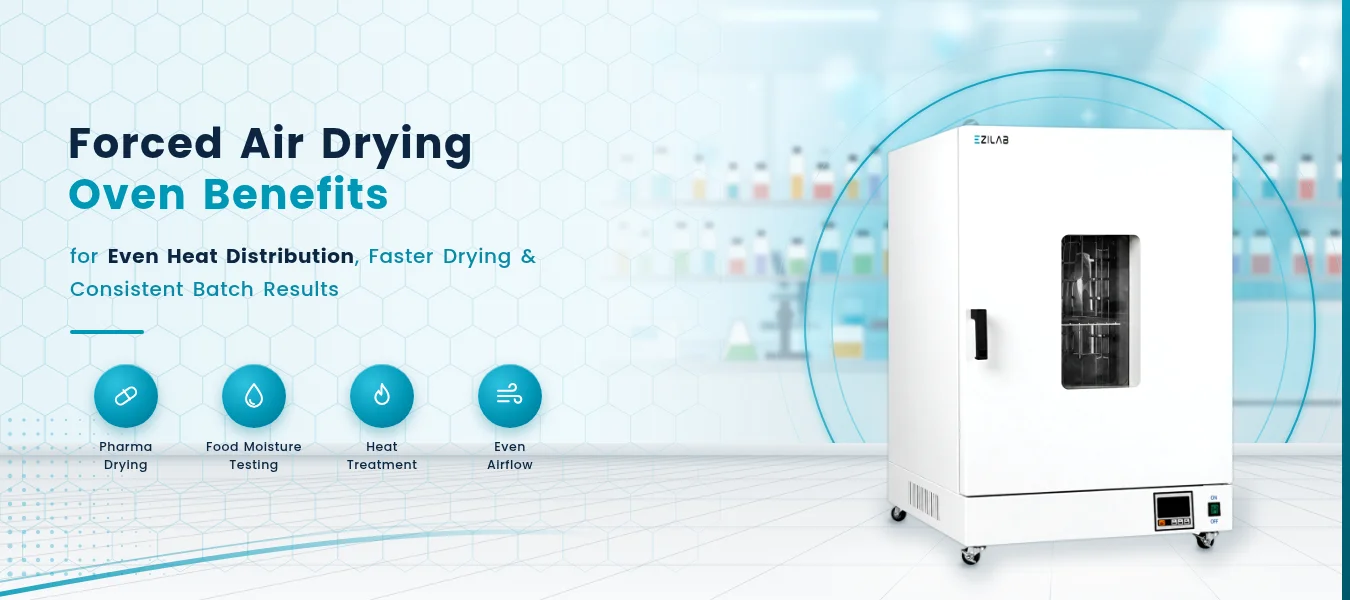
How fan-driven airflow changes drying speed and uniformity, where it fits in pharma, food and materials work, and how to run it for repeatable batches.
Why Controlled Drying Matters
Drying looks simple until results start to vary. Granules on the top shelf finish dry while those near the door stay damp. A moisture test reads high because a sample did not reach constant weight. A cured coating cracks because one corner of the chamber ran hotter than the rest. In most cases the cause is the same: uneven air temperature inside the chamber.
The Ezilab Forced Air Drying Oven EZL-FDO101 addresses this with fan-driven circulation in a 72-litre chamber, a working range from room temperature +5 °C up to 300 °C and temperature fluctuation held to ±1 °C. The sections below explain how it works, where it fits and how to get consistent batches from it.
How a Forced Air Oven Works
A gravity convection drying oven relies on warm air rising naturally, which leaves layers of hotter and cooler air inside the chamber. A forced air oven adds a circulation fan that pushes heated air through a duct and across the shelves, so air temperature evens out from top to bottom and front to back.
Moving air also carries moisture away from sample surfaces faster. That shortens drying time, because the boundary layer of humid air around each sample is constantly replaced with drier, heated air.
The Drying Cycle in Five Steps
Forced Air Drying Ovens Diagram: Key Parts
A forced air drying ovens diagram usually shows the chamber in front view, with the fan and heaters behind a perforated rear wall and the controls in a panel below the door.
Diagram: front view, parts numbered 1–8
- 1Insulated chamber — a 400 × 400 × 450 mm working space that holds heat with low loss.
- 2Removable shelves — let you set spacing to suit trays, crucibles or glassware.
- 3Air duct — directs heated air from the rear wall across the shelves.
- 4Circulation fan — drives uniform forced airflow through the chamber.
- 5Heating elements — warm the air before it reaches the samples.
- 6Program controller — runs multi-segment profiles with a 0.1 °C display step.
- 7Over-temperature protection — cuts heating if the chamber exceeds its limit.
- 8Viewing window — lets operators check samples without opening the door.
Heat Distribution, Cycle Speed and Batch Consistency
Three outcomes explain why labs move from gravity units to a forced air drying oven laboratory setup.
Even Heat Distribution
Fan-driven airflow and ±1 °C fluctuation reduce hot and cold zones, so shelf position no longer decides the result.
Faster Drying Cycles
Moving air strips moisture from sample surfaces quickly, shortening time to constant weight.
Consistent Batch Results
Multi-segment programs repeat the same ramp and hold profile from one batch to the next.
Wide Working Range
From room temperature +5 °C to 300 °C covers gentle drying through curing and heat treatment.
Sample Protection
Over-temperature protection guards heat-sensitive materials during unattended runs.
Long Timed Runs
A timer of up to 9999 minutes supports overnight and multi-day drying without manual shut-off.
EZL-FDO101 Technical Specifications
| Parameter | Value |
|---|---|
| Capacity | 72 L |
| Temperature range | RT +5 °C to 300 °C |
| Display step | 0.1 °C |
| Temperature fluctuation | ±1 °C |
| Working size | 400 × 400 × 450 mm |
| Timer | 1 – 9999 min |
| Voltage | AC 220 V, 50 Hz |
| Power consumption | 1400 W |
| External dimensions | 550 × 600 × 800 mm |
| Net / gross weight | 45 kg / 72 kg |
| Key features | Multi-segment programming, uniform forced airflow, removable shelves, over-temperature protection |
Forced Air Drying Oven Uses Across Pharma, Food and Materials
Pharmaceutical Drying
Drying granules, excipients and wet-washed glassware, and running loss-on-drying checks on raw materials.
Food Moisture Testing
Drying grain, flour, spices and feed samples to constant weight for moisture content results.
Material Heat Treatment
Curing coatings and adhesives, conditioning polymers and annealing small components.
A drying oven in laboratory settings also serves electronics labs baking out moisture before soldering and research teams preparing dry samples for analysis. If you need a different chamber size or range, the Ezilab forced air drying oven lineup covers both 50 L and 72 L formats.
Forced Air vs Gravity Convection vs Vacuum Ovens
Each laboratory oven type suits a different job. Matching the airflow method to the sample avoids slow cycles or damaged material.
| Factor | Forced air | Gravity convection | Vacuum |
|---|---|---|---|
| Air movement | Fan-driven | Natural rise of warm air | Little or none |
| Temperature uniformity | High | Moderate, layered | Depends on shelf contact |
| Drying speed | Fast | Slower | Fast at low temperature |
| Fine powders | May be disturbed by airflow | Well suited | Well suited |
| Typical work | Bulk drying, curing, heat treatment | Light powders, gentle drying | Heat-sensitive or solvent-laden samples |
Compared with an industrial drying oven built for production lines, a benchtop laboratory drying oven trades chamber size for tighter control. For smaller loads, the EZL-FDO100 forced air drying oven offers a 50 L chamber.
Common Selection Mistakes
Choosing forced air for light powders. Strong airflow can lift fine particles; gravity or vacuum units suit these better.
Undersizing the chamber. Crowded shelves block airflow and undo the uniformity the fan provides.
Ignoring the top temperature. Curing or heat treatment may need far more than drying; check the upper limit first.
Skipping programmability. Single-setpoint units cannot run ramp and hold profiles for repeatable curing.
Overlooking safety cut-outs. Over-temperature protection matters for unattended overnight runs.
Forgetting power and space. Confirm a 220 V supply and room for door swing and rear ventilation.
User Tips for Repeatable Drying
- Preheat the chamber to setpoint before loading samples.
- Leave gaps between trays and the chamber walls so air can circulate.
- Place samples on the same shelf positions for comparable batches.
- Use shallow, wide containers to speed moisture release.
- Cool moisture samples in a desiccator before weighing.
- Save drying and curing profiles as programs instead of re-entering settings.
- Avoid opening the door during a cycle; use the viewing window to check progress.
- Wipe the chamber and shelves after runs to prevent cross-contamination.
Exploring the Forced Air Drying Oven Range
This category groups benchtop forced-convection ovens by chamber volume and temperature range. When comparing options, buyers usually weigh capacity, top temperature, fluctuation, programming depth, timer length and safety features against the samples they process most often. Together, these factors define the forced air drying ovens system that suits a given lab.
You can compare both models in the Ezilab forced air oven collection, or browse other laboratory equipment from the Ezilab.
| Model | Capacity | Temperature range | Fluctuation |
|---|---|---|---|
| EZL-FDO100 | 50 L | 80 – 250 °C | ±1 °C |
| EZL-FDO101 | 72 L | RT +5 – 300 °C | ±1 °C |
Plan Faster, More Even Drying
Review the full specifications, programming options and dimensions of the EZL-FDO101 before setting up your next drying or curing method.
Explore EZL-FDO101Amelia Brooks
Blog Content Writer at Ezilab Scientific
Amelia Brooks is a blog content writer at Ezilab Scientific, specializing in laboratory equipment, scientific instrumentation, and technical content development. She focuses on translating complex product specifications and scientific concepts into clear, informative, and engaging articles. Her writing highlights equipment features, practical applications, and industry developments to help readers understand laboratory technologies and make informed decisions based on their technical requirements.