

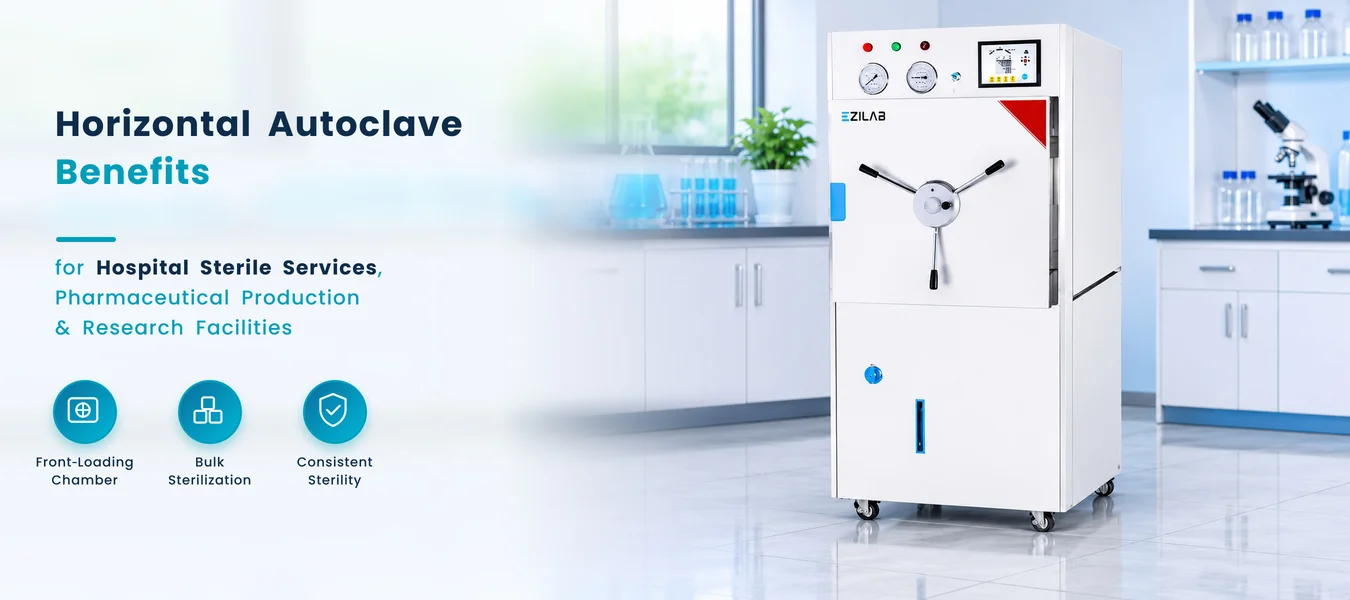
A professional overview of how a horizontal steam sterilizer turns pressure, heat and timed cycles into controlled bulk sterilization.
Why Chamber Size and Cycle Control Shape Sterile Processing
Hospital sterile services, pharmaceutical production areas and research facilities share one practical need: large mixed loads must be processed in a controlled, repeatable way. Moist heat under pressure is the long-established method for instruments, glassware, culture media and laboratory waste, and the size and layout of the chamber decide how much can be handled at once.
The Horizontal Autoclave EZL-CH102 from Ezilab is a horizontal autoclave machine with a cylindrical chamber of two hundred liters. It is described for departments that have outgrown smaller units, making it a practical autoclave machine horizontal in layout for busy sterile services and need to place full instrument trays, glassware racks, media bottles and waste bags into one load. This article explains how the equipment works, what to look at on the specification list and which selection mistakes are worth avoiding.
From Pressure to Sterility: The Working Principle
The horizontal autoclave principle is moist heat. Water is heated until it produces steam, the steam fills the closed chamber, and rising pressure lets heat reach surfaces and wrapped items far more effectively than dry air could. Held for the set time, that heat inactivates microorganisms on the load.
The horizontal autoclave working principle then follows three controlled stages: heating and pressure build-up, a timed sterilization period, and a separate drying period. On this model, the working pressure range is listed from zero point nine to two point one bar, and the sterilization and drying timers each run from zero to sixty minutes.
A horizontal chamber lies on its side, so trays and racks can be arranged in layers along its length instead of being stacked downward. That layout is the reason a horizontal sterilizer is often chosen for bulk work, and a horizontal autoclave sterilizer of this size suits sterile services that process several trays at once.
Reading a Horizontal Autoclave Diagram, Part by Part
A simple horizontal autoclave diagram makes the sequence easy to follow. Water is heated, the chamber fills with steam under pressure, protective devices watch the vessel, and the controller manages the timed stages.
Diagram: cycle path, parts lettered A to F
- AWater fill — Water enters manually or through a piped supply.
- BHeater — A twelve kilowatt heater in stainless steel three hundred sixteen raises the water to steam.
- CChamber — A cylindrical chamber in stainless steel three hundred four holds the load.
- DPressure protection — Safe pressure release and an overpressure protection system guard the vessel.
- EControl display — A PLC with a digital display shows temperature, pressure and real-time stage status.
- FTimers — Separate sterilization and drying timers run from zero to sixty minutes.
Running a Cycle Step by Step
Day to day, horizontal autoclave working follows a short routine that stays the same from load to load.
Large Chamber, Bulk Capacity and Consistent Cycles
Large Cylindrical Chamber
Two hundred liters of chamber capacity gives room for full trays, racks and bottles in one load.
Efficient Bulk Sterilization
Mixed items, wrapped or unwrapped, can be processed together instead of being split across several runs.
Consistent Cycle Control
A PLC with a digital display and separate timers keeps each stage visible and repeatable.
Protective Design
Safe pressure release and an overpressure protection system are part of the listed features.
Materials Chosen for Steam
The chamber uses stainless steel three hundred four, and the heater uses stainless steel three hundred sixteen.
Easy Maintenance Access
Maintenance access is listed as a feature, which helps routine servicing.
EZL-CH102 Technical Details
| Parameter | Value |
|---|---|
| Chamber capacity | Two hundred liters |
| Chamber shape and size | Cylindrical, five hundred millimeters in diameter and one thousand millimeters long |
| Working pressure | Zero point nine to two point one bar |
| Sterilization time | Zero to sixty minutes |
| Drying time | Zero to sixty minutes, set separately |
| Control | PLC with digital display |
| Heater | Twelve kilowatts |
| Water supply | Manual fill or piped supply |
| Chamber material | Stainless steel three hundred four |
| Heater material | Stainless steel three hundred sixteen |
| External size | One thousand three hundred by seven hundred fifty by one thousand seven hundred fifty millimeters, length by width by height |
| Electrical supply | Dedicated supply matched to the heater rating |
The full list is available on the Horizontal Autoclave EZL-CH102 product page.
Where It Fits: Hospitals, Dental Practices and Research Labs
Hospitals and Clinics
Surgical and medical instruments.
Central Sterile Departments
Units that have outgrown one hundred fifty liter machines.
Dental Practices
Handpieces and instrument trays.
Research Laboratories
Culture media and glassware.
Biohazard Waste
Decontamination before disposal.
Mixed Wrapped and Unwrapped Loads
Laboratory instrument loads in either form.
These horizontal autoclave uses share one trait: the load is large or varied enough that a bigger chamber saves repeated cycles. Typical horizontal autoclave machine uses also include routine batch work as well as occasional large runs, and readers who want to see how other sizes differ can browse the horizontal autoclave category page.
Horizontal and Vertical Chambers Compared
| Consideration | Horizontal Chamber | Vertical Chamber |
|---|---|---|
| Load arrangement | Trays and racks arranged in layers along the length | Items lowered into baskets from above |
| Bulk handling | Suited to large, mixed loads | Suited to smaller, simpler loads |
| Floor and room use | Needs more floor length | Needs more headroom |
| Typical setting | Sterile services and larger laboratories | Smaller laboratories and clinics |
This table is general background on chamber layouts; the right choice depends on load size, room dimensions and the way the department works.
Common Selection Mistakes
Choosing by volume alone. Chamber diameter and length decide which racks and trays actually fit, not the liter figure by itself.
Overlooking the electrical supply. A twelve kilowatt heater needs a dedicated, matching supply, so plan the room before delivery.
Ignoring water supply. Decide early between manual filling and a piped connection, because it changes daily routine.
Forgetting the drying period. Wrapped loads need a separate drying time, so confirm the controller offers one.
Skipping room clearance. Allow space around the unit for loading, servicing and maintenance access.
Treating all loads alike. Waste, media and instruments behave differently, so group loads sensibly and set times to match.
Habits That Keep Cycles Consistent
- Load items loosely so steam can circulate between trays and racks.
- Check the water supply and the chamber before starting each day.
- Record sterilization and drying times with each load.
- Watch the display for pressure and stage status throughout the cycle.
- Release pressure safely before opening and schedule routine maintenance.
Exploring the Wider Family of Horizontal Steam Sterilizers
This model belongs to a category of horizontal steam sterilizer autoclave equipment for hospitals, research institutions and manufacturing facilities. Chamber volumes in the range run from one hundred fifty to five hundred liters, so one department can often find a size close to its workload.
When reviewing horizontal autoclave manufacturers and their ranges, readers usually compare chamber volume, chamber dimensions, working pressure, temperature range, heater power, control display and water supply. The full range is easy to browse on the Ezilab horizontal autoclave range, and wider laboratory categories sit on the Ezilab.
Continue to the Product Details
See the full specification list, features and applications for this model.
Explore Horizontal Autoclave EZL-CH102Amelia Brooks
Blog Content Writer at Ezilab Scientific
Amelia Brooks is a blog content writer at Ezilab Scientific, specializing in laboratory equipment, scientific instrumentation, and technical content development. She focuses on translating complex product specifications and scientific concepts into clear, informative, and engaging articles. Her writing highlights equipment features, practical applications, and industry developments to help readers understand laboratory technologies and make informed decisions based on their technical requirements.