

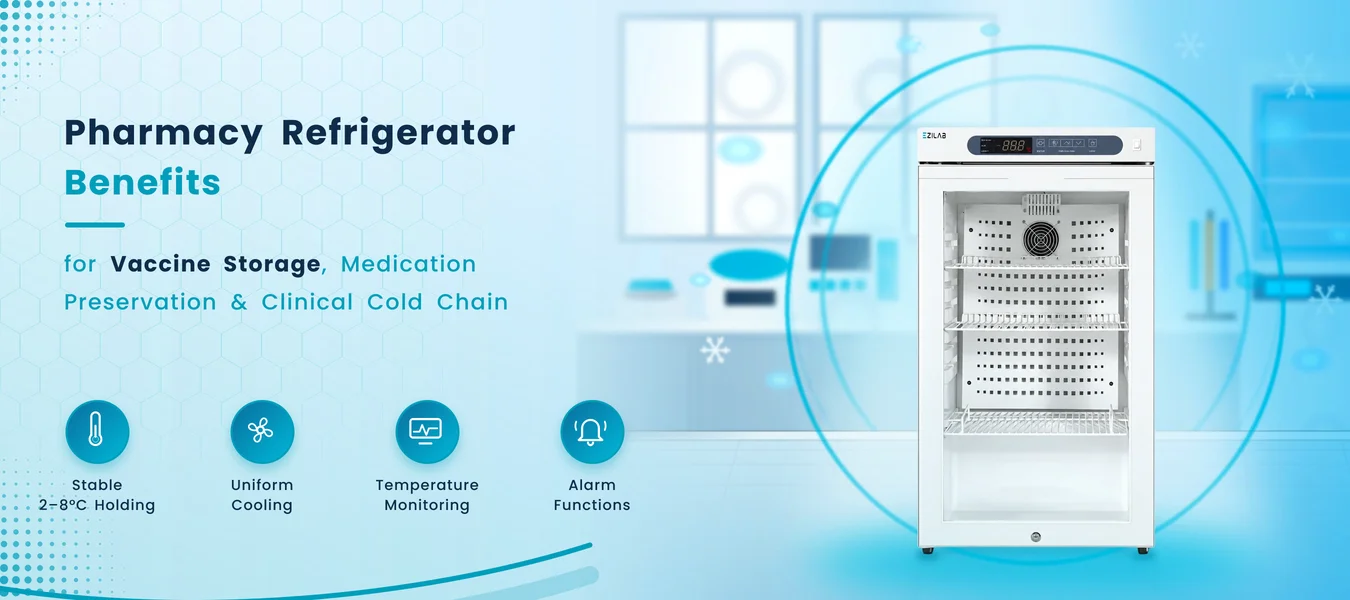
Cold storage in medical and laboratory settings depends on small details: how cold air moves through a cabinet, how temperature is read, and how quickly staff learn that something has drifted. This article walks through how a compact cabinet handles those details and where it fits in daily work.
Why Narrow Temperature Bands Matter
Vaccines, drugs, hormones and enzymes share one trait: they respond poorly to temperatures outside a narrow band. Research materials such as stem cells, extracted RNA and gene libraries bring the same expectation to the laboratory bench. The Pharmacy Refrigerator EZL-PR101 is designed around that band, holding two to eight degrees Celsius while the room around it stays between ten and thirty-two degrees Celsius.
A medical refrigerator of this kind differs from general cooling equipment in what it prioritizes. The aim is not simply a cold cabinet but a cabinet whose range can be read at a glance, so that a vaccine refrigerator shelf, a medicine refrigerator tray or a reagent rack behaves predictably from the first morning check to the last evening one.
How Forced Air Cooling Holds the Range
The EZL-PR101 pairs forced air cooling with a suction circulation system. Rather than leaving cold air to settle in one zone, forced air circulation moves it through the interior so that shelves at different heights see similar conditions. That even spread is what makes a compact cabinet practical for mixed stock.
A microprocessor controller works with an NTC sensor to follow cabinet temperature, and the reading appears on a digital display. Auto defrost removes the need for manual defrosting, while the refrigeration circuit carries heat out of the cabinet. Together these parts form a simple control loop: sense, compare, cool, display.
Practical Use Cases Across Medical and Research Sites
Compact cold storage earns its place where space is limited and stock must stay close to the people using it. The cabinet suits sites that need dedicated cold storage without a large footprint.
Community pharmacies
A pharmacy fridge used behind the counter saves floor space and keeps pharmacy fridge medicine stock within reach during dispensing.
Clinics and vaccination sites
Small clinics and satellite vaccination sites keep daily doses close to patients without committing to a larger cabinet.
Hospital wards
Wards use a refrigerator for pharmacy use at unit level, holding medication stock where nurses need it rather than in a distant store.
University and biotech laboratories
Laboratories keep reagents, stem cells, extracted RNA and gene libraries apart from general storage at the required range.
Reading the Cabinet Layout
Interior planning affects how well a small cabinet performs. Three height adjustable shelves let staff set spacing around vials, boxes and trays, and internal LED lighting makes contents visible when the door opens. The exterior is SPCC sprayed steel and the interior is HIPS.
Electrical and acoustic details deserve a glance too. An eighty watt draw and a fifty decibel noise level are worth reading against the room where the cabinet will sit, particularly when it will stand close to staff all day.
Monitoring and Alarm Awareness
Multiple alarm functions flag temperature problems early, and that matters in a compact cabinet. Door openings shift conditions faster in a small interior than in larger units, so an early signal gives staff time to respond before stored material is affected.
The digital display supports the same goal from the other side. Reading it at the start of a shift and again after busy dispensing periods turns monitoring into a habit rather than an afterthought, and it keeps the clinical cold chain visible to all staff handling stock.
Selection Mistakes to Avoid
Most poor choices come from skipping a few simple questions before purchase.
- Guessing capacity. Count daily doses and shelf needs first, then confirm that one hundred liters is enough for the stock on hand.
- Ignoring the room. The rated ambient range runs from ten to thirty-two degrees Celsius, so a hot storeroom or an unventilated corner deserves a second look.
- Overlooking alarm functions and display visibility, which decide how quickly a problem is noticed.
- Forgetting shelf flexibility, which determines whether tall boxes and small vials can share the cabinet comfortably.
Once those questions are answered, the pharmacy refrigerator listings make side by side checks of capacity and range much easier.
Where the Cabinet Sits in the Wider Range
The EZL-PR101 belongs to the pharmacy refrigerator category within the refrigerator group at Ezilab. This category covers cabinets built to hold medicines, vaccines and biological materials within a narrow cold range, and it is where readers compare capacity, temperature range, ambient range and defrost type.
The range also includes the Pharmacy Refrigerator EZL-PR100, a far larger cabinet with twelve shelf and drawer positions, which shows how the same category stretches from compact counter use to wide stock holding. The full range is easiest to explore through the pharmacy refrigerator category page, where models can be matched to the real volume of material.
Closing Perspective
A compact cabinet earns its value through consistency: even cooling, a readable display, timely alarms and a layout staff can adapt. When those elements match the stock, the room and the daily workflow, vaccines, medicines and research materials stay where they are meant to be, within a narrow and carefully watched range.