
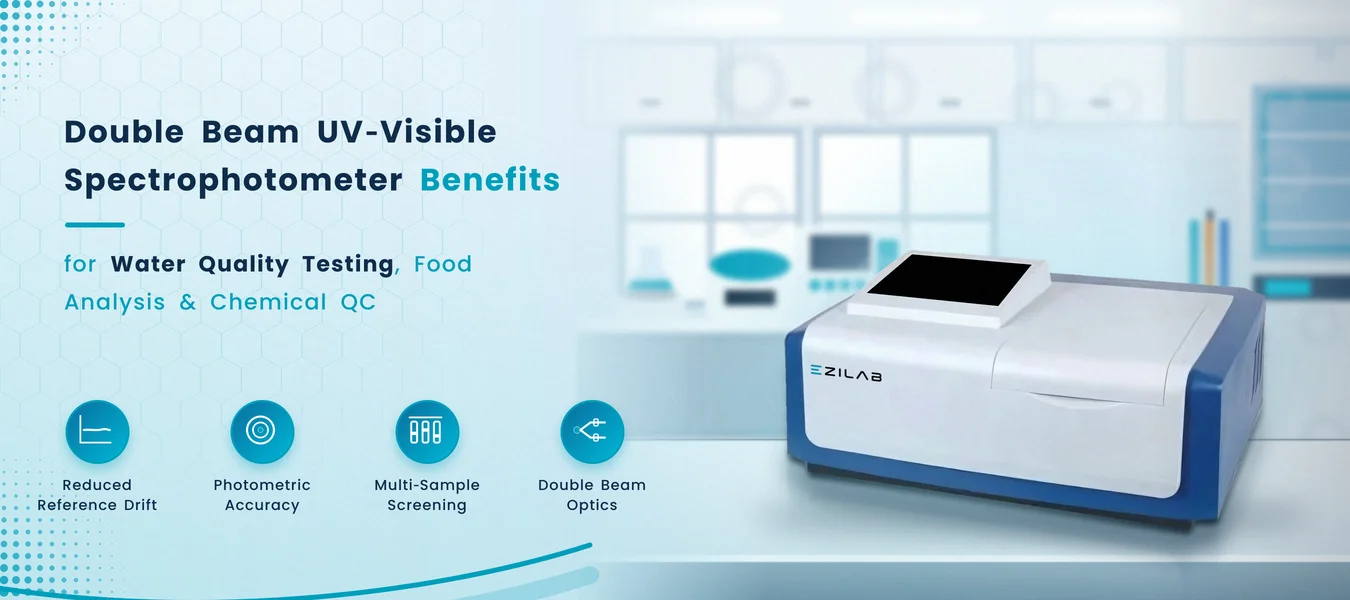
An educational look at how a reference beam steadies absorbance readings in water, food and chemical laboratories.
Why a Reference Path Changes the Quality of a Reading
Absorbance readings look simple, yet small shifts in lamp output or electronics can move a result between the first sample and the last. In busy water, food and chemical laboratories, that movement is easy to mistake for a real change in the sample. A double beam uv visible spectrophotometer limits the problem by measuring a reference and a sample together.
The UV-Visible Spectrophotometer EZL-US123 from Ezilab uses this double beam layout. It covers the ultraviolet and visible range, pairs a silicon photocell detector with an eight inch touch screen, and comes with processing software, which makes it a practical example for readers learning what a double beam spectrophotometer does in routine work.
The Double Beam UV Visible Spectrophotometer Principle
Light from the source passes through a monochromator that selects one wavelength at a time. A beam splitter then sends that light along two paths, one through the sample and one through a reference. The detector compares the two signals and reports the ratio as absorbance.
Because both paths share the same source at the same moment, a small dip in lamp output lowers both signals together and the ratio holds steady. That is the reason a double beam uv spectrophotometer is chosen when reference drift would otherwise blur small differences between samples.
Reading a Double Beam UV Vis Spectrophotometer Diagram, Part by Part
A clear double beam uv visible spectrophotometer diagram shows why the layout steadies readings. The two beams travel side by side from the splitter and meet again at the detector.
Diagram: light path, parts lettered A to F
- ALight source — Supplies light across the ultraviolet and visible range.
- BMonochromator — Selects one wavelength at a time from the source light.
- CBeam splitter — Divides the light into two matched paths.
- DSample beam — Passes through the sample cuvette.
- EReference beam — Passes through the blank so source changes cancel out.
- FDetector and screen — A silicon photocell compares both signals, and results appear on the eight inch touch screen.
Double Beam Spectrophotometer Working, Beam by Beam
From the operator side, the working routine is short and repeatable, which is what makes it suitable for rows of similar samples.
Reference Stability, Photometric Accuracy and Screening Workflow
Reduced Reference Drift
The reference beam follows the same source changes as the sample beam, so slow shifts largely cancel out.
Higher Photometric Accuracy
Photometric accuracy is listed at two thousandths of an absorbance unit in the lower absorbance range.
Low Stray Light
Stray light is listed at three thousandths of a percent transmittance, which protects readings of strongly absorbing samples.
Organized Multi-Sample Screening
A large data memory and included software help keep results organized across a run of samples.
Eight Inch Touch Screen
Settings and results are handled on a large display without extra controls.
USB Data Output
A USB port moves results into reports and records.
EZL-US123 Technical Details
| Parameter | Value |
|---|---|
| Optical system | Double beam |
| Wavelength range | One hundred ninety to one thousand one hundred nanometers |
| Spectral bandwidth | One point eight nanometers, fixed |
| Wavelength accuracy | Three tenths of a nanometer |
| Photometric accuracy | Two thousandths of an absorbance unit from zero to half an absorbance unit |
| Stray light | Three thousandths of a percent transmittance or less |
| Detector | Silicon photocell |
| Display | Eight inch touch screen |
| Software | Spectrum data processing software included |
| Output | USB port |
| Included accessories | Glass cuvettes, quartz cuvettes, power cord, spare fuses and operation manual |
The full list is available on the UV-Visible Spectrophotometer EZL-US123 product page.
Where It Fits: Water, Food, Chemical and Research Labs
Pharmaceutical Labs
Qualitative and quantitative assays.
Biotechnology Labs
Protein and nucleic acid quantification.
Chemical Quality Control
Identity and purity checks on raw materials.
Environmental and Water Testing
Screening of water and air quality samples.
Food Safety Labs
Checks on additives in food and beverage samples.
Academic Coursework
Kinetics, quantification and method development.
These uv double beam spectrophotometer uses all depend on a steady baseline from the first sample to the last. Readers who want to see how sibling models differ can browse the double beam UV visible spectrophotometer category page.
Fixed Bandwidth Versus Selectable Bandwidth Models
| Factor | Fixed Bandwidth | Selectable Bandwidth |
|---|---|---|
| Setup | No bandwidth choice to make | Bandwidth is set to suit each method |
| Routine assays | Simple and repeatable | Flexible across different assays |
| Sharp peaks | Resolved to one fixed level | Narrower settings can resolve finer detail |
| Typical role | Daily quantification and screening | Method development and mixed work |
A beam spectrophotometer with a fixed bandwidth is often enough for routine screening, while selectable bandwidth suits laboratories that change methods often.
Common Selection Mistakes
Choosing by wavelength range alone. Bandwidth, stray light and photometric accuracy also shape the quality of a reading.
Ignoring bandwidth needs. Match the bandwidth to the sharpness of the peaks your methods produce.
Using the wrong cuvette material. Glass blocks most ultraviolet light, so quartz is needed for work in that region.
Skipping the blank. A poorly matched blank moves the whole baseline.
Overlooking data handling. Check that the software and USB output fit the way results are recorded.
Treating sample prep as secondary. Bubbles, particles and fingerprints add error that no instrument can remove.
Habits That Keep Readings Consistent
- Handle cuvettes by the frosted sides and wipe the clear faces before each reading.
- Use a matched cuvette for the blank and the sample.
- Rinse cuvettes with the solvent before filling them with a new sample.
- Keep samples free of bubbles and visible particles.
- Record the settings used for each run so results can be repeated later.
Exploring the Wider Family of Double Beam Instruments
This model belongs to a category of benchtop instruments that measure reference and sample at the same time. Most listed models cover the ultraviolet and visible range, while bandwidth varies from a fixed value to several selectable options.
When reviewing double beam uv vis spectrophotometer manufacturers and their ranges, readers usually look at wavelength range, bandwidth choices, photometric accuracy, stray light, display style and data output. The full range is easy to browse on the Ezilab double beam spectrophotometer range, and wider laboratory categories sit on the Ezilab.
Continue to the Product Details
See the full specification list, features and applications for this model.
Explore UV-Visible Spectrophotometer EZL-US123Amelia Brooks
Blog Content Writer at Ezilab Scientific
Amelia Brooks is a blog content writer at Ezilab Scientific, specializing in laboratory equipment, scientific instrumentation, and technical content development. She focuses on translating complex product specifications and scientific concepts into clear, informative, and engaging articles. Her writing highlights equipment features, practical applications, and industry developments to help readers understand laboratory technologies and make informed decisions based on their technical requirements.