

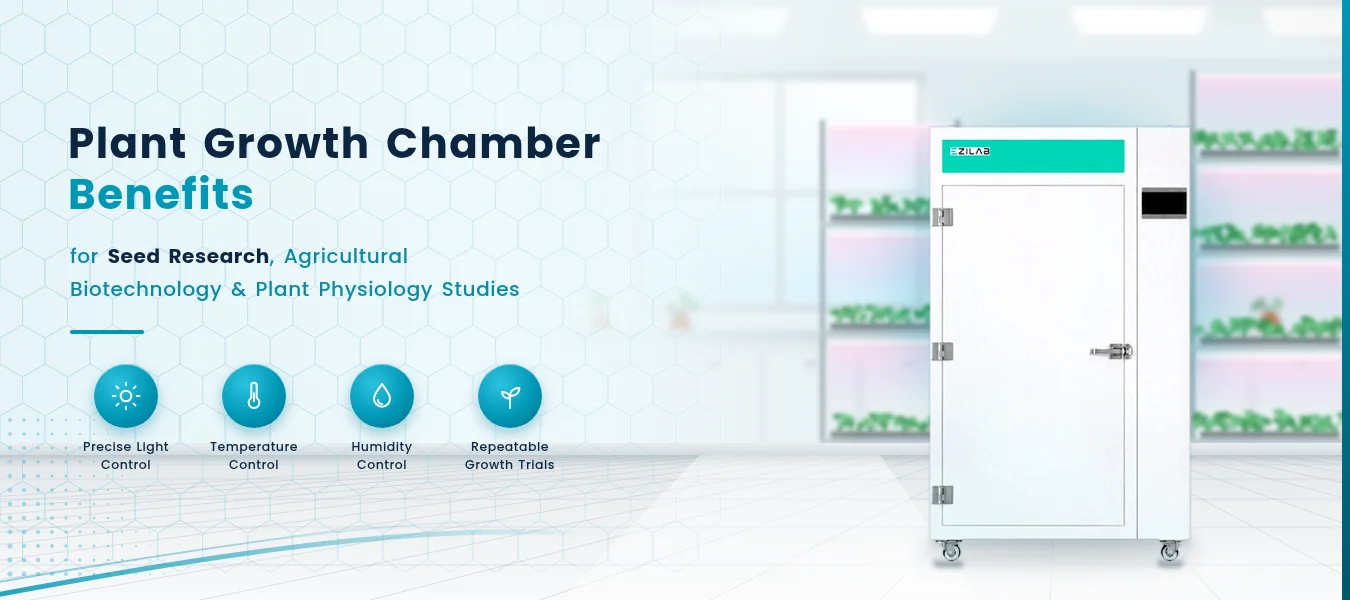
How controlled light, heat and moisture turn variable greenhouse conditions into repeatable plant experiments, and what to check when setting one up.
Why Plant Research Needs a Controlled Climate
Plants respond to small changes. A few degrees of extra heat shifts germination timing, a cloudy week changes leaf area, and a humid spell invites fungal growth that has nothing to do with the trait being studied. In a greenhouse or field plot, these variables move together, which makes it hard to tell whether a result came from the treatment or the weather.
The Ezilab Plant Growth Chamber EZL-PG414 separates those variables. It offers a 790-litre interior with four modular LED lighting shelves, temperature control from 3 °C to 45 °C held within ±0.5 °C, and humidity from 50% to 90% RH. The sections below explain how it works, where it fits and how to keep growth trials repeatable.
Plant Growth Chamber Working Principle
An environmental growth chamber is an insulated cabinet that recreates a chosen climate and holds it steady. Sensors measure air temperature and relative humidity, while a PID controller compares those readings with the programmed setpoints and adjusts heating, cooling and humidification in small steps to avoid overshoot.
Light is handled separately. LED panels on each shelf deliver photosynthetically active radiation at an adjustable intensity, and day and night periods can be set to mimic seasons or test photoperiod responses. An air circulation system with fresh-air recycling keeps conditions even from the top shelf to the bottom.
The Control Loop in Five Steps
Plant Growth Chambers Diagram: Main Components
A typical plant growth chambers diagram shows a tall cabinet with stacked lighting shelves, a side control panel and the machinery that conditions the air.
Diagram: front view, parts numbered 1–8
- 1Insulated growing space — 781 × 656 × 1515 mm of stainless-steel interior.
- 2Modular LED shelves — four shelves delivering up to 300 µmol/m²/s at 10 cm, with adjustable intensity.
- 3Plant trays — hold seedlings, pots or tissue culture vessels on each level.
- 4Control panel — PID control for temperature and humidity, with remote access through a mobile app.
- 5Air circulation duct — moves conditioned air across the shelves with fresh-air recycling.
- 6Cooling unit — removes heat produced by the lights and lowers temperature for cool-season trials.
- 7Humidity system — holds RH between 50% and 90%.
- 8Temperature and RH sensors — feed live readings back to the controller.
Light, Temperature and Humidity Working Together
A growth chamber earns its place by controlling the three factors that most influence plant development, and by holding them steady across trials.
Precise Light
Adjustable LED intensity and timed photoperiods let you test light response without seasonal swings.
Stable Temperature
±0.5 °C fluctuation and uniformity keep germination and growth rates comparable between shelves.
Controlled Humidity
50–90% RH with ±3% uniformity supports transpiration studies and reduces disease pressure.
Repeatable Trials
Saved climate settings let you repeat an experiment months later under matching conditions.
EZL-PG414 Technical Specifications
| Parameter | Value |
|---|---|
| Capacity | 790 L |
| Temperature range | 3 °C to 45 °C |
| Temperature fluctuation / uniformity | ±0.5 °C / ±0.5 °C |
| Humidity range | 50% to 90% RH |
| RH uniformity | ±3.0% RH |
| Illumination | LED, adjustable intensity |
| Light intensity | 300 µmol/m²/s at 10 cm |
| Shelves | 4 modular lighting shelves |
| Air flow | Fresh-air recycling system |
| Remote access | Mobile app remote control |
| Interior (W × D × H) | 781 × 656 × 1515 mm |
| Exterior (W × D × H) | 1165 × 800 × 1940 mm |
| Optional upgrades | CO₂ control, observation window, extended temperature and humidity ranges, multi-color LED panels |
Plant Growth Chamber Uses in Research Labs
Seed Research
Germination and vigor testing under fixed temperature and photoperiod settings.
Agricultural Biotechnology
Growing transgenic and edited lines in contained, repeatable conditions for trait screening.
Plant Physiology
Studying photosynthesis, stress response and flowering time under controlled light and heat.
Plant growth chambers lab teams also use them for tissue culture, insect rearing and climate simulation. If your space or temperature needs differ, the Ezilab plant growth chamber lineup spans volumes from 768 L to 1213 L.
Growth Chamber vs Plant Incubator vs Greenhouse
The right setup depends on how much control your experiment needs and how many plants it involves.
| Factor | Plant growth chamber | Plant incubator | Greenhouse |
|---|---|---|---|
| Light control | Full, programmable LED | Basic lighting | Mostly sunlight |
| Humidity control | Active, set by program | Limited | Weather-dependent |
| Space | Walk-up cabinet, multiple shelves | Compact benchtop | Large |
| Repeatability | High | Moderate | Low |
| Typical work | Controlled trials, phenotyping | Seed germination, small cultures | Scale-up, breeding blocks |
A compact plant growth incubator suits small germination runs, while a full chamber handles larger trials. For sub-zero or cold-hardiness work, a wider-range model such as the EZL-PG413 plant growth chamber reaches −15 °C with lights off.
Common Selection Mistakes
Measuring light in lux only. Plants respond to PAR; check output in µmol/m²/s at a stated distance.
Ignoring light heat load. Strong lighting adds heat; confirm cooling can hold setpoint with lights on.
Underestimating plant height. Tall species need shelf spacing or removable shelves.
Skipping humidity specs. Check RH range with lights on and off, since the two often differ.
Forgetting future needs. CO₂ control or extra LED spectra may be needed later; check upgrade options now.
Judging a plant growth chamber manufacturer on volume alone. Ask about uniformity data, spare parts and service response.
User Tips for Consistent Growth Trials
- Run the chamber empty for a day to confirm it holds setpoints before loading plants.
- Rotate trays between shelves on a schedule to even out small position effects.
- Measure light at canopy height and adjust intensity as plants grow taller.
- Use distilled water in the humidity system to limit scale and sensor drift.
- Leave space between pots so air can reach lower leaves.
- Clean shelves and trays between trials to prevent carry-over of pests or pathogens.
- Log temperature, humidity and light settings with each experiment for traceability.
Exploring the Plant Growth Chamber Range
This category groups walk-up growth cabinets by volume, temperature span and lighting type. When comparing options, buyers usually weigh interior size, lights-on and lights-off temperature ranges, humidity control, light intensity and spectrum, shelf flexibility and remote monitoring.
You can compare all four models in the Ezilab plant growth chamber collection, or browse other laboratory equipment from the Ezilab.
Set Up Your Next Growth Trial
Review the full specifications, lighting options and upgrades for the EZL-PG414 before planning your next plant study.
Explore EZL-PG414Amelia Brooks
Blog Content Writer at Ezilab Scientific
Amelia Brooks is a blog content writer at Ezilab Scientific, specializing in laboratory equipment, scientific instrumentation, and technical content development. She focuses on translating complex product specifications and scientific concepts into clear, informative, and engaging articles. Her writing highlights equipment features, practical applications, and industry developments to help readers understand laboratory technologies and make informed decisions based on their technical requirements.