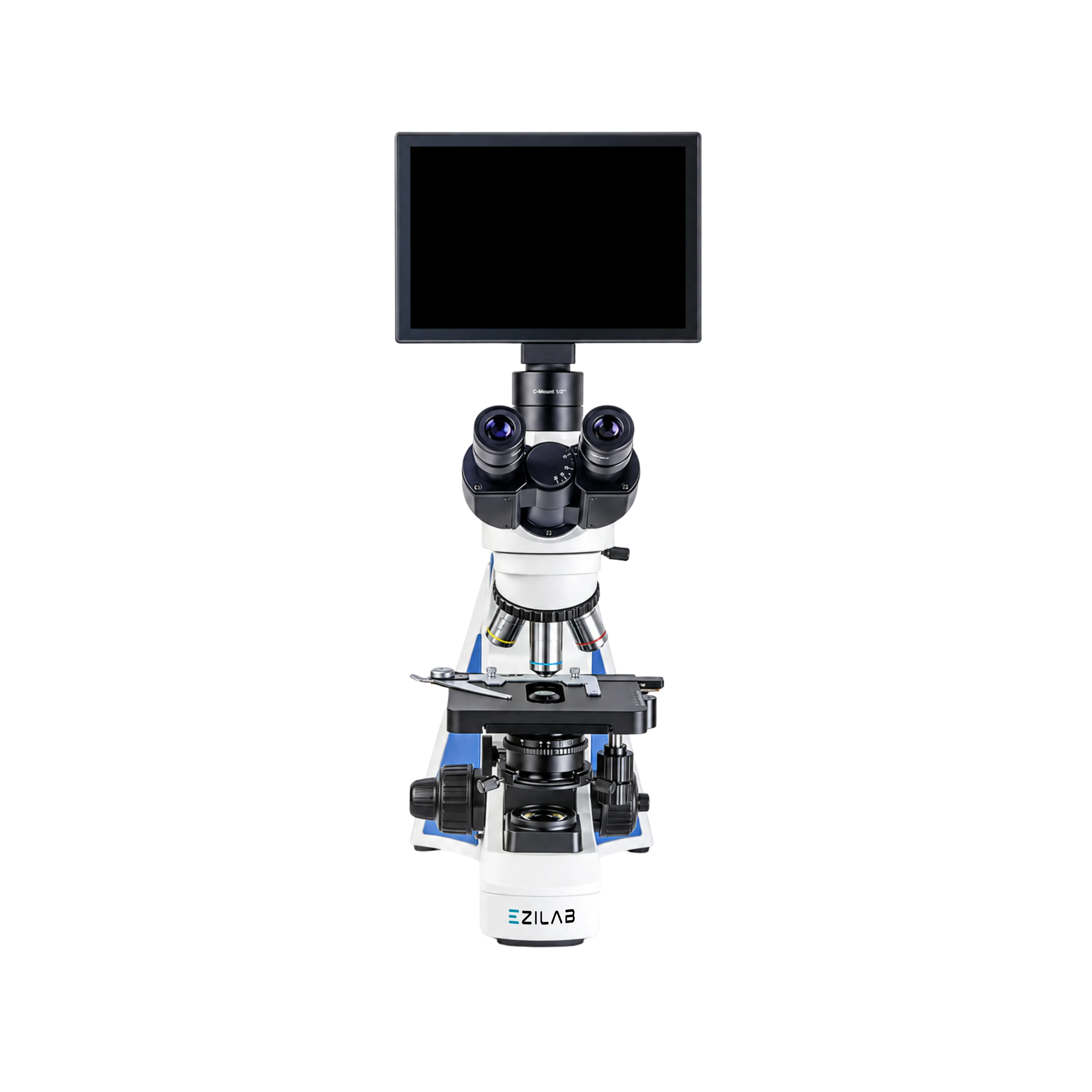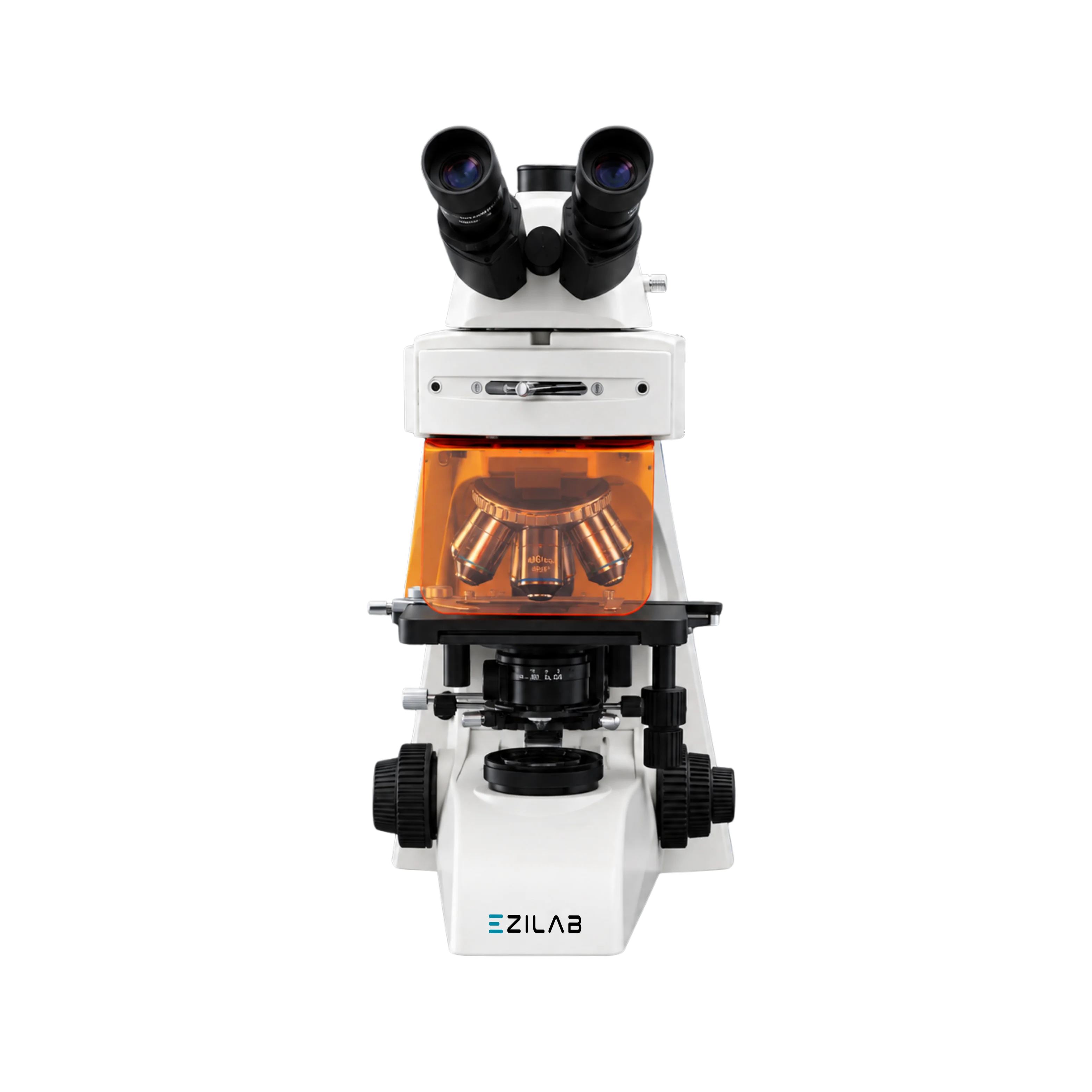
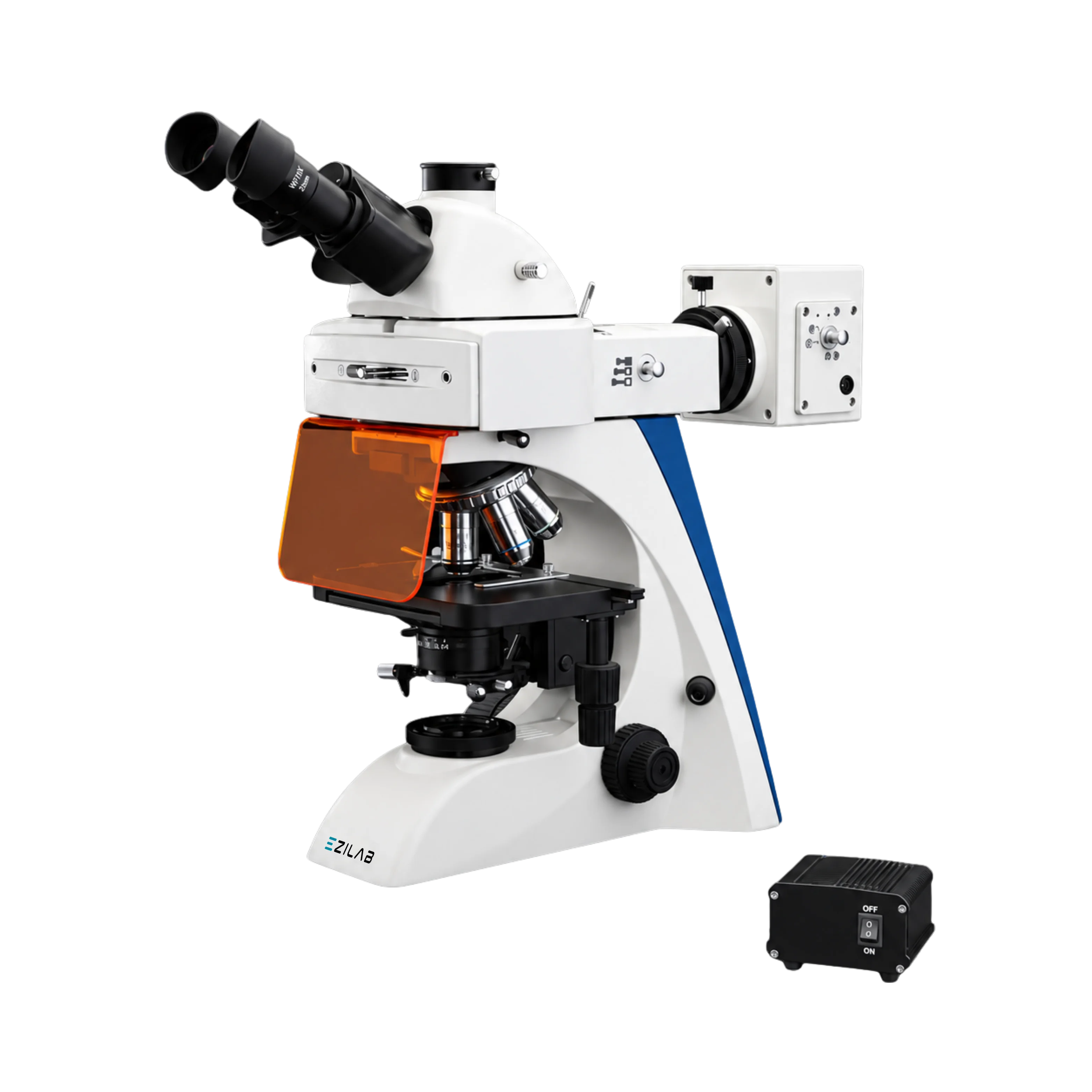
EziLab offers the Fluorescence Microscope EZL-FM100, a trinocular microscope with a Siedentopf head inclined at 30° that rotates 360° and adjusts from 50 to 75 mm interpupillary distance. Five infinity plan objectives at 4x, 10x, 20x, 40x, and 100x oil sit on a quintuple ball-bearing nosepiece, paired with WF10x/20 mm eyepieces and an Abbe N.A. 1.25 condenser with iris diaphragm. Built-in Kohler illumination uses a 3 W LED or 6 V/20 W halogen lamp, and a 3 W LED epi-fluorescence lamphouse carries blue and green excitation filters. Coaxial coarse and fine focus, an antifungal coating, and an 18 kg stand complete it. The trinocular port takes a C-mount camera for documenting stained samples, and LED excitation avoids the warm-up and short life of mercury lamps. Researchers image cells, track GFP-tagged proteins, and run immunofluorescence and FISH, switching filter modules between dyes. Optional phase contrast and dark field kits add live-cell and unstained viewing. University and biological research labs study cell structure and protein expression, while hospital pathology labs examine tissue sections. Microbiology groups identify stained bacteria, and life science teams use this LED fluorescence microscope for imaging and teaching. Blue and green excitation covers dyes such as GFP, FITC, and rhodamine but not DAPI, which needs UV or violet light, so check your stain list before comparing the Lab Equipment and Microscope pages.
| Viewing Head |
Siedentopf type trinocular head inclined at 30°, 360° rotation Interpupillary adjustable distance 50 to75 mm Antifungal system |
|---|---|
| Eyepiece | WF10×/20 mm |
| Objective | Infinite plan objectives (5pcs) 4×, 10×, 20× 40× (s), 100×(soil) |
| Focusing | Coaxial coarse & fine adjustment knobs |
| Condenser | Abbe N.A. 1.25 condenser with iris diaphragm |
| Nosepiece | Quintuple quick stop, revolving mechanism with multiple ball bearing |
| Illumination | Build in Kohler illumination system with 3W LED,6V/20W halogen lamp brightness adjustment, field diaphragm |
| Epi-fluorescence LED |
(B,G) Excitation filter LED power source 3W LED lamphouse B-LED lamp/ G-LED lamp) Centring objective |
| Dimension (W×D×H) | 650 × 420 × 490 mm |
| Net Weight | 18 kg |
| Gross Weight | 21 kg |
| Feature Area | Description |
| Viewing Head | Trinocular head that rotates for comfortable viewing, with an antifungal system. |
| Objectives | Infinity plan objectives running from low power through oil immersion. |
| Illumination | Built-in Kohler illumination with brightness adjustment and a field diaphragm. |
| Epi-Fluorescence | LED lamphouse paired with blue and green excitation filter modules. |
| Focus & Nosepiece | Coaxial coarse and fine focusing with a quick-stop ball bearing nosepiece. |
Eyepiece pointer Battery pack
Binocular phototube 50%: 50% (vis: doc) Dark field equipment (DF slider 0.65) Camera adapters: C mount adapters 2/3 Software with camera driver
Original OMEGA excited filters
Tilting removable mirror (only for fixed Kohler stand variable) Phase contrast equipment: 10×/Ph1, 20×/Ph2, 40×/Ph2, 100×/Ph3 Halogen lamp 6V/30W with phase sliders
The Fluorescence Microscope EZL-FM100 is well-suited for observing cellular structures, protein expression, and tissue morphology under fluorescent labelling. Its high-contrast imaging allows researchers to visualize even subtle cellular changes with clarity. It is compatible with common fluorophores used in immunofluorescence and molecular diagnostics. This makes it a reliable tool for studies involving cell signalling, cancer research, or neurobiology. Researchers can depend on it for routine and advanced imaging tasks.
Ezilab’s Fluorescence Microscope EZL-FM100 features an intuitive control layout and user-friendly operation, making it accessible even to those new to fluorescence microscopy. The ergonomic design helps minimize user fatigue during long sessions. Brightness and focus adjustments are smooth, allowing users to quickly achieve optimal image quality. The system is also compatible with digital camera attachments, enabling users to capture and share images easily. This makes it ideal for teaching labs and multi-user environments.
Our Fluorescence Microscope EZL-FM100 is designed with user safety in mind, including protective filters that shield the eyes from intense excitation light. The lamp housing and optical path are engineered to minimize UV exposure to the operator. It encourages safe use of fluorescence techniques without sacrificing image quality. Proper usage guidelines and included safety labels help reduce the risk of accidental exposure. These features ensure a safe working environment, particularly in shared or teaching laboratories.
Ezilab’s Fluorescence Microscope EZL-FM100 offers smooth switching between bright field and fluorescence modes, allowing users to perform multiple observations without changing instruments. The stable illumination and crisp optical performance reduce the need for frequent re-adjustment. It’s ability to connect a digital camera allows real-time image capture and documentation. This boosts workflow efficiency during high-throughput or time-sensitive experiments. The system supports a seamless transition between viewing, analysis, and documentation.
Our Fluorescence Microscope EZL-FM100 is built for durability, but regular care is important to maintain performance. Users should clean the lenses with appropriate optical tissue and store the microscope with a dust cover when not in use. The light source and filters should be inspected periodically for wear or fading. It is designed with easy-access components to simplify maintenance routines. With basic upkeep, the microscope delivers consistent, long-term imaging performance.
The Fluorescence Microscope EZL-FM100 supports digital camera integration, enabling users to capture high-quality still images and video during observation. This is especially useful for documentation, publication, and collaboration in research settings. It works well with imaging software for analysis, measurement, and data storage. This functionality streamlines recordkeeping and supports traceable experimental workflows. It’s a valuable tool for labs that require both visual and analytical outputs.