

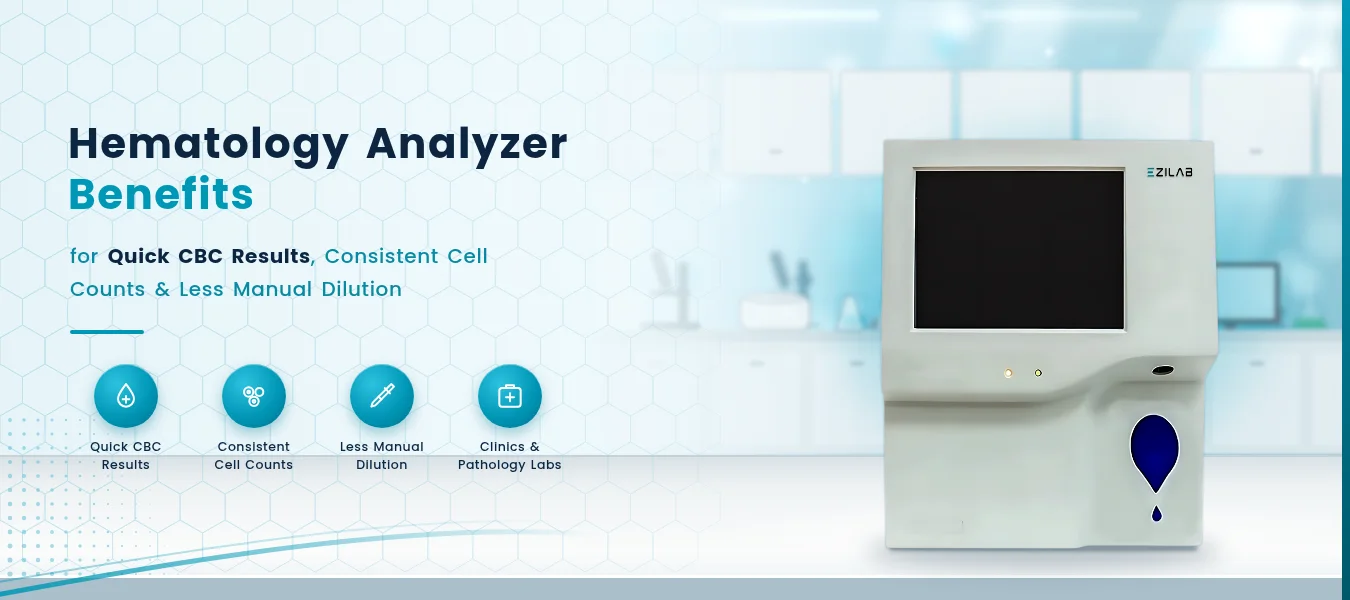
How automated blood counting works, where a three-part analyzer fits, and the habits that keep CBC results consistent from day to day.
From Counting Chambers to Automated CBC
A complete blood count is one of the most requested tests in any clinical setting. In smaller labs, parts of that work still rely on hand dilution, a hemocytometer and a technologist counting cells under a microscope. The method works, but it is slow, and two people counting the same sample rarely land on the same number.
The Ezilab Hematology Analyzer EZL-HA102 automates that process. It uses electrical impedance and colorimetric methods to report 21 parameters with 3 histograms from less than 20 µL of blood, at up to 60 samples per hour, and stores up to 50,000 results on a 10.4-inch touchscreen system.
Hematology Analyzer Working Principle
The hematology analyzer working principle rests on two measurements made on the same sample. Blood is diluted and split into two channels. In the first, cells pass one at a time through a tiny aperture carrying an electric current. Each cell interrupts the current and creates a pulse; the number of pulses gives the count and the pulse height gives the cell volume. In the second channel, a lysing reagent breaks open red cells, and the released hemoglobin is measured by light absorbance.
Hematology analyzer diagram: sample path inside the instrument
impedance counting
lyse + colorimetric
This combined hematology analyzers principle is why one small sample yields counts, sizes and calculated indices such as MCV, MCH, MCHC and RDW. Put simply, the Hematology analyzer principle is to count by pulses, measure hemoglobin by color and let software handle the arithmetic.
What a Three-Part CBC Reports
A three-part hematology analyzer CBC machine separates white cells into three size groups. The EZL-HA102 reports:
White Cells
WBC, LYM, MID and GRAN as counts and percentages.
Red Cells
RBC, HGB, HCT, MCV, MCH, MCHC, RDW-CV and RDW-SD.
Platelets
PLT, MPV, PDW, PCT, P-LCR and P-LCC.
Speed, Consistency and Less Hand Dilution
Quick CBC Results
Up to 60 samples per hour turns a morning queue into same-session reports.
Consistent Cell Counts
Machine aspiration and counting remove the spread between different operators.
Less Manual Dilution
Internal dilution ends repetitive pipetting and a common source of error.
Built-In QC
3-level QC with Levey-Jennings graphs and X-B analysis shows drift early.
Abnormal-Sample Flags
RBC, WBC and PLT flags tell staff which results need a smear review.
Large Memory
Up to 50,000 results with histograms and patient details for traceability.
EZL-HA102 Technical Specifications
| Parameter | Value |
|---|---|
| Measuring principle | Electrical impedance and colorimetric |
| Differential | 3-part (LYM, MID, GRAN) |
| Parameters | 21 parameters, 3 histograms |
| Sample volume | < 20 µL |
| Throughput | 60 samples/hour |
| Display | 10.4-inch color touchscreen |
| Memory | Up to 50,000 results with histograms and patient data |
| Reagents | Built-in LH lyse, external diluent, probe cleaner |
| Quality control | 3-level QC, L-J graph, X-B |
| Calibration | Manual and automatic |
| Printer | Built-in thermal printer; external printer supported |
| Operating conditions | 10 – 35 °C, 20 – 85% RH |
| Dimensions / weight | 390 × 280 × 390 mm / 16 kg |
Hematology Analyzer Uses in Clinical Settings
Pathology Labs
High-volume CBC testing with QC tracking and stored histograms.
Clinics
In-house counts so physicians can act within the same visit.
Health Screening Centers
Wellness panels for large groups with a consistent report format.
Teaching and Research
Cell counting for training and laboratory studies.
As a hematology analyzer for laboratory use, it handles routine counts and flags unusual samples for smear review. For larger or more detailed workloads, the Ezilab hematology analyzer lineup also includes five-part models.
Running a Hematology Analyzer Test
Three-Part vs Five-Part Differential
| Factor | Three-part | Five-part |
|---|---|---|
| White cell groups | Lymphocytes, mid cells, granulocytes | Neutrophils, lymphocytes, monocytes, eosinophils, basophils |
| Technology | Impedance + colorimetric | Adds optical or flow methods |
| Reagent setup | Simpler | More reagents |
| Typical setting | Clinics, screening, routine pathology | Hospitals, referral and specialist labs |
Labs that need a full white cell breakdown on routine samples can look at a five-part hematology analyzer system such as the EZL-HA104 hematology analyzer, which reports 31 parameters.
Common Selection Mistakes
Buying more differential than needed. Five-part systems add reagents and upkeep that routine screening may not require.
Ignoring peak volume. Match throughput to your busiest hour, not your daily average.
Overlooking reagents. Check which reagents are built in and how often external ones need changing.
Skipping QC tools. Built-in multi-level QC and L-J charts save time during audits.
Forgetting data needs. Look at memory depth and printing before choosing a hematology analyzer machine.
Judging a hematology analyzer manufacturer on specs alone. Ask about training, reagent supply and service response.
User Tips for Accurate Blood Counts
- Test EDTA samples within the time window your method allows.
- Check tubes for clots; clotted samples lower platelet counts and can block apertures.
- Review Levey-Jennings charts for trends, not only single QC failures.
- Recalibrate after maintenance or a change of reagent lot.
- Run probe cleaner as directed to prevent carryover between samples.
- Keep the room within 10 – 35 °C and 20 – 85% RH.
- Log cleaning, calibration and QC for traceable records.
Exploring the Hematology Analyzers Range
This category covers benchtop blood cell counters from compact three-part units to five-part systems with scattergrams. When comparing hematology analyzers, buyers usually weigh differential type, number of parameters, throughput, sample volume, reagent setup, QC tools, memory and printing.
You can compare all models in the Ezilab hematology analyzer collection, or browse other clinical lab equipment from the Ezilab.
| Model | Differential | Parameters | Throughput |
|---|---|---|---|
| EZL-HA101 | — | 3 histograms | 60 tests/h |
| EZL-HA102 | 3-part | 21 + 3 histograms | 60 samples/h |
| EZL-HA103 | — | 2 histograms, 2 scattergrams | 60 samples/h |
| EZL-HA104 | 5-part | 31 + 3 histograms, 2 scattergrams | 60 tests/h |
| EZL-HA105 | 5-part | 28 + 2 histograms, 2 scattergrams | 60 tests/h |
| EZL-HA106 | — | CBC with ESR options | Up to 80 t/h |
Faster Counts, Clearer Reports
Review the full specifications, parameters and QC tools of the EZL-HA102 before planning your CBC workflow.
Explore EZL-HA102Amelia Brooks
Blog Content Writer at Ezilab Scientific
Amelia Brooks is a blog content writer at Ezilab Scientific, specializing in laboratory equipment, scientific instrumentation, and technical content development. She focuses on translating complex product specifications and scientific concepts into clear, informative, and engaging articles. Her writing highlights equipment features, practical applications, and industry developments to help readers understand laboratory technologies and make informed decisions based on their technical requirements.